
Those familiar with the Museo de Arte Contemporáneo’s warehouse will agree that it resembles, with its random disposition and arrangement, a furniture store after a bomb attack. The remains of past exhibitions accumulate without order or care; broken shelves, crippled tables, deconstructed armoires. For his exhibition proposal, artist Óscar Abraham Pabón went to the museum’s basement in search of such remainders. Representación de un piano (Representation of a Piano) is an auditory and visual mechanism to introduce viewers to a musical instrument. The gallery is made to resemble the warehouse, albeit with a little more care put into the spatial arrangement of the furniture and carpeting fragments. A gravity-defying masonry piece announces the inversion of elements. A pathway is sketched out guiding us to the chairs that invite visitors to sit down and listen. From the furniture piece in front of the audience emerges the sound of a piano. The precariousness of the structures, their fragility, is intentional. The arrangement of the furniture seems to aspire to give shape to a design, a logic, or its atomization, following the trail established by El Lissitzsky in his “Proun” spaces. Or is it that Pabón wants to pretend that the gallery has indeed become the disordered interior of a grand piano? Such unexpectedness, such inadequacy, carries us sensibly to other spaces.
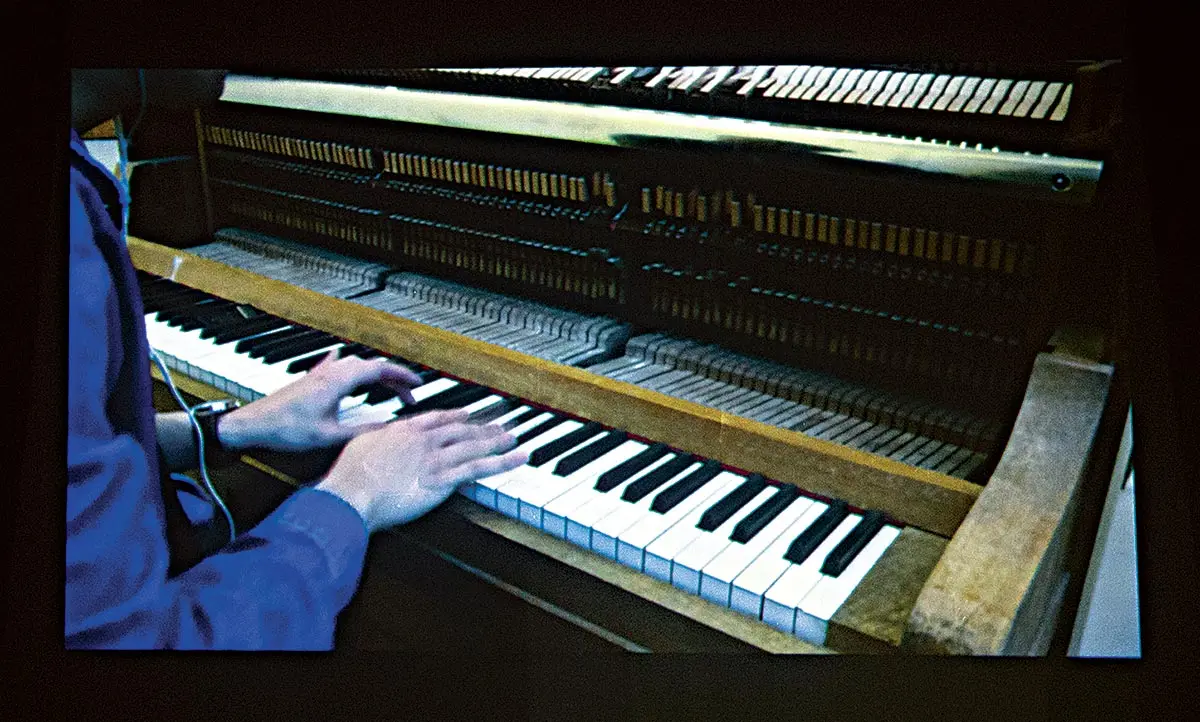
Interested in philosophy and architecture, Pabón has investigated the ways to “represent a piano” since 2010. There are clues, notes, that go beyond mere aesthetic chaos: the sounds that emanate from the wooden drawers are musical pieces dubbed Copy Attempts, interpretations executed by the artist himself with no musical training. In one of the corners we see hand-written scores: these are free recreations of Olivier Messiaen’s Réveil des oiseaux (the French composer, who claimed birds were the greatest musicians, transcribed the songs of bird species he encountered in his travels). Imitation, transcription, copy: concepts that are well known in modern Chile, a culture that has adopted the European canon in the arts, in music, and an ideology. Our journey inside Pabón’s piano—and its implications—expands. In another gallery, we find a video in which the artist interprets, amateurishly, the imperfect compositions he has rewritten. The conclusions become inescapable: materials that were useful, with a definite and complete purpose, are reutilized to present a new life. The originality of the copy.
Here it’s interesting to mention an essay Pabón published on the occasion of a contest for the creation of an emblematic sculpture for the Gabo y el mejor oficio del mundo Gabriel García Márquez Journalism Award, in 2014. After analyzing the premises of the competition—“the purpose of this call is to select the concept and design of an original and unique work of art on the general subject of ‘Gabo and the Best Job in the World’”—Pabón offers an updated understanding of the term plagiarism in literature, journalism, and art. His reference to Jorge Luis Borges’ Pierre Menard, Author of the Quixote is not trivial, as that short story imagines an exceptionally clairvoyant example of creation and re-creation. Seen from that perspective, this “representation of a piano” appears as a mystery and a game, and ultimately as a grand allegory. Pabón plays the symbolic role of someone who appropriates, without knowledge or mastery, the work of another, with the intention of assimilating it and making it his own. And the reference is not limited to the adaptation of European culture by Latin Americans. It is possible to delve much deeper in the origins of art and philosophy, revisiting debates about the imitation of nature and its representation that have continued since Plato’s day.
There are no rules or solutions to a game proposed by Óscar Abraham Pabón. With this, a journey through the museum’s warehouse, innocent in principle, becomes a meditation about culture, originality, and imitation. After this exhibition, the furniture will silently return to their basement. But the ideas will continue to echo in our minds, like the frenzied songs of Messiaen’s birds.
JUAN JOSÉ SANTOS