
It was long overdue. An exhibition offering a broad view of the daring and multifaceted work of Nicaraguan artist Patricia Belli had been a pending task for years. Finally, from July to October 2016, Teorética held the show titled Fragile: Works by Patricia Belli, 1986-2015. Organized and curated by Miguel López, it offered a retrospective summary, a synthetic view of her production over a period of three decades, all within Teorética’s small yet great space.
Although Belli’s oeuvre is in no way complacent and even incorporates a sense of violence, the exhibition conveyed a peaceful feeling, of finding oneself in a place full of intellectual and visual challenges. The chosen works presented important forms and themes in the evolution of her artistic career, from her first assemblages to recent installations and videos, from intimate compositions to political statements. It showed how as of the 1980s, Belli already represented human beings through anatomical fragments or empty items of clothing. For example, in Traps (1997), a group of nylon stockings hanging inert from their garters spoke of absent women, of lives carried out under the precepts of an imposed system of values.
In her use of simple, used and worn materials, Belli reveals political attitudes towards art and poetry, understood as genuine, personal forms of expression. We also perceive feminist convictions in her process of combining, tearing, stitching, and darning cloth remnants in abstract, highly expressive compositions. The Broken Column, (1996) conveys both pleasure and pain through its cut-up bras and corsets —with their teeth-like rows of hook-and-eye clasps — assembled one over the other like crooked vertebrae. In addition, it alludes to Frida Kahlo’s aching self-portrait with the same title. Just as Belli reconstructs fragile inner garments, in the video Hair (2001), she deconstructs the concept of hair as an essential feature within the dominant discourse for feminine beauty. We watch the back of a woman’s head as she goes from stroking her blond tresses to revealing her bald head as the wig slips away. And for those who still believe that “beauty must suffer,” Belli offers her dark, symbolic high-heeled Shoe (1998) with a thorn-covered inner sole.
Belli’s surreal objects also include anthropomorphic furniture. The assemblage entitled Prayer (2001) consists of a small wooden dresser with open drawers that resemble gaping mouths. Protruding from the back of the dresser are two long stuffed cylinders with three-dimensional feet that resemble the legs of a priest in humble prostration. In Confused, (2000), a long-legged stool protrudes horizontally from high up on the wall. It has a cushioned seat from which long arms with open hands reach down to the viewer. Belli makes reference to people within domestic environments, but also to dysfunctional human relationships.
In the video Sisyphus (2015), two fingers walk across a string, like an acrobat on a high wire. The hand carries a growing number of stones that endanger the possibility of achieving equilibrium in this circus act and, seemingly, in life. Instability also provides the theme for collages like Earthquake and Hurricane (both 2014) that consist of groups of drawings and tracings mounted in irregular arrangements on the wall. The artist transitions from personal anguish to the instability of a whole people, to the seismic imbalances with which nature can surprise us, the serious consequences of which Nicaraguans know better than most of their neighbors in the region.
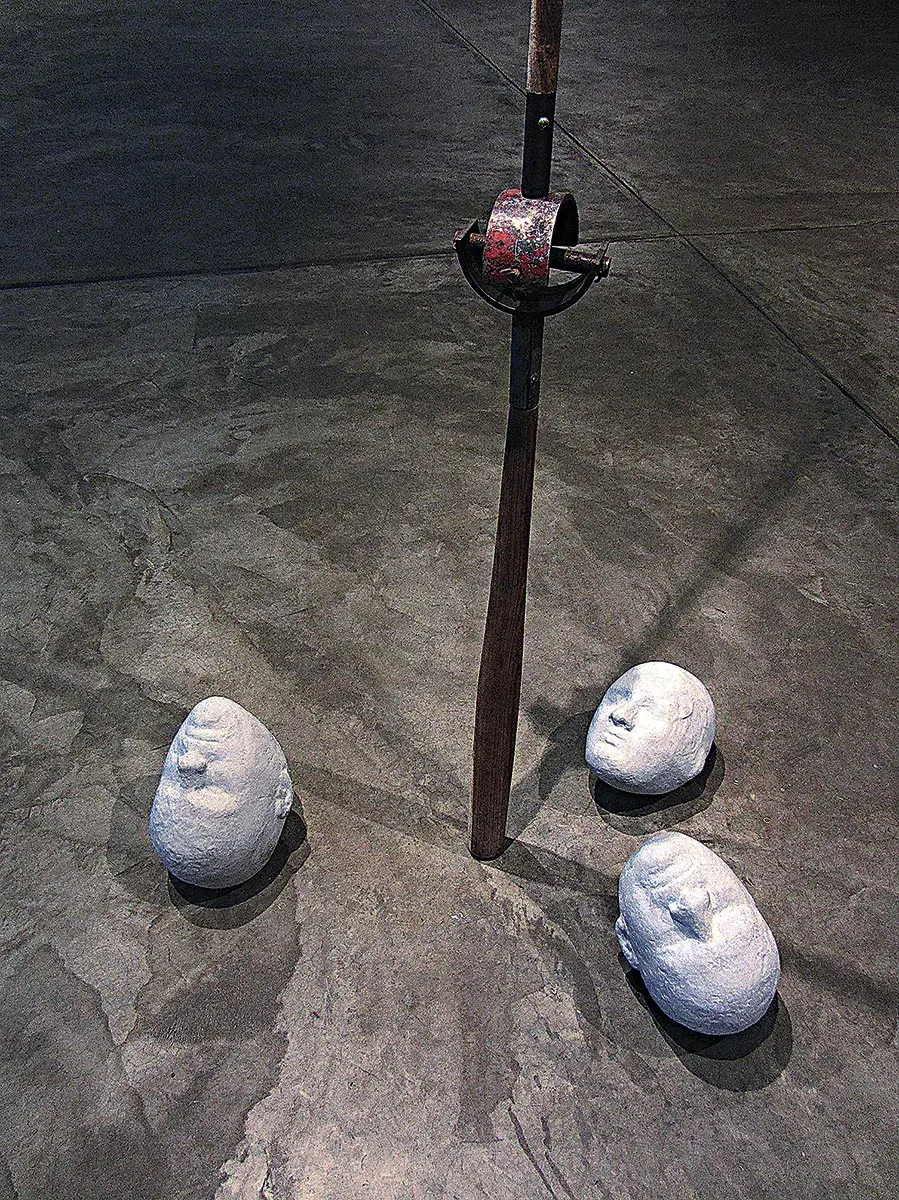
As part of her research into the subject of equilibrium, Belli recently produced a sound installation of a large upturned, disembodied head that broadcast stories by people who had lost their sense of balance. It was presented at the Tenth Central American Biennial that took place in San José at the same as her show at Teorética. At the solo exhibition, there was a related installation entitled Stubborn (2015), which included three sculptures of human heads. They were placed on the floor around a suspended baseball bat that, upon being set into motion by a spectator, would hit the heads again and again. The piece triggered thoughts regarding our failed political systems and the region’s never-ending cycles of violence.
Belli is a resolute and capable woman as much in her attitude towards life and her oeuvre, as in her resolve to pass on her knowledge to others in order to promote growth and development among young artists. Beyond her personal oeuvre, as Miguel López explains in the exhibition brochure, “Belli is probably the most important figure in the critical renegotiation process of artistic education in Central America. She has trained hundreds of young creators, from all of the region’s countries, in alternative educational programs that she has led in Managua since 2001".1
The works by Patricia Belli that were shown at Teorética provide food for thought. The exhibition leaves the observer with a craving to see, know, and understand more about her artistic development. Fortunately, there is an upcoming book that will finally do justice to this artist who has made such a significant contribution to contemporary art in the region.
NOTE
1. http://teoretica.org/portfolio/fragiles-obras-patricia-belli-1986-2015/
MÓNICA E. KUPFER