
Rolando Peña (Venezuela, 1942) is one of the indisputable Latin American artists that pioneered conceptual art, the happening, performance, and art films across the American continent. Through a body of work developed for decades, Peña has achieved what death denied the great Colombian writer José Eustasio Rivera (1888-1928), author of La Vorágine (The Vortex). After having created that masterpiece which not only addressed the struggles between mankind and the power of the natural world but also delved into our tendency to turn natural resources like rubber into a symbol of our greedy nature, as part of a civilization that regards gold as something more valuable than life.
During a stay in New York, and as he was working on a book—about the dark tales of the US Standard Oil Company and its corrupt dealings with high government officials in the Southern states for the construction of pipelines—Rivera died under mysterious circumstances on the eve of his return flight to his country after giving a conference in Columbia University, where he had been honored. His death meant that the manuscript he had been developing never saw the light of day and, thus, the world was denied of a critical vision, forever buried, which addressed the malpractices of a specific company.
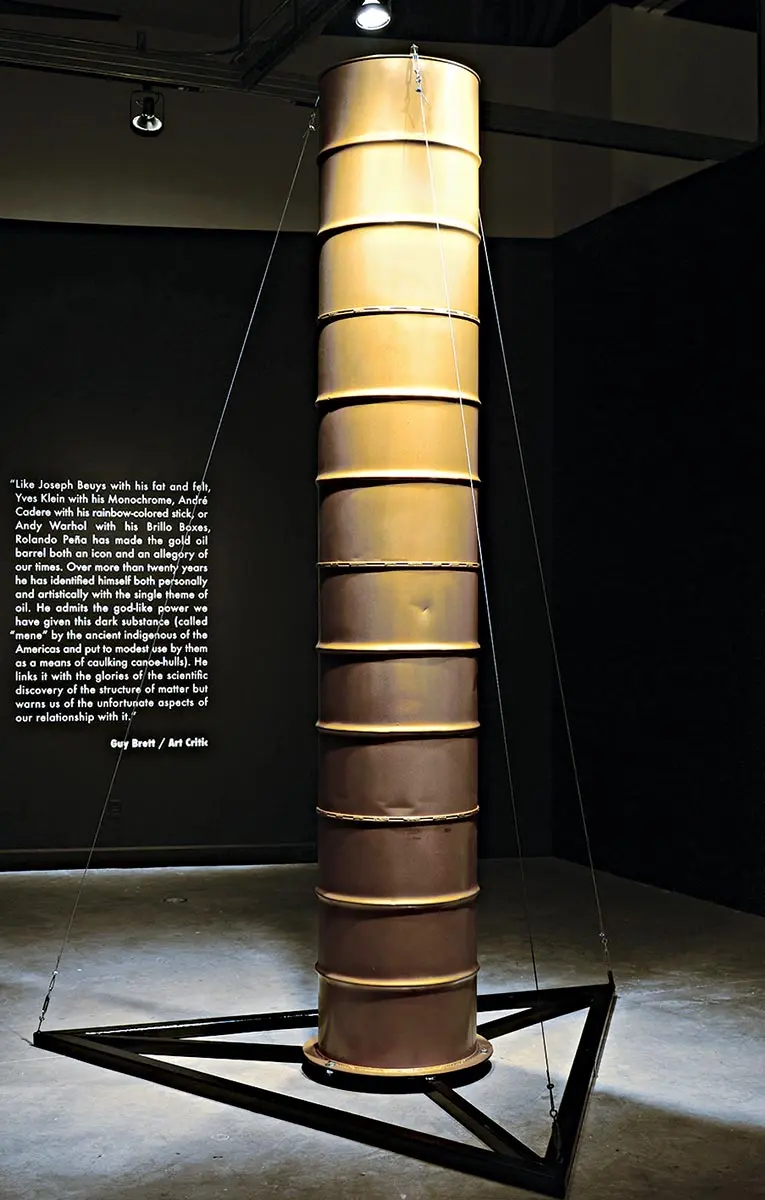
With the lucidity of an obsession capable of capturing a metaphor for dark times in the form of “black gold,” represented with his unmistakable golden barrels, Rolando Peña or the “Dark Prince”—as he is also known because of his rigorous all-black dress code, a fashion style very much like that of Felipe II and Andy Warhol, in whose movies he participated creatively—became the first contemporary artist to make the theme the leitmotiv of conceptual work.
In the magnificent exhibition by Peña at the Museum of Contemporary Art North Miami (MOCA) titled Black Gold, and curated by Jorge Gutiérrez, the writing on the rigorously painted black wall where a pyramid constructed with his iconic golden barrels was exhibited, including a revealing quote by art critic Guy Brett. By accurately comparing them to Andy Warhol’s Brillo Boxes, Yves Klein’s monochromes, and Joseph Beuys’ fat and felt, Brett not only evokes the conceptual power of the objects that great artists have turned into the language of the times in which they live but also places the Dark Prince in the corresponding dimension within the narrative of a history of art with a strange property: the indelible ink with which the stories of the figures of the global North are recorded gradually disappears when the names of the great pioneers from the South are written. To highlight this vanishing ink and revisit his pioneering creations—often created at the same time of those by his contemporaries from the North—while comparing both stories to demonstrate their interrelationship and break any hegemonic vision, becomes a central task.
This rewriting succeeded in the best possible way in this exhibition with other works in different media like digital photographs that reflect—through the beauty of the formal relationship between the golden barrels and the infinite black backgrounds that allude to the contained oil—a contradiction addressed by Guy Brett in his text on the exhibition: [Peña] admits the power, similar to that of gold, which we have given to this obscure substance […] He connects it to the glory of scientific discoveries about the structure of its matter, but warns us about the unfortunate aspects of our relationship with it.” Such an explicit relationship is clearly alluded to in the title of another psychedelic installation. It consists of illuminated barrels with electric tones arranged like swords of Damocles that hang over the heads of viewers entering an exhibition space surrounded by walls covered in metallic paper, which offer a spectacular effect: Broken Symmetry. The conjunction between the reflection of the moving bodies and the dangerously pending barrels, speak of an oil dance—as golden as is obscure—that involves us all.
On the other hand, in the video Barril Simetría (Barrel Symmetry) the mirror principle is used to create a sort of harmonious kaleidoscope of forms: the barrels floating over an infinite black space—at the rhythm of a composition that evokes the music of the spheres—are molecules that take us back to the contemplation of beauty contained in the matter; unfortunately contaminated by the economic excesses of mankind. Just in this work, the Dark Prince has achieved an infinite variety capable of connecting in continuously changing forms, the cosmic dimension of black gold, with a meditation about its political and economic implications.
In the video titled Black Gold, Peña achieves a prodigious visual synthesis of notions like economic accumulation and dematerialization, the fragmentation of bodies, and the concentration and dispersion of wealth in the mechanisms of the world. The accurate and risky proposal by curator Jorge Gutiérrez included the presentation of a didactic historic narrative that lays out Peña’s conceptual contributions to 20th-century art, along with an exhibition area for photographic documentation that reclaims its role in the development of film-art and performance art during the golden period of the 1970s in the Big Apple. This layout leads to a better understanding of the poignant performance titled Sacred Fire, in which the Dark Prince, transformed into a percussionist, used a group of black barrels as bass drums. These resonated along with a piano-playing life, with the same video in the background in which gold is also an all-consuming fire that evokes the archetypical representation of sinking worlds. The concert of Rolando Peña’s vision, which has fulfilled its aspirations of being total art, functions as an impeccable parable of beauty and chaos that encourages an invocation against the destructive voraciousness of human ambition.
ADRIANA HERRERA