
As though it were a Victorian-era salon, the gallery’s main wall, which confronts visitors as they ingress, is covered with framed portraits. The background is black. The subjects are all older afro-descendent women, fifty of them, to be precise. All look dignified, wise, imposing, and are seated on stools. They wear white clothes that bring to memory the colonial styles of dress in the Americas. They are shown in full of images that play with their appearance, and it is difficult to tell whether these are paintings or photographs. The absence of color in the women’s dresses finds an echo in their heads: their silver hair illuminates each scene; the lighting is welcoming, and the characters emanate nobility.
Every one of these women dominates the space; the sum of their presences fills the gallery with whispers, with secrets that seek an attentive ear for their stories of an old city and a sick society that must be regarded with open eyes.
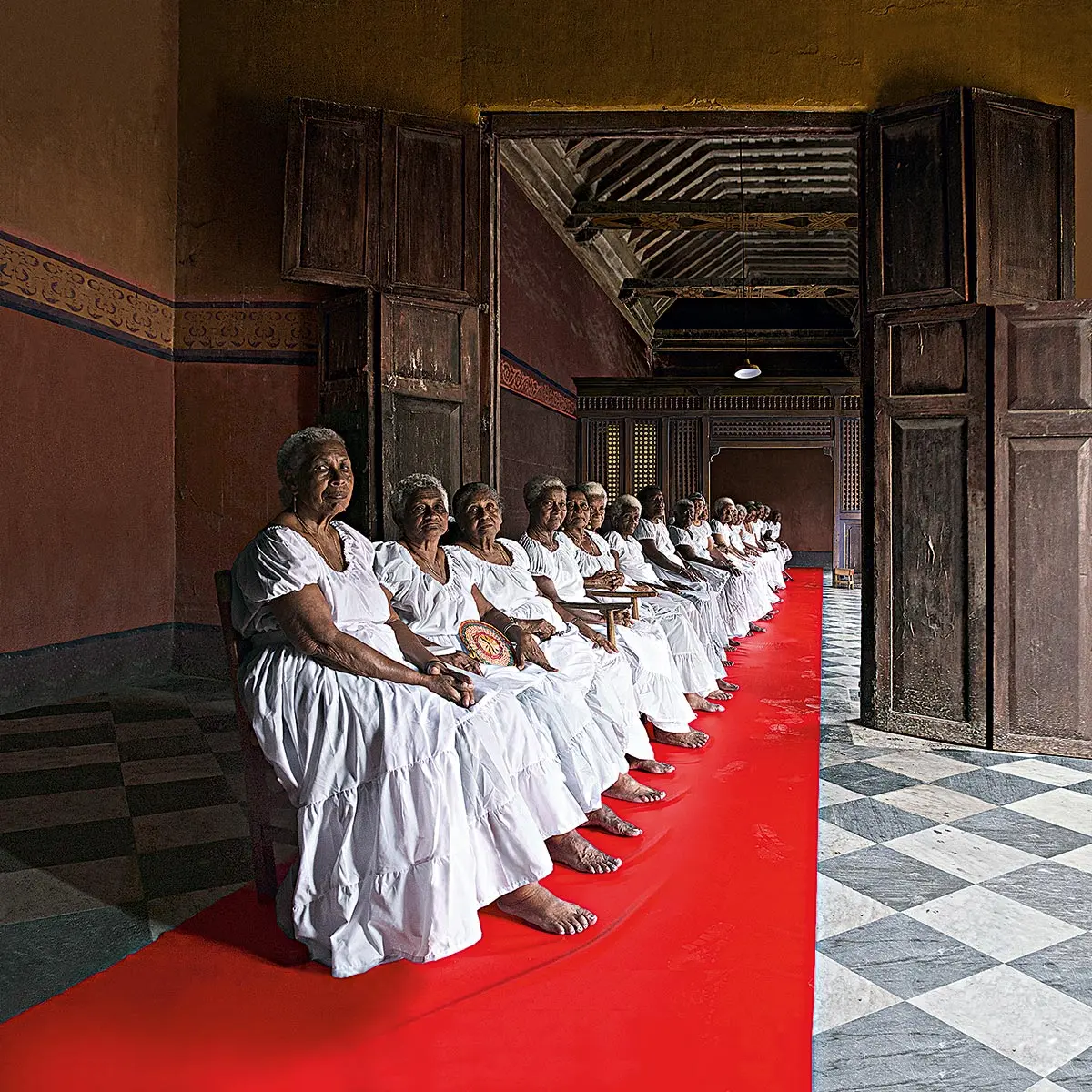
Ruby Rumié, a Cartagena-based artist whose career already spans two decades of activity, is the creator of this encounter. Besides being a metaphor for the local character (a phrase used by Cartagena grandmothers to name the activity of wandering about the city in search of opportunities, all the while sewing up and mending its denizens’ gazes with songs, sales, and salutations), the exhibition’s title, Tejiendo calle (Street Weaving), is perfectly matched to the artist’s homage to palenqueras1, those extraordinarily appealing women who dance as they walk and sing as they talk, and who, with the passage of time and the power of the publicity that comes with excessive tourism, has become an icon for a Latin American city dramatically transformed by gentrification. The second protagonist of this exhibition is, thus, Cartagena de Indias itself, expressed via a variety of media, revealing in video and in graphic elaborations—such as postage stamps and books containing historical documents and process registers—a ritual, an art with a powerful performative charge, resolved into itself as an indivisible body.
Rumié’s artistic practice began, like almost everybody’s does, with an academic exercise: in her case, making hyperrealist pictorial portraits of people she felt close to. She was always attracted to the social life of her city, the historical relationship between servants and masters, black and white people, the rich and the poor. As time passed, Rumié came to question the use of traditional formats and decided to work directly with individuals. She began to develop projects where the social fabric and the colors, longings, and anxieties of vulnerable communities replaced the canvas, in a line of work as aesthetically effective as it was ethically perilous. Rumié is aware of those ethical perils: the difference between poverty porn and a sublime poetics, the latter only reachable by those who suffer with and see themselves reflected in personal stories that become transcendent documents for living in the present. Without a doubt, this artist is able to walk the tightrope of an art world fraught with unscrupulous intentions that pervert the meaning of the human drama.
Speaking about her interests and her work, Ruby Rumié reveals that she was baptized, or named, on two separate occasions: first, following common practice, by her parents, who gave her the name of María Margarita de las Mercedes Rumié, loaded with upper-crust social status; then, by the woman who was her nanny, who, in a gesture of incommensurable love that gave meaning to the artist’s life ever since, called her Ruby, a derivation of Blanca Rubia (Blonde White). Rumié describes herself as the descendant of Arab and French migrants, but with an Afro-soul, something that is clearly anecdotal yet necessary in any exploration of a poetics that it's built on the consciousness of an artist who understands that art is indebted to society and who, in consequence, recognizes as one of her duties the shedding of light on issues that the vagaries of everyday life have rendered second-hand. To that end, Rumié focuses on subjects that she transforms into long-term projects (often, as in this case, two-year projects) and which, in turn, become creative laboratories built on new rules for every eventuality, in a kind of game through which the artist forces herself to notice the realities that she is intent on intervening.
Tejiendo calle was born, Rumié says, from an epiphany. Dominga Torres Terán was the first of her septuagenarian muses. Women are an essential part of the dynamics that permeate her productions. Dominga was a living testimony of the fact that the streets of that grand dame that is Cartagena, a City-Woman, were inside Dominga, a Woman-City. Seeing her, Rumié understood that she had to return to painting in order to apprehend her own reality, and—as at the beginning, when the Academy dictated methods and forms—she went back and painted again. This time around, however, she painted in light. Photography was her method to explore every one of those fifty woman-cities, who, paradoxically, are also the last bridge connecting tradition with the current era, the distant, boundless colonial hacienda and the contemporary city, the notion of a large family with the atomized cyber family of our times.
The compendium of this production is ciphered on the life experiences of these women-cities, echoes of those of the city-woman. Ruby Rumié extolled the legendary vitality of these anonymous protagonists, these grandmothers who saw themselves recognized and valued in the act of another—an exhibition of contemporary art—and at the same time in an act that is intimately their own: finding a girl2 who defined them and reminded them of their place in the world, as if echoing Gabriela Mistral’s verse, “We were all to be Queens.”
NOTES
1. This name, derived from San Basilio de Palenque, the first town populated by free Afro-descendant people in the Americas, is given to women who work as informal peddlers in Cartagena de Indias and have become an iconic image of the city.
2. As part of the colonial tradition deeply embedded in the local culture, the word Niña always preceded the name of a Master’s daughter, as a respectful term of endearment to be used in social interactions.
OSCAR ROLDÁN-ALZATE