
One of the most important representatives of Neo-Concrete art in Brazil, Willys de Castro (Minas Gerais, 1926–Sao Paulo, 1988) showed his work for the first time in the United Kingdom in 1965, as part of the exhibition titled Brazilian Art Today, at the Royal Academy of Arts in London. Forty-nine years later, his work was once again shown in the UK as part of the 2014 exhibition titled Radical Geometry: Modern Art of South America from the Patricia Phelps de Cisneros Collection presented, once again, at the Royal Academy of Arts. After that second appearance, the Cecilia Brunson Projects gallery organized the first solo show by De Castro in that part of the world. The exhibition was based on the retrospective exhibition by the artist at the Instituto de Arte Contemporânea in São Paulo, inaugurated in early 2016 and curated by Gabriel Pérez-Barreiro.
Titled Willys de Castro, From Painting to Objects 1950-1965, the exhibition included a selection of pieces produced during the first fifteen years of his artistic production. It consisted of drawings, paintings, and objects. It could be said that the works selected represented three chapters (displayed across three walls) that delved into different periods of De Castro’s professional career and three different types of works: beginning with his preparatory sketches or drawings, samples of his geometric abstractions (paintings) and neo-concrete poetry; and, lastly, his well-known Active Objects.
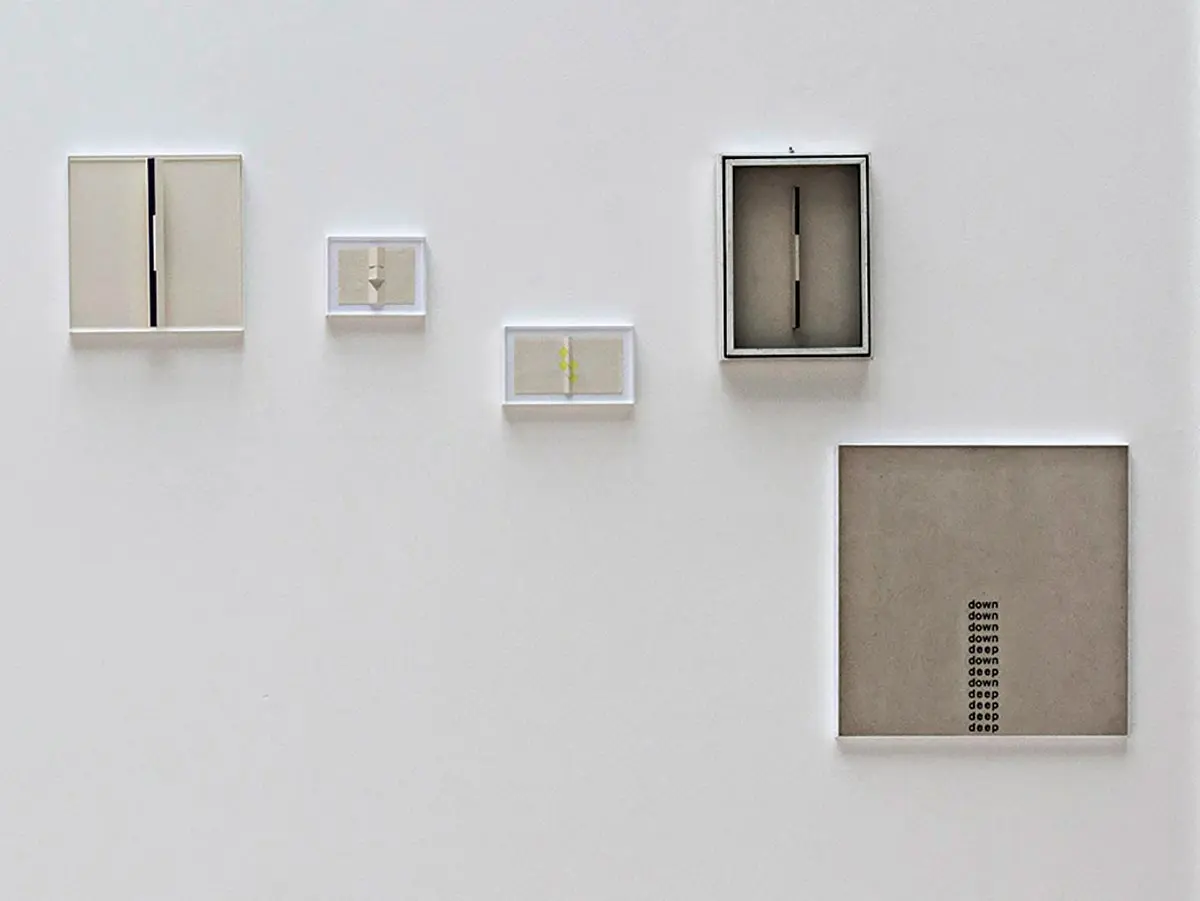
Willys de Castro was a painter, writer, designer, costume designer, graphic artist, and poet. After switching the course of his professional career from chemistry to the visual arts and relocating—from Minas de Gerais, his hometown, to São Paulo where he would study drawing with André Fort—he created his first series of painting during the 1940-1950 period. Later on, in 1954, De Castro founded a graphic design studio, with artist Hércules Barsotti, in which he worked until 1964. It is possible to recognize in this exhibition at Cecilia Brunson Projects some pieces that belong to that early period of his artistic education. Oils, paintings, and drawings composed of pure colors and geometric figures that suggest movement and equilibrium. Here it is possible to identify the great influence that architecture (in the incorporation of architectural forms in his drawings and paintings) and graphic design (because of the formal similarities) had on this artist.
Nonetheless, it was not until 1959 when De Castro produced his most celebrated works: the so-called Active Objects. Which could be placed somewhere between the definitions of sculpture and painting. These objects are fashioned with narrow strips of wood covered with canvas, painted with often monochromatic geometric abstract forms, and hung on the wall. During the second phase of his career, De Castro entered into contact with the Neo-Concrete Movement (the Grupo Frente), which was formed by Lygia Clark and Hélio Oiticica, among others. This movement was formed in response to concrete art. While both movements shared interest in abstraction and the use of color to convey scientific principles, the Neo-Concrete artists wanted a more poetic aesthetic with deeper content and a greater sense of freedom.
The Active Objects included in the exhibition turn painting into a three-dimensional object. The viewer’s figure and his/her movement across the gallery space play a central role: it allows viewers to observe the work from different perspectives, perceiving in this manner the different angles and the multiplicity of forms that the works can acquire. In this manner, the aesthetic experience is centered, not around the objects per se, but on the viewer’s subjective perception. In this work De Castro questions the possibilities of painting, going beyond the two-dimensional surface and space.
With respect to the historic content of the period, the military regime in Brazil headed by Humberto Castelo-Branco seized power by force in 1964. It is important to take into account that geometric art did not offer overt political connotations. De Castro remained silent during the repression perpetrated by that military government. It was not until 1970 that he once again adopted an active posture and resumed his artistic trajectory. Despite the lack of overt political references in his work, it is possible to interpret his presence, or lack thereof, in the public and exhibition spaces during the different sociopolitical contexts (dictatorship vs democracy) in Brazil as a sort of artistic posture.
The exhibition also included three types of aesthetic explorations that De Castro delved into before the period of the military regime. There are geometric abstractions, preparatory sketches, and Active Objects. The exhibition offers rhythm and balance, tension and instability, spaces full of color and empty ones. There is also poetry, sculpture and painting, colors and writings, paper, wood, and canvas; objects and subjects, proximity and distance.
PAULA LÓPEZ ZAMBRANO