
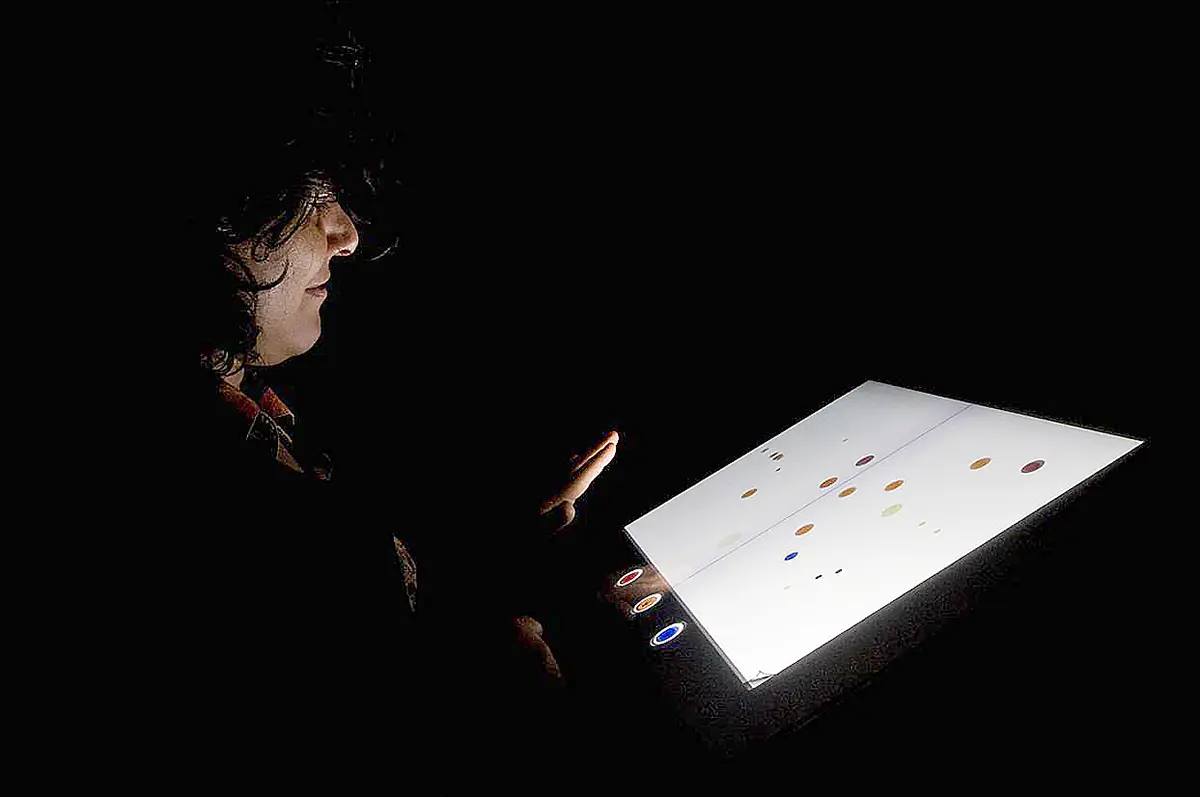
At Art@Work, an alternative art space located in the waiting room of orthodontist Arturo Mosquera’s medical practice, Miami-based Colombian artist and composer Alba Fernanda Triana installed the work titled Partitura Sonora (Sounding Score, 2009). The piece consists of a sound and visual installation generated through an interactive interface that allows viewers to activate and enter into a dialog with a composition containing the entire range of variations of a score created by Triana. Once manipulated by the spectator, the piece is modified through algorithms from the original composition. At the same time, beautiful circles of different colors, which appear in the “book” are also projected on the screen at the back of the exhibition room, representing the notes of prerecorded musical sounds. When played, these notes change form and size through a projection that runs concurrently with the audio. In this instance, the book becomes the instrument, and the piece is played through simple actions like turning a page or touching the buttons that appear on the screen.
For the most part, the body of work by Triana reflects on the constitutive elements of music and proposes the construction of sound and visual bridges that offer viewers an intuitive approach to the installations for a first-hand, auditory, and aesthetic experience. On the other hand, her work combines visual and sound architectures that meet the demands for a hybrid and open understanding of contemporary art. Triana is concerned with the contemporary redefinition of music, and works with vibrations and noises in an attempt to redefine the basic elements of both sound and visual compositions from a polyphonic “perspective.”
One of the fundamental questions that Triana asks in her work is whether or not music must be exclusively perceived through only one of our senses. This question becomes the point of departure for the construction of installations whose visual elements stem from her continuous reflection on the physicality of sound: that visual space in which art, music, and technology intersect. She experiments with vibrations, frequencies, algorithms, and images that have led her through the years to the production of a solid and poetic body of work that explores the operative structures of musical composition, their polysemy, epistemology, authorship, and the visual space that they occupy.
About Partitura Sonora, Triana said the following: “The book becomes an instrument, the instrument is played by the viewer, the viewer becomes a musician, the viewer becomes a coauthor; and rather than being generated by the author, the piece is generated by the instrument, and so on and so forth.” In this manner, the piece plays with the idea of mutation, of randomness, of the dialectic between openness and the adoption of different roles, as well as with the intrinsic properties of musical structure.
Every time viewers activate the book, it emulates a new visual and auditory representation of the original score. In this manner, viewers become the temporal performers of the score, and every time that they play one of the integral parts of the composition—whose activation depends on the points and colors pressed on the book—they are exposed to and can reflect on, the relevant aspects of the musical composition—like the tone, registry, duration, dynamics, and timbre—in an intuitive and random manner. It is a process that erases any preconceived hierarchies between the composer and the public, allowing for the compositional and auditory experiences to become collective rather than individual events.
Musically, Partitura Sonora evokes the prerecorded sounds of a Glockenspiel, and the drawings emerging from the pages of the virtual book create an environment reminiscent of the traces left by raindrops on bodies of water. The visually generated image is a real-time representation of every detonated action. It pushes the boundaries between the merely auditory, the visual, and the tactile in response to one of her most important areas of research: the study of the behavior of musical waves, the manner in which they travel, and how to hypothetically visualize them.
Partitura Sonora perfectly functions under the precepts of an open work in which the art object serves as score and instrument but also as art space and installation that encourages viewers to experience music from a different, more interactive, and visually attractive, perspective. Participants become artists and performers, playing for the rest of the people waiting for their medical consultations.
The installations by Alba Fernanda Triana are translated into participatory experiences that are also meditative, environmental, and interactive. In them, the exchange of roles between listeners and performers is central for the work to be completed; in this manner, the role of the composer merges with that of the viewer. While this does not necessarily mean the simplification of the compositional process, it does allow for the viewer to be immersed in a visual and auditory experience that he himself performs without needing to know how to play an instrument or to have a musical education. Viewers find meaning in Partitura Sonora only when they participate to modify it, as the piece is developed into what Umberto Eco called an “Openwork,” inciting the performer/public to perform those “acts of conscious freedom” that complete the work.
To view and listen to the work by Triana, visit: http://www.albatriana.com/partitura-sonora.html
AMALIA CAPUTO