
Alexandre Arrechea is a technically polyglot artist, a manufacturer, and painter whose works can at times be seen as divagations, yet are machines and impossible objects of desire. Rehacer (Remaking), his debut exhibition at São Paulo’s Nara Roesler Gallery, curated by Paulo Miyada, features a repertoire of sculptures and watercolors. The single word of the exhibition’s title includes the meaning of counterbalancing previous experiments, and this is why the sign that holds it together is sowing: “I was always curious about the fact that when we remake a field, the what was there before and was cultivated disappears.”1
At the entrance to the exhibition, the sculpture Cuentos del campo (Tales from the Countryside) represents a personification of tilled soil. It is a mathematically molded zigzag of a polished aquamarine hue. The small acrylic spheres with dispersed photographs contribute to the crystals’ effect of attraction Arrechea’s methodology convinces us that beauty is one of the signs of power. Here, landscape, environment, and habitat interrogate the futuristic molds that are applied to our peripheral countries. This glittering greenfield also alludes to the agricultural work that, as a way to making a contribution to the economy, was mandatory for all students in Cuba’s post-revolutionary Public education system in the 1970s and 1980s.
These farming activities, with their many meanings, motivated Arrechea to imagine a mural in the main gallery and to hang his large-scale watercolors (200 x 113 cm) above it. With motifs like those in the usual projects, these watercolors are inscribed into the all-over effect produced by the thick parallel black lines of the cropland painted on the wall. Among the titles, El Sol (The Sun) takes us to the playful universe suggested by the construction play sets the artist uses to manufacture this landscape, also populates with “trees” in a clearly futuristic style. This dialog between the motifs in the watercolors and the promise of they being brought into three dimensions has mnemonic connections to childhood. When, at the age of nine, Alexandre Arrechea was shown the site where his father worked every day as a machine repairman, the “monster machines” arouse his enthusiasm and drove him to start drawing using 3D relationships.2 Another motif of the landscape as a high-value entity appears in Arrechea’s sepia-toned watercolor, which features the almost solitary example of architecture: the prefabricated buildings used to house Cuban students working in the fields.
Arrechea moved in a space where philosophy, aesthetics, and practice were grated to a very small, selected few. That space was the Instituto Superior de Arte, where, after the fall of the Berlin Wall, programs of study introduced important readings in post-modernism and their practical counterparts. Students graduating from the Instituto in those years made significant contributions to the so-called Renaissance of Cuban Art, a time that—like very few in the history of the country’s art—amplified metaphorically and critically the proposals that emerged. As a member of the Los Carpinteros group, Arrechea saw the outsize furniture of their first series soon become celebrated as sculpture in the art-world mainstream and the biennial circuit.
However, in 2000 Arrechea decided that the circumstantially established group no longer made sense for him, and set out to continue his career as a solo artist. Legitimization for his work was not long in coming. Soon thereafter, with Rolled Time (After the Monument) (2004), a building with its edges reduced to the shape of a coiled water hose, the central idea for one of his most famous series took shape. No Limits, from 2006, deployed with great extravagance a number of structural architectures along Park Avenue, where New York icons like the Empire State building end in the most diverse assortment of things, like a topspin or those entertaining water hoses mentioned above. As Lowery Stokes noted, these are key examples of those “weird uses” given to architecture in the contemporary era.3
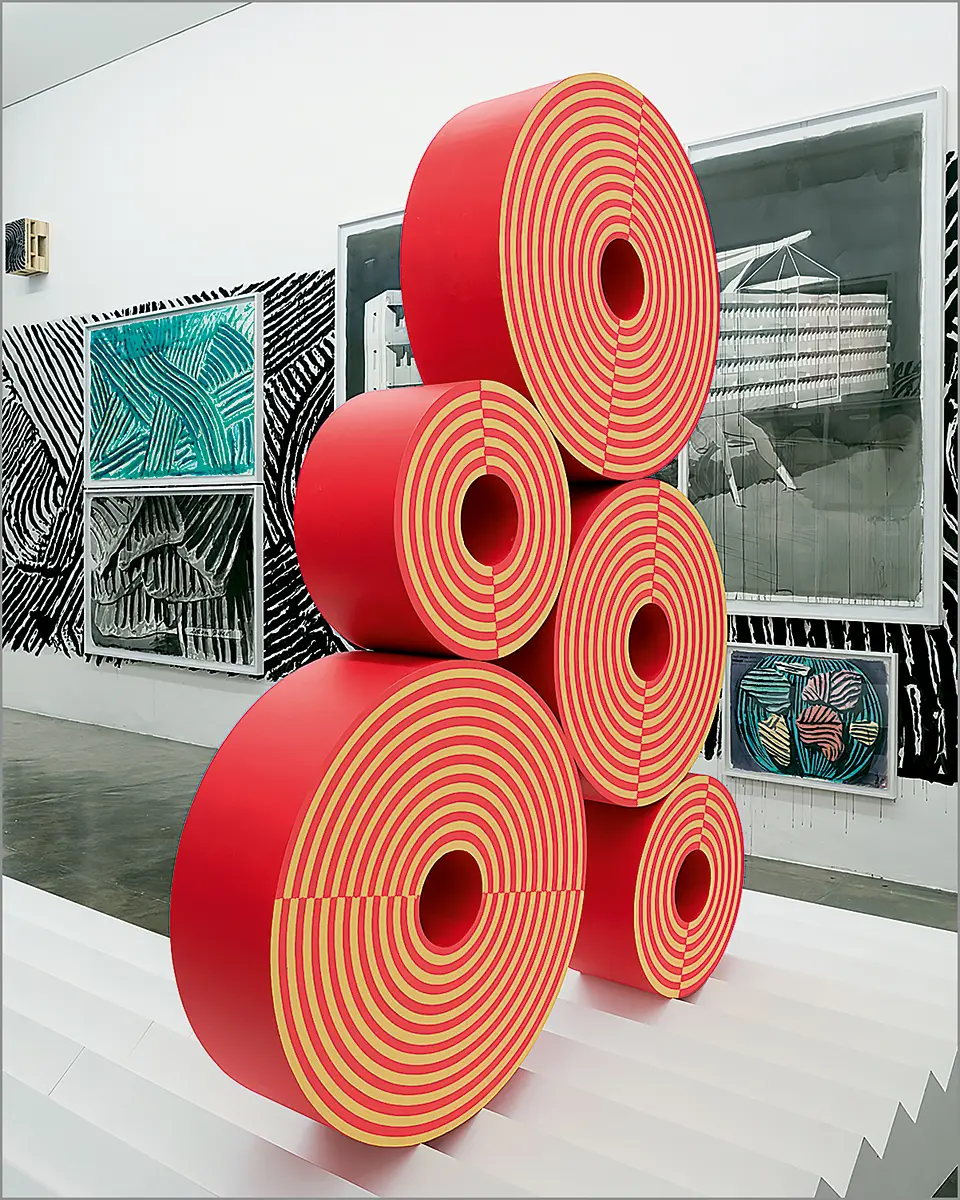
Given these precedents, viewers cross the threshold of Rehacer and encounter Puente vertical (Vertical Bridge), with parallel lines offering a concentric motion that reminds us of a stone falling on a lake. In this work, the brute rock rests at the center, and the lines repeat the hypnotic gesture in pink and pale yellow hues. The key is to understand where does Arrechea’s fascination with concentric circles comes from. Under this syndrome, also put in play in Piano Key, the bronze sculpture occupying another one of the gallery walls, and the opaque black spreading in waves, Arrechea induces us to an infinite projection. Such concentric circles were Nietzsche’s metaphor for the eternal return. It is true that, all by itself, this metaphor sets forth key principles of the postmodern period: expansive motion from the inside, in an urban area or an X context, whose progress characterizes like few others the univocal end of modernity.
NOTES
1. Notes from an interview around the exhibition.
2. Arrechea, in “Monsters Machine”, an interview with Tony Llavat.
3. “Á la Recherche des édifices perdu”s. Alexandre Arrechea’s architectural sculptures.
XENIA BERGMAN