
Seeing the work of Anita Malfatti a century after her legendary Modern Painting Exhibition—Casa Mappin, Libero Badarò, which gained for her the title of trigger1 of the Modernist movement in Brazil—presupposes a highly skillful curatorial exercise. Independent curator Regina Teixeira was tapped to shape Anita Malfatti: 100 anos de Arte Moderna (Anita Malfatti: 100 Years of Modern Art).
Documents, critical approaches, and diary entries give context to a selection of both rarely seen and widely known works of art, organized by period: Malfatti’s early years; her formative time in Paris; the folk themes of her mature life.
A unique case in the history of the reception of art in the country, the long cycle of navel-gazing debates in the Academy gave way to the shock effect or the scandal that came with the new era. Barely ten days after opening day, Monteiro Lobato published his review of Malfatti’s exhibition in the city’s main daily paper. He accused her of suffering from “strabismus,” of being “the kind of artist who sees in abnormal ways,” and persuaded many that her canvases were nothing more than ridiculous signs of “paranoia and mystification,”2 which caused many freshly purchased paintings to be returned.
Scholars note that Lobato’s vitriol was not directed to the entirety of the fifty-three works on exhibit, but to the series that Malfatti later named Immigrants (from 1915), with titles like The Russian Student; Japanese Man; The Yellow Man; The Green-Haired Woman (Of these, by the way, only the first two are included in the MAM show; the others were not loaned because they are part of permanent collections.) It is not by chance that Malfatti’s best-known déjà vu came about in this series. That analytical coloring, so central to her avant-garde works, was blamed for “accentuating” the distortion of the figures. Malfatti, however, has combined the foundations of expressionism with the experience of a Duchamp and his Nude Descending a Staircase, discovered at the first International Exhibition of Modern Art, the Armory Show, held in New York in 1913.
So, what lurks behind the critic’s arguments to “ridicule” a young female artist (Malfatti was 27) is an indirect attack against the foreign avant-garde, and against a kind of intellectual who was beginning to vie for space with the traditional São Paulo elite: the immigrant. Proof of that is the fact that just a few months prior to the publication of his scathing article, Lobato had voted in favor of Malfatti’s Tropical (1916) as a member of a competition jury. And, needless to say, her art did not lack in the tamed national subjects and the classical forms that Lobato favored.
Did anything positive result from that dispute? One thing we cannot ignore is the chain reaction that occurred around 1917. For Oswald de Andrade, famous for his irony-laden pronouncements against the past, it “had the benefit of rattling the local scene and jolting it from its usual morose reaction to events.”3 Mario de Andrade, a key writer in the movement, dedicated a sonnet to Malfatti’s Yellow Man: “And isolated by the flooding waters of scandal that have overtaken the city, the three or four of us swooned in front of the paintings. I wrote a sonnet, very much in the style of Parnassianism, to that Yellow Man.” 4
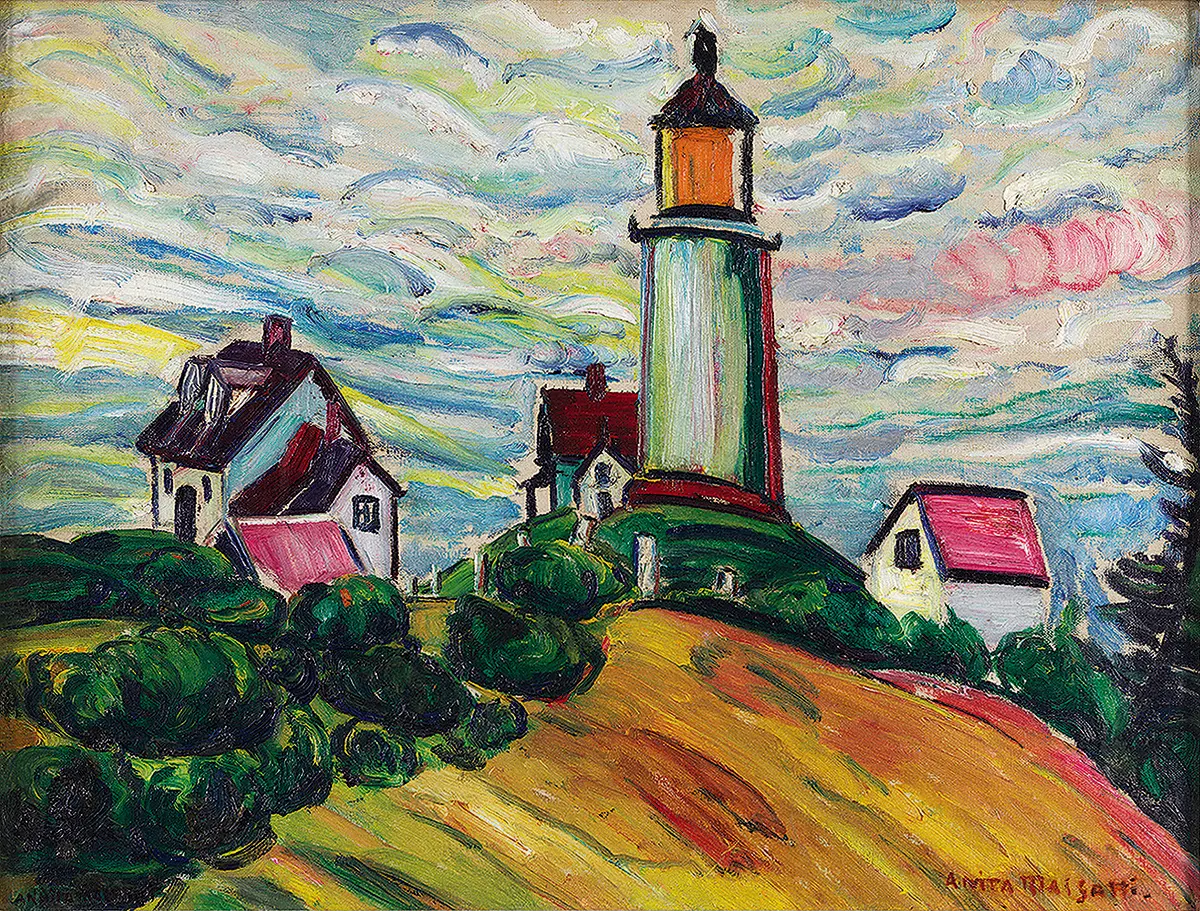
Shortly thereafter, these new intellectuals, energized by the chain reaction mentioned above, launched the Art Week of 1922, where some of the martyr-artist epithets reappeared. The Week featured, along some of her Immigrants, earlier series by Malfatti, such as those landscapes she had brought with her from New York, works from 1915: Streetlamp and Landscape (yellow), Monhegan, which, with their interplay of contortions, were expressive of “the courageous fear, on the ship that took her to the rocks in the open seas,”5 and inducted Malfatti for all time into the annals of Brazil’s expressionist landscape painting.
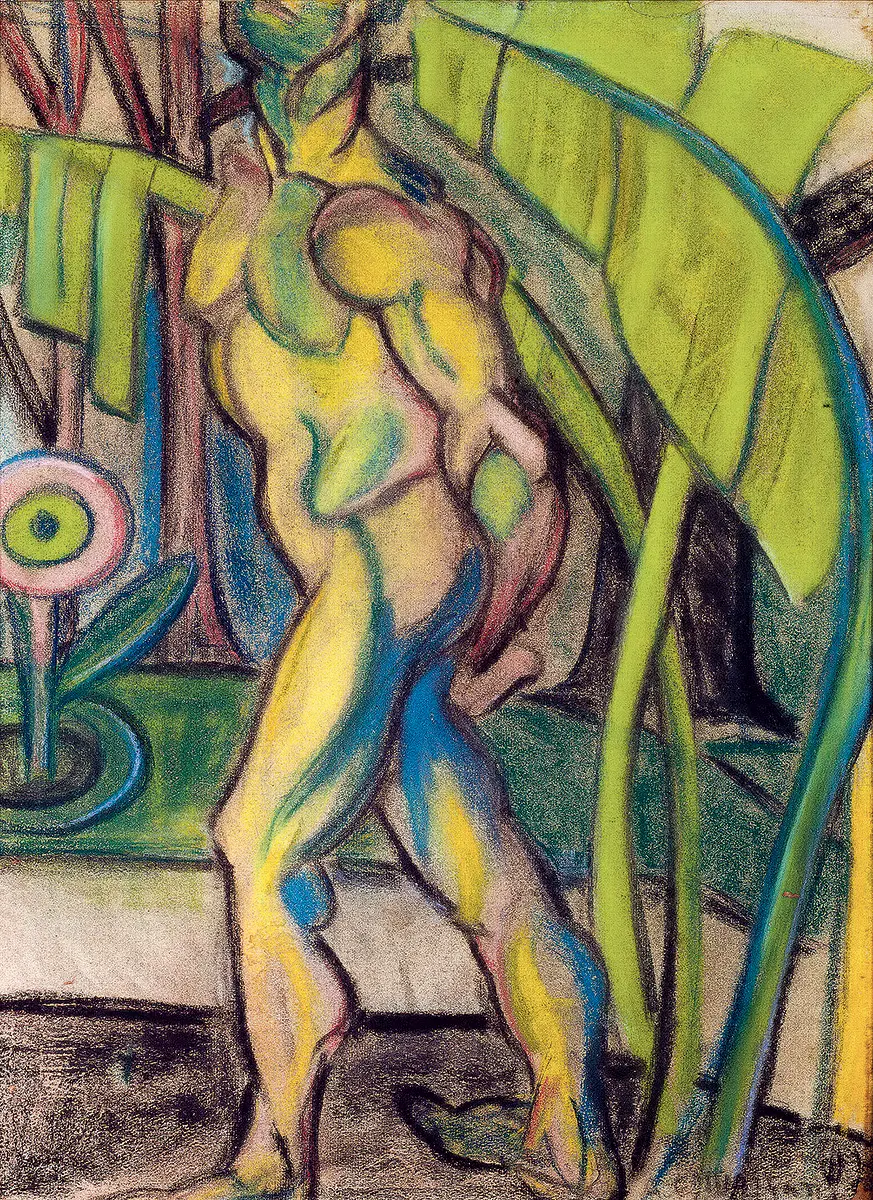
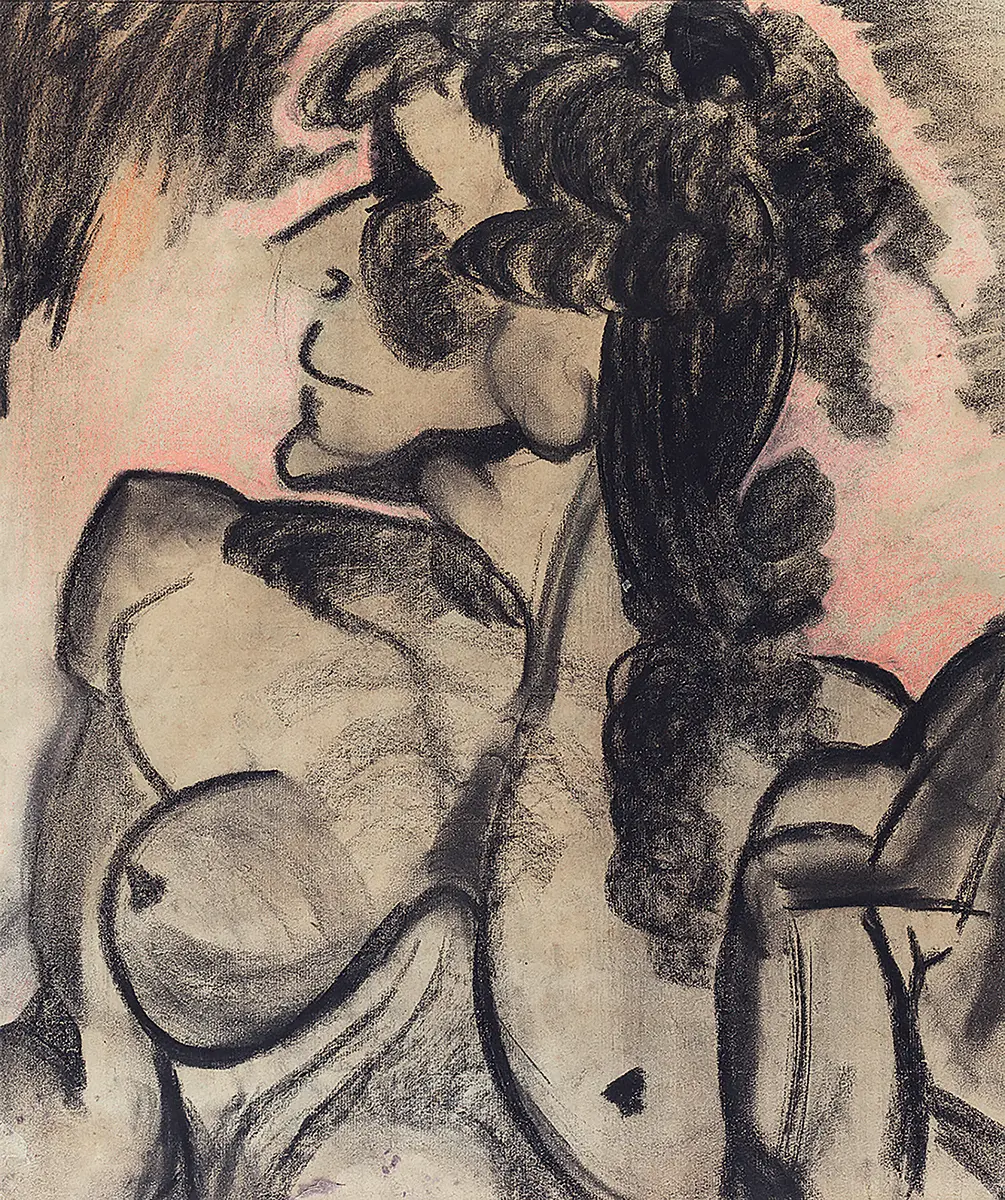
In the same way, her series of male nudes in charcoal and pastels, also revisited in 1922, became a landmark in the history of Modernist drawing. Malfatti’s nudes, be it for their moral stance or for their technique, gave experts much to talk about. As the artist wrote in her diary, although in her view they had been the weak point in her initial production in 1914, these works were praised by Freitas Valles, a patron of the arts.
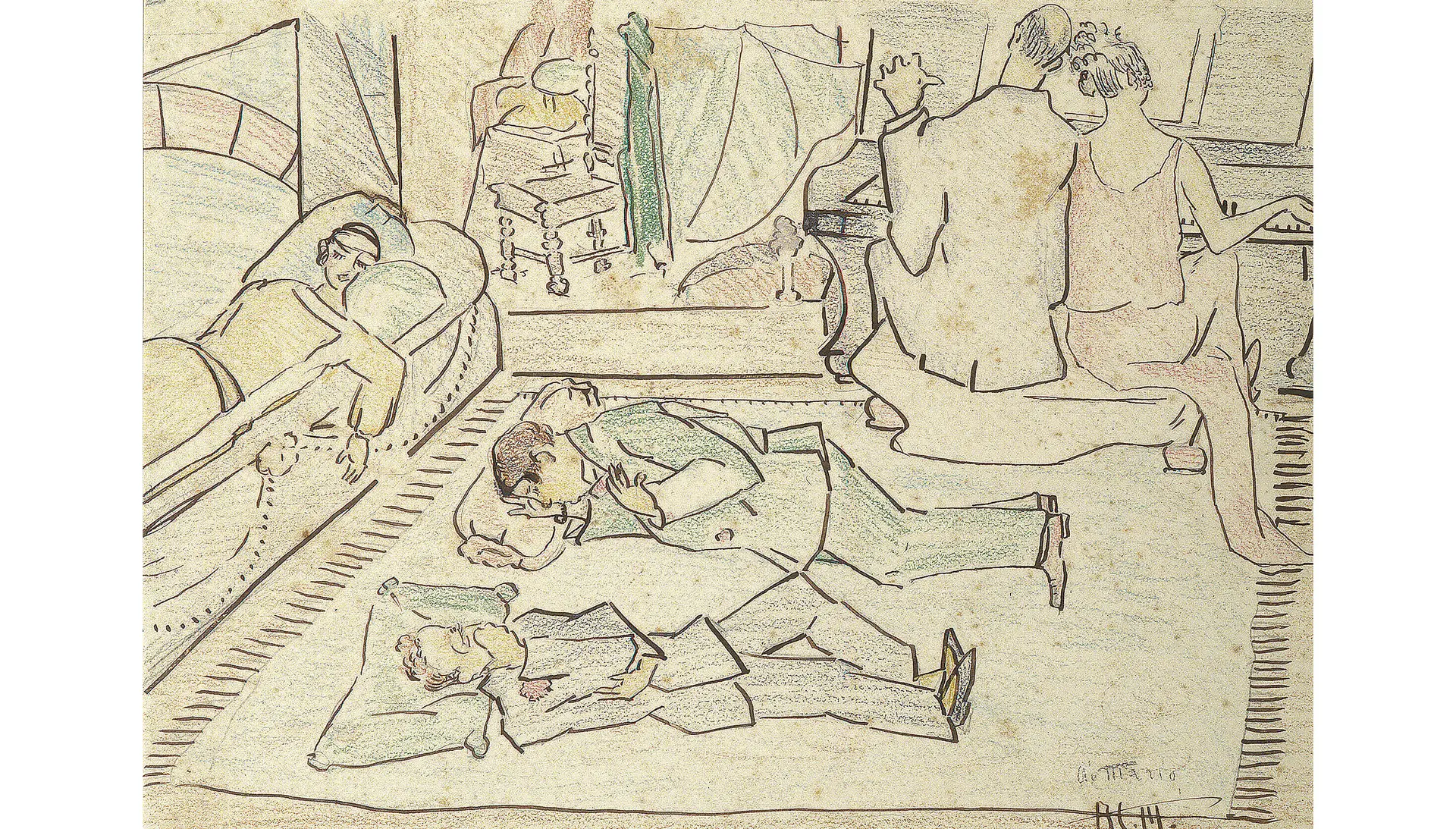
Another benefit that came from that 1917 was Malfatti’s closeness to Tarsila, Menotti, and the Andrade siblings, the Group of Five, where the movement’s theoretical advances reverberated; by way of a chronicle of this encounter, she left us her drawing The Five, (1922). Malfatti also produced many portraits of Mario de Andrade, such as Mario at the Paulicea (Drawn on a Menu), and illustrated several of the group member’s books, like Oswald de Andrade’s The Condemned and Menotti’s Man and Death; these are on display behind glass in the exhibition, and reiterate Malfatti’s ode to the male nude.
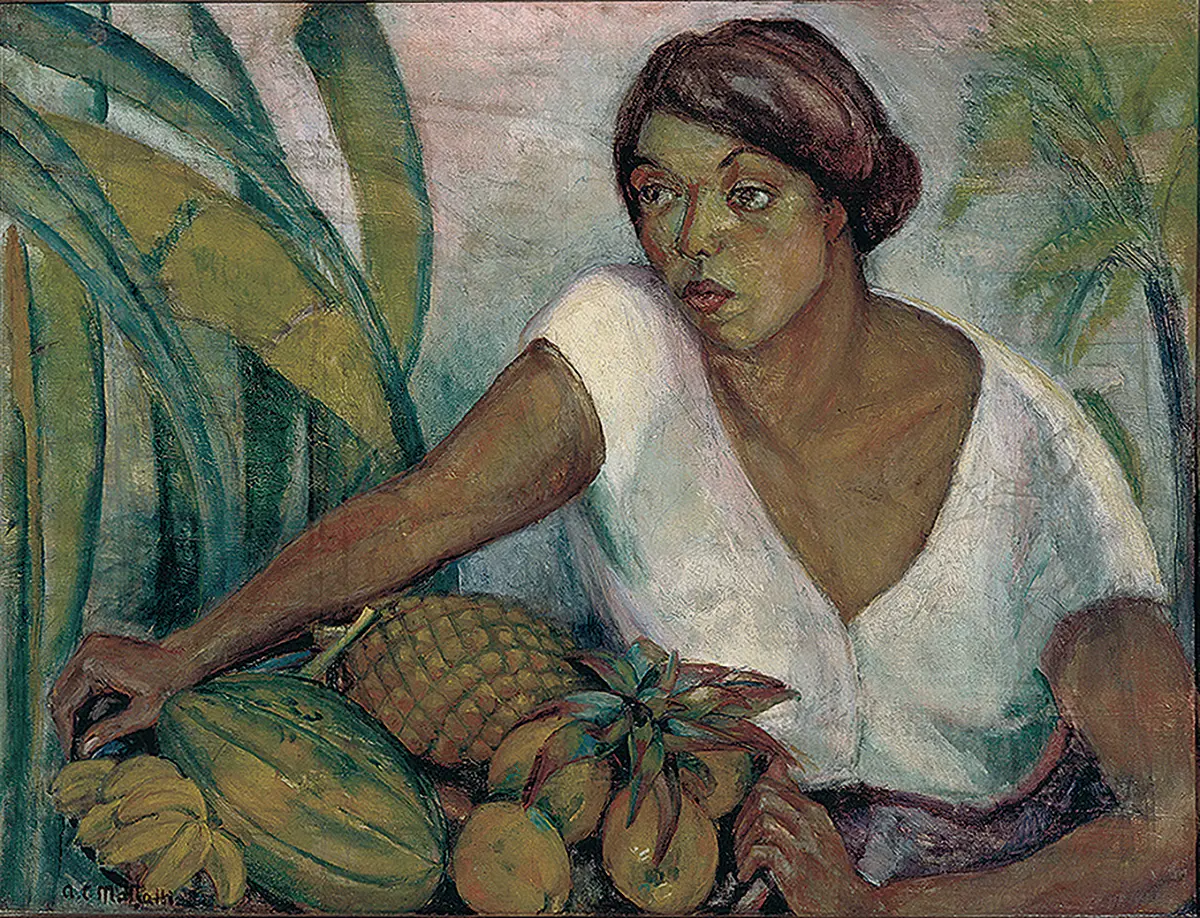
Moving on to the second segment of the exhibition, we see the results of Malfatti’s adherence to the Return to Order tendency. These works were mostly produced in Paris thanks to a Pensionato de São Paulo grant,6 ending in 1928, and include titles like Woman from Pará and Monaco Interior, c. 1928. During this period, Malfatti sought solace in the classicism of post-Impressionists like Monet and Matisse. After a selection of portraits, we see how her work fuses into what became her famous series on folk subjects: Little Train, from 1940, and Samba, from 1941/45. Her contemporaries this move decried, but Malfatti had no qualms about exhibiting these works when she was invited to the São Paulo Biennial.
In the last decades of her active career, Malfatti returned to teaching at the Mackenzie School, and institutions like the Roerich Museum in New York invited her to curate important exhibitions. She joined, as a distinguished member, the professional guilds Sociedade Pró-Arte Moderna and Familia Artística Paulista, which finally, in the last years, produced new motifs still to be unveiled.
NOTES
1. The expression is reported by Mario Silva Brito in História do Modernismo Brasileiro. Antecedentes: a Semana de Arte Moderna. Rio de Janeiro: Civilização Brasileira, 1974.
2. Monteiro Lobato. “Concerning Anita Malfatti”. Estado de São Paulo, Dec., 1917.
3. Oswald de Andrade. Diario del Comercio, São Paulo, January 11, 1918.
4. Mario de Andrade. Selected Works.
5. Anita Malfatti. Diaries.
6. This institution was established in 1922 to promote the development of artistic production in the State by financing study trips to Europe.
XENIA BERgMAN
Art critic.