
In childhood, our knowledge of the world is built gradually on the basis of sensorial experiences; it is a time when verbal language has yet to acquire its later preeminence over the notion of what is means to “be in the world.” In that period, lived experiences come by means of touch, smell, and taste, and often the gaze is insufficient by itself, requiring the support of other senses in order to be useful. For a child, smelling, touching, and licking truly are necessary. For a number of years, before it becomes obvious to us that certain attitudes cause eyebrows to be raised, jaws to drop, and even voices to be directed at us in exasperation, we are purely and simply guided by an insatiable curiosity. Without a clear objective, a political agenda, or a strategy for manipulation or negotiation, we do whatever we feel like doing, responding to a genuine desire to explore sensations and experiences. We still lack judgment, we do not yet understand the concepts of the adult world, we do not know with any precision the meaning of words like “good”, “correct”, “appropriate”, “moral”—these are the first stages of our “training” for life in society. First we need to reconnoiter—only later, following the codes that have been communicated to us, will we begin to classify thing in order of importance, relevance, or utility.
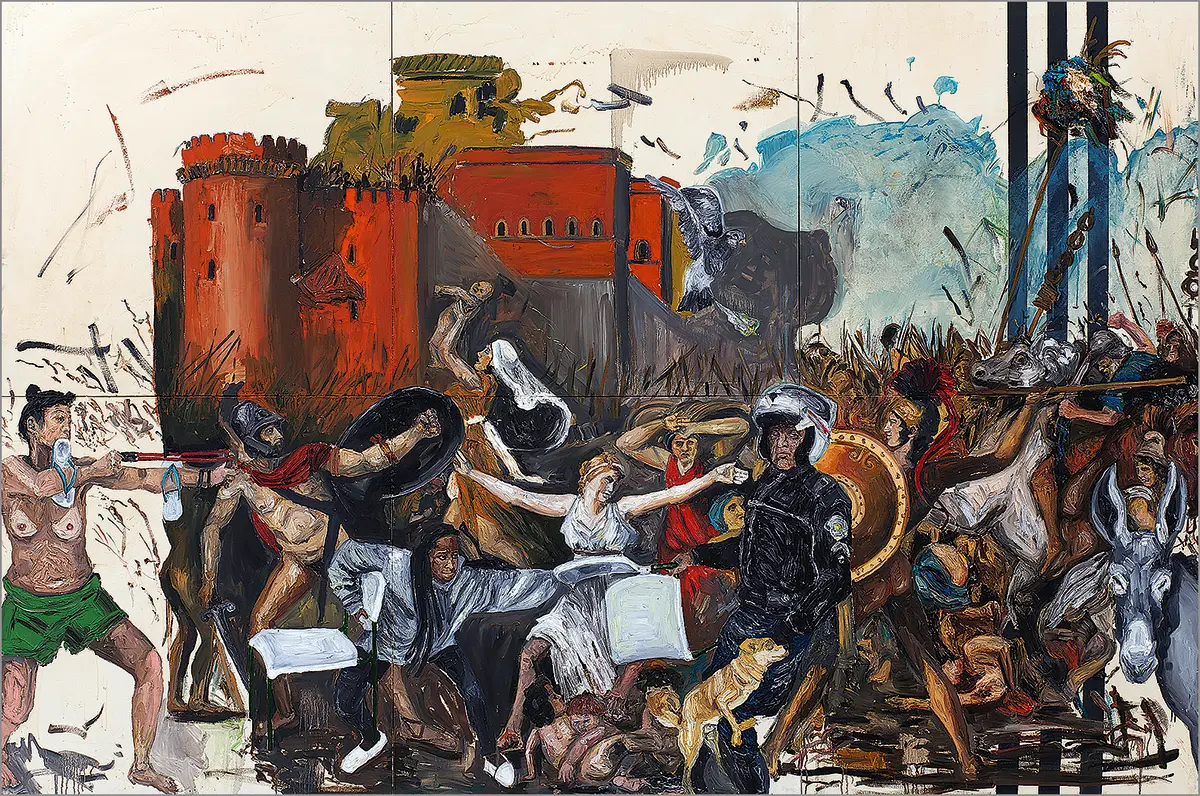
Starting from this premise, one can conclude that all conventions, moralities, prejudices, and even all ethics are social constructs. We are not born with a mental checklist of what is good or bad; what is censurable or laudable varies between cultures and operates at different intensities in different spatial and temporal circumscriptions. This conclusion is one of the keystones of Brazilian artist Camila Soato’s practice. Using the most mainstream, best-established technique in the entire history of the arts, painting, Soato deconstructs everything that the status quo imposes as solid, both inside and outside the exhibition space. She checkmates the mandates of art itself, such as the need for a careful finish, the trompe l´oeil, and even authorship itself, appropriating images from the media, from iconic works of art, and from the Internet, applying pure colors in thick layers and mixing it in quick, intense gestures, be it with brushes or with her hands; she leaves her unfinished drawings in plain sight, uncovered, negating, in a Brechtian manner, any possibility of accepting the canvas as a faithful depiction of life; she leaves on the canvas knots of accumulated color that put us in mind of excrement. The artist dubs this method for constructing her works fuleragens, a Portuguese neologism that derives from the slang fuleiro (gross, vulgar) and relates to the idea of the improvised, the ramshackle, and the careless. The concept of the fuleragem was created by the Research Group on Informatic Bodies (GPCI, in its Portuguese initials), which brings together performance-art practitioners in order to do research and is coordinated by Maria Beatriz de Medeiros, a professor at Camila Soato’s alma mater, the University of Brasilia. The artist describes her participation in the group as a very enriching experience of cross-contamination.
Soato’s solo exhibition Caviar é uma ova (Caviar Is Fish Eggs) provides a fairly complete overview of her work. It includes nearly thirty previously unseen canvases, all faithful to her guiding principles. In them, we find Soato’s sarcasm, her relaxed attitude, and eschatological leanings, the weapons she wields in combat against hypocrisy and prejudice. Also on ample display are her celebration of feminism and of individual freedom, as well as her denunciation of the ridicule of appearance, the words that denude reality of all adornment, in phrases like the one in the show’s title, which plays with the self-evident and the provocative.1 The show also features paintings in which the artist portrays herself as a person connected to the causes she embraces. The botched erasures, the sketches, and the lack of finish are all on purpose, and are used as instruments of force: the viewer’s attention is captured by the aggressiveness of the work, and Soato’s strategy is successful. To the beauty of a painstaking finish, which places the public in a purely contemplative position, Soato prefers a thought-provoking clash. In Ventilador na ppk dxs outroxs es refresco (the title is untranslatable), she depicts a girl with her skirt flying up in front of a fan. The conceptual implications are various: from the use of the letter “x” in the title to avoid indicating the genre (unavoidable in Portuguese) to the demystification of female genitalia (here named using the slang ppk, pronounced pepeca, which translates as something like the American “pussy”), to the suggestion of the sexual pleasure experienced by the character in the scene. Soate turns art inside out, sending a misbehaving message of “shut up!” into the outworn debate about the death of painting. At the other end, she also raises the unimportant, unpretentious scenes she takes from social media to a new status, using them to question our most sacred notions. Nothing could be more contemporary.
NOTE
1. In Brazilian Portuguese, the expression “It’s an egg!” denotes, with a degree of aggressiveness, that the speaker does not believe what he or she has just heard to be true, or that it has any value.
SYLVIA WERNECK