
During the last fifteen years, Colombian artist Carlos Castro (Bogotá, 1976) has gradually expanded the institutional boundaries of artistic practices, allowing diverse confrontations to situations coming from a wide spectrum of cultural representations. This is the manner in which Castro has explored and expanded the reach of institutionalized artistic mediums in Western art like realistic painting, kinetic sculpture, found objects, video documentaries, documentary photography, and site-specific interventions; always finding the “incorrect” way of interpreting them. At the same time, Castro, on the one hand, has explored fiction as if it were an objective fact and, on the other, has approached what might be considered true as if it were entirely fiction. Through these simultaneous movements, he manages to show how the only true thing is the notion that reality is a form of cultural representation.
Castro’s most recent project, titled The Language of Dead Things, was presented at El Dorado space in Bogotá. It consisted of a series of interventions resulting from his approaches to several sculptural monuments that appear to be evocative of the failed implementation of modernity in Colombia. These are sculptures associated with the construction of national narratives that emerged from predominant places of power in modernity such as politics and religion. He also addresses the relationship between these regimes of power and the education field, which became the chosen vehicle in Colombia to implement national modern narratives imagined by the cultural hegemony. Given the commemorative nature of the practice of erecting monuments, the permanence of the characters that were represented during the last two centuries becomes paradoxical if we consider that the contexts of interpretation in which they were conceived have clearly disappeared. It is perhaps for that reason that many monuments have changed their location throughout history—a fact that evidences another paradox; given the assumption that one of the purposes of monuments is to symbolically speak about the meaning or use of the places in which they have been located.
Carlos Castro takes advantage of this dysfunctional dimension of monuments to point to the presence of such dysfunction in the cultural representations that originated them and that flow through their narratives. Education, which is at the junction between the discursive regimes of the church and the state, literally incorporates cultural representations in the subjects; hence, Castro’s inclusion of a brick or a chain made with translucent materials whose interior contains a reddish color that comes from human fat (obtained from cosmetic surgery clinics). Clearly, liposuction and, generally speaking, all cosmetic surgery procedures are evidence of how the body follows hegemonic cultural representations and not the other way around.
The project The Language of Dead Things connects the cultural experiences of viewers by putting together the different pieces that form the specific spaces of the building in which the work is exhibited. In this manner, the proposal not only occupies the three exhibition sections of El Dorado space—known as Black Cube, Grey Cube, and White Cube —but also intervenes “inappropriate” spaces (in the museographic sense), such as the area adjacent to the staircase or in the courtyard in the building’s ground floor.
The walk proposed by Castro implied first entering the Black Cube section where the charred remnants of a school bus were displayed. In there, a film created in collaboration with Andrés Borda and Daniel Castro sparked some connections between the different components of the project. The exhibition then continued on the second floor—located on the same level of the courtyard, in the back of the building—where the display of sculpture molds or sculpture fragments dismantled conventional elements of the monument practice.
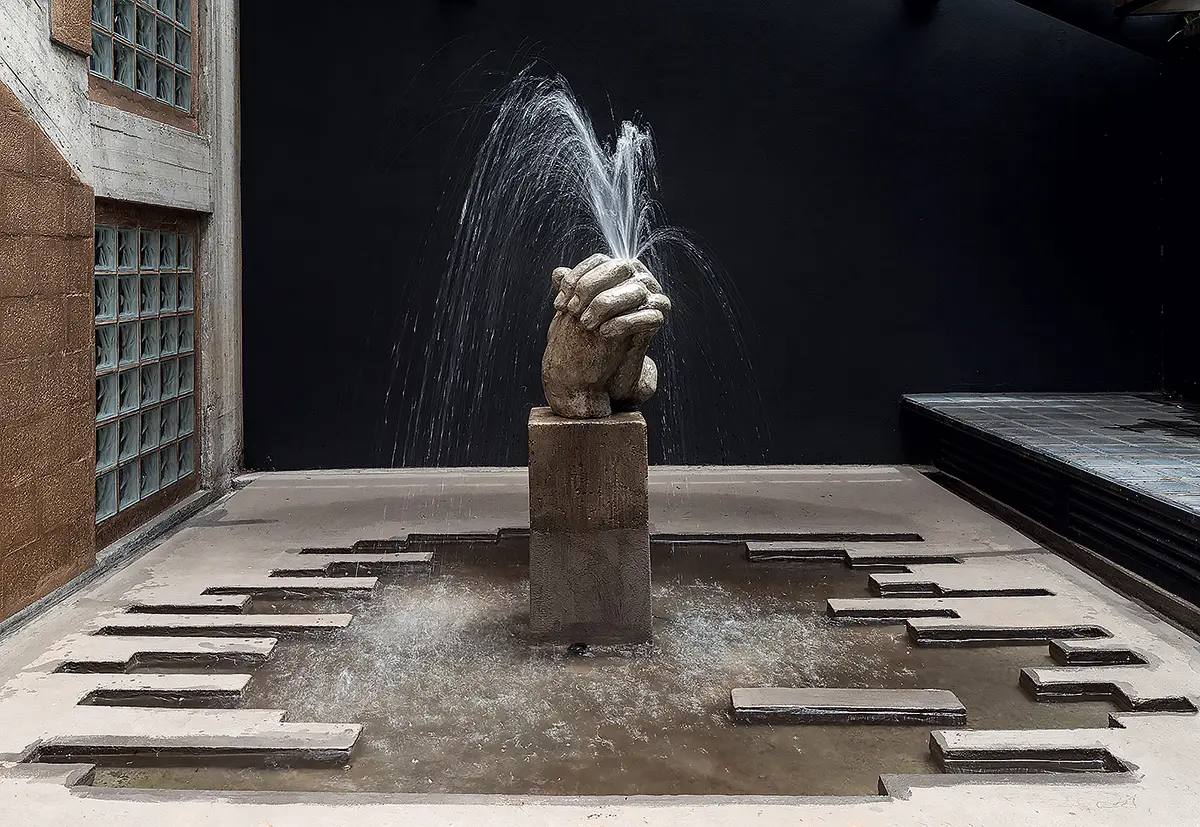
The pieces displayed in the White Cube section were connected to the educational sphere by institutional colors and patterns that outlined the space, and in the courtyard, Castro referenced the public fountains that incorporate sculptures, which, in this case, approached the connection between the body and water ironically.
In the Grey Cube, body, language, and monument intersected in the educational context to recall the inherent paradoxes of the relationship between body, power, and public education. The presence in this exhibition room of water and live fish surrounding the bust of a political leader, the continuous flow of ink around a word carved on the wall, and a chain covered in human fat, proposed the idea of a perpetual cycle of repetitions like those that have recurrently marked the history of Colombia.
JAIME CERÓN SILVA