
Fabián Peña (Havana, 1976) belongs to a generation of Cuban artists that became known during the first decade of the 21st century. It is a generation that was greatly affected, on the one hand, by the very harsh economic reality of Cuba’s so-called Special Period in Time of Peace, announced in 1991 after the fall of communism in Eastern Europe, and, on the other, by the worsening of the commercial embargo imposed on Cuba by the United States, and by the return of Cuban military servicemen from the African Wars. Politically and culturally speaking, it was a period in which the “battles of ideas” emerged to vindicate the national values from revolutionary nationalist positions as means of resistance and to defend revolutionary achievements against the end of the utopian communist project.
Within this context, the work by Fabián Peña becomes known during the 2000s and immediately stands out from his generation for the use of innovative materials in his work. Flies and mosquitoes, and then the gradual introduction of roaches, eggshells, and papers, among other things, become some of the materials employed to render his symbolically powerful works. Prominent among them are pieces like Frozen Flight (2008), a flag created with fly wings, nylon thread, fishing hook, and light; Pintura Épica (Epic Painting, 2010), created with roach wings fragments on canvas. Also noteworthy of mention are works from the exhibition titled The Book, the Egg, and the Fly (2017) shown at the David Castillo Gallery, which included works like Horizontal Portrait and It’s Just a Dream. And there is also the piece titled Working for Change, rendered with crushed flies on canvas.
Seen as a whole, the materials in Peña’s work maintain a direct relationship with the biology of his surroundings, with everyday life. Therefore, his work feeds from autobiographical archives, from a personal perspective that functions as a metabolic process of his reality. Using everyday life as material and translating it from a place of introspection, whether through a neo-figurative poetic key or in a neo-conceptual one (Fabián Peña combines both poetics), it became a very recurrent practice in the artistic production of the 1980s and 1990s. Also very present were patriotic symbols and slogans used by the Revolution’s rhetoric of cultural politics to indoctrinate and mobilize the masses as part of its communist social project. In this instance, the innovative element in Peña’s proposal would consist of incorporating to the spectrum of introspection elements from the biology of everyday life that are part of a dimension verging on the scatological. It is biology ingrained in the world of those insects that populate Cuban homes under conditions of material scarcity and pauperization. In popular culture flies, for instance, represent a tenacious spirit, indomitable resolve, and fireproof value in the face of conflict. On the other hand, those very qualities also make them a symptom of decomposition, dirt, and an evocation of death.
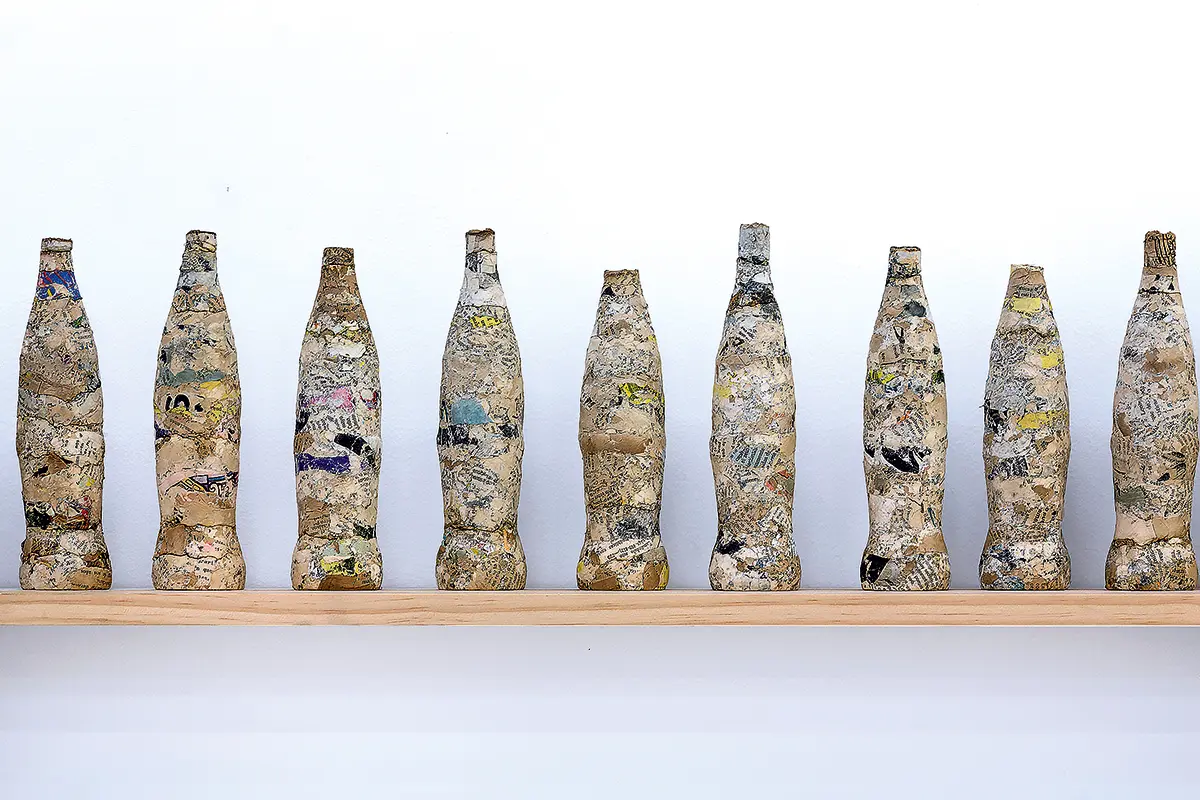
Degradation as a matter or concept that loses its qualities is an implicit idea in works like Coca-Cola del Olvido (Coca-Cola of the Oversight). There, Peña creates paper pulp from books, magazines, and publications of all sorts centered on revolutionary politics and ideology that have been edited during the revolutionary period. When observing this objectual installation, the bottles it contains look like a hodgepodge of randomly superimposed texts, images, and phrases; converging voices that produce unexpected meanings or meaningless discourses. A similar operation appears in the piece titled Working for Change, in which Peña mixed together slogans—rendered with crushed flies— used in the last US presidential election.
The exhibition The Book, the Egg, and the Fly reveals an analytical artist, both discursively and poetically. Degradation, the erosion of meaning suffered by the images and the cultural discourse of our time, guides the central interest in the work by Peña. In his work, ideologies and their forms of representation are subscribed to a political program that promises the masses the very best of two possible worlds. Interestingly, Peña recognizes such experience within the context of a totalitarian system, through a piece like Coca-Cola del Olvido, but also in the antithetical social model, capitalism, in works like Working for Change. Both works address two models of antithetical societies. And both works also question the colors with which each system paints the way of life it promises to its citizens. One, sacrificing the present for a utopian future in which inequality does not exist, like a post-historic world where all periods converge; and, the other, seducing the subject’s desire into an eternalized present with the promise of infinite consumption. Fabián Peña appears to be telling us that neither model is the right one.
DENNYS MATOS