
History with a capital “H” is also written in the invisible fog of destruction and barbarism. That is the idea that Fritzia Irizar develops in her exhibition at Nieves Fernández Gallery: a look at violence and politics as engines of history.
Fritzia Irizar (Culiacán, Mexico, 1977) has exhibited her work in institutions like Sala Siqueiros in Mexico City, the Museo de Arte Zapopan, and the Headlands Centre for the Arts in San Francisco. She has participated in the Mercosur Biennial in Porto Alegre, the FEMSA Biennial, and group exhibitions at CA2M; CIFO Fontanals Cisneros Foundation, Miami; Giorgio Cini Foundation, Venice; the Museo de San Ildefonso, Mexico; the Museo Rufino Tamayo; and the Banco Santander Foundation in Madrid.
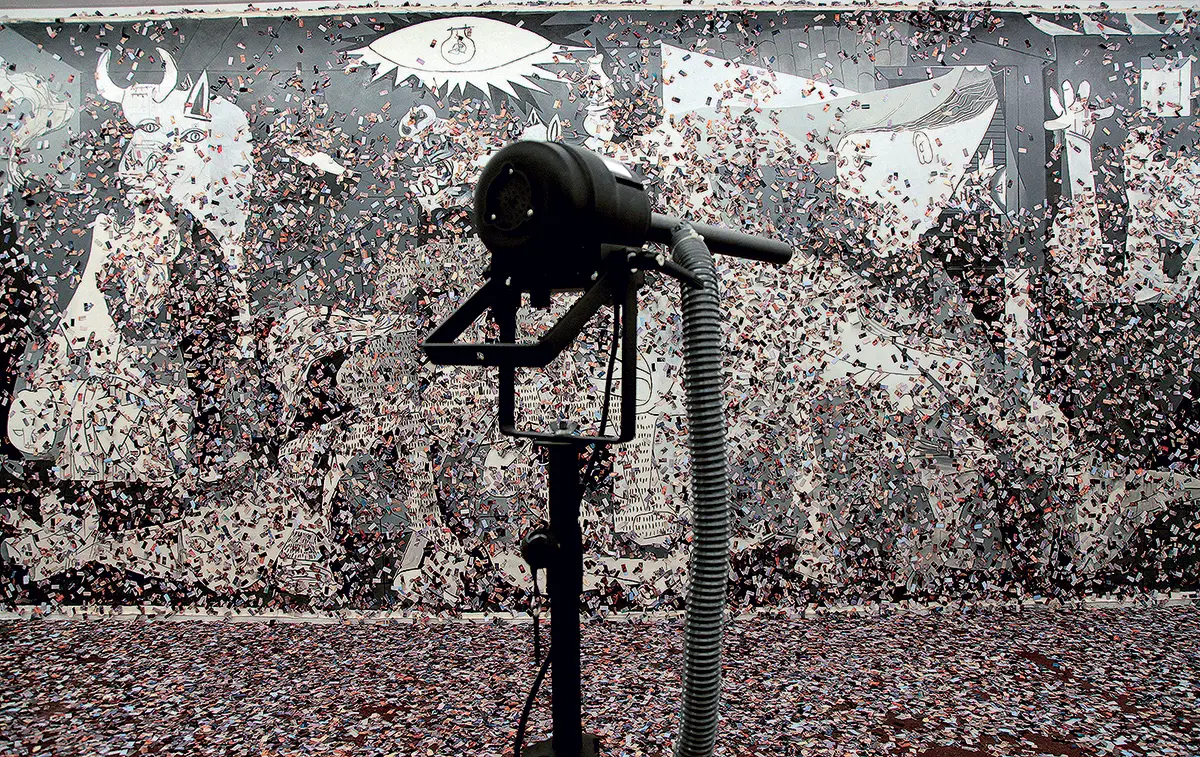
Starting with a reflection about two conflicts that have impacted the recent past in her native country, Mexico, Fritzia Irizar establishes a parallel between the War of Independence in the Nineteenth Century and the Revolution of the early Twentieth Century. The cycle continues the conflict currently raging across Mexican society against crime and drug trafficking, which has already produced over one hundred thousand deaths. European history, meanwhile, doesn’t emerge unscathed either: eighty years after the German and Italian air forces’ bombardment of the Second Spanish Republic in Guernica, the news is filled with yet another bloody episode—Russia’s attack on Aleppo, Syria. There is a certain irony in what appears to be the ceaseless repetition of such news, always with the ghost of economic interests floating around them.
Irizar’s discourse analyzes the causes of the West’s wealth, to which end she revisits the work of Adam Smith, the theorist and “father” of liberalism, and his book The Wealth of Nations, which provides a theoretical justification for an unjust order based on the war market and the oppression of some nations under a few dominant powers.
The exhibition at Nieves Fernández Gallery features a number of objects that deal with the relationship between violence, economics, and politics. The idea for the project emerged when, following a mechanical cold process, the artist burned one hundred US$1 bills and used the resulting ash to manufacture a pencil. Irizar’s poet collaborators (Óscar Paul Castro, Eduardo Ruiz, Alejandro Lee, Leonardo González, and Francisco Alcaraz) then wrote seven poems about money using the pencil. The paper on which the poems were written was made from a copy of The Wealth of Nations. The poets were compensated with the equivalent of the pencil charcoal they used, which could also be seen in the exhibition.
The show, then, had a strong process and performance component. The display was complemented with a life-size replica of Picasso’s Guernica: a global icon of humanity’s potential for destructiveness and the consequences of war for civil society. Interestingly, the canvas has not lost any of its currency; recent history again makes it urgent and meaningful. On opening day at Nieves Fernández Gallery, Irizar intervened in the work launching pieces of paper printed with images of the war in Aleppo, using a series of cannons that fired photographs chopped into confetti. In this way, she signaled the contradiction that often mars our commemorations, celebrations, and even the history of our visual culture: the ephemeral nature of our consumption of images that cover real stories of suffering and violence. Contemplating Irizar’s work, another thought emerged: the ubiquitous presence of violence, of a gruesome history in black and white, and the obsolescence of consumer society that seems to be built upon and rejoice in the most superficial and frivolous values. The results could not have been more eloquent: Guernica’s unmistakable figures (the bull, the horse, the mother, and child) in contrast with the confetti fragments, filled with color and so festive in nature.
We must not forget that Picasso carries specific and strong connotations in the history of art: modernity embodied in the “genius” artist, someone who dwelled in the centers of power (Paris and New York) and established his oeuvre on the basis of shrewd marketing moves. The radical aspect of Fritzia Irizar’s project arises, perhaps, from that small gesture, subversive for many reasons: the authorship of a female artist, born in the so-called “periphery” as described by conventional narratives, who counters the past with an unbeatable dialectic—the power of the collective confronting images that incessantly pop up only to disappear into mere gimmickry.
ANA FOLGUERA