
After a number of years without exhibiting in Mexico, Héctor Zamora (Mexico City, 1974) presents Memorándum, a project in the new line of the investigation his work is following, which involves actions that intervene in specific sites.
In this new work, some of the artist’s usual concerns, such as dissatisfaction and oppression, converge with a mechanical activity, usually associated with “women’s work”, in order to engage in sociological and political terms the relationships between systems of institutional power.
The role of the secretary or executive assistant in a bureaucracy is often associated with a dynamic in which their work, while crucial, is rather undervalued and their presence is rendered invisible in many different ways in a context where men often occupy the executive positions and women are faced with sexism and misogyny.
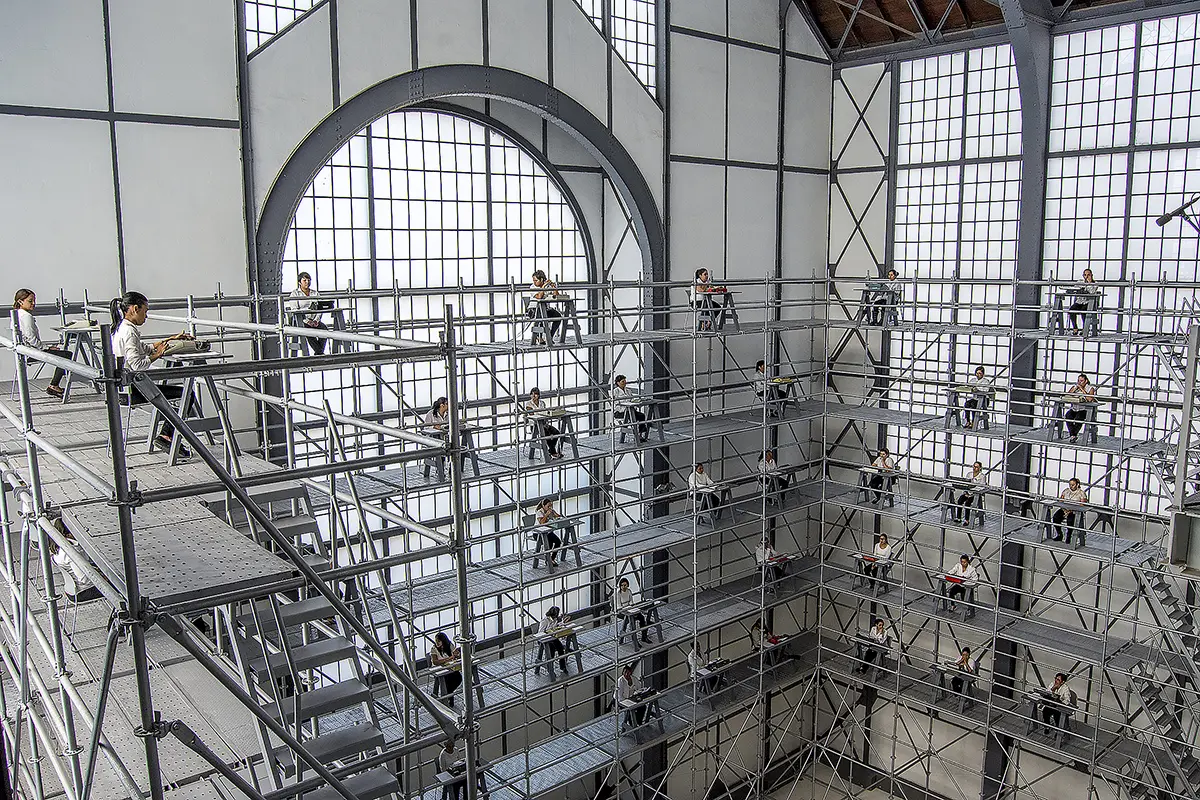
By way of vindication and as a personal tribute to his own mother, who worked for years as a secretary, Zamora reverts this subjugation, placing the 48 typists front and center as the main presence of the action framed by the majestic Eighteenth-Century building of Museo del Chopo, made mostly in metal and glass.
In the scene, the participants type (without ink) their own biographies and throw the pages to the wind, in what is perhaps a liberating act.
The exhibition featured three actions where the audience could see the women typing and throwing pages. Later, a register of the action, a sound-art work based on the action’s audio, and a large installation made from the tables, the chairs, the typewriters, and a few of the pages are exhibited as a trace of the event.
Memorándum is closely connected to other recent works by Zamora, such as Ruptura (Rupture, 2016); REviraVOLTA (2015); Ensayo sobre lo fluido (Essay on What Flows, 2015); El abuso de la historia (The Abuse of History, 2014); Orden y progreso (Order and Progress, 2012-2016); and Inconstancia material (Material Inconstancy, 2012-2013). In these works, the artist reflects on the issue of oppression, but also on the possibility of a new beginning, or the visibility of processes in the art world.
In this work, Zamora deals with the issue of vulnerability in the justice system via references to Franz Kafka’s The Process or The Swedish Theory of Love (2015), the latter a documentary about an efficient, well-organized society that is nonetheless haunted by isolation and individualism. He also makes reference to Todo lo demás (Everything Else, 2016), by Mexican filmmaker Natalia Almada, which depicts the indifference and dehumanization suffered by government workers and presents a portrait of survival marked by routine, alienation, and solitude, and inspired by philosopher Hannah Arendt’s idea of bureaucracy as one of the worst forms of violence. In her 1958 book The Human Condition, Arendt highlights the destructive dynamism of a capitalist economy that makes work the center of life for a majority of the human population, creating living beings who toil for mere survival and with the sole purpose of producing consumer goods and contributing to the dynamics of oppression.
The work’s sound and constructive elements, the mechanical labor, and the homogeneity of the participants refer to the idea of the kind of manufacturing work that takes place in factories and workshops, where the disadvantages of being the bottom rung of the ladder in an injustice-filled system of production are in clear display—a system where women are often more vulnerable and are forced to work in conditions of abuse, and where they might even become victims of organized crime while their bosses and their governments remain indifferent to their plight.
Zamora’s work is a way of granting visibility to the work of thousands of women who have devoted many years of life to a dehumanizing kind of work, which the very title, Memorándum, brings to mind with its allusion to institutional circulars as well as with its Latin meaning of “something that must be remembered,” thus using memory as an instrument for the visibilization of their dignity and the witnessing of their courage and poise.
ISAURA RUIZ