
In the Spanish language, there are two words for “fish”: pez and pescado. The difference between them is that the former refers to "live" fish and the latter to "dead" (or at least caught) ones. This distinction does not exist in English or Portuguese, but O Peixe (The Fish, 2016), a complex video by Brazilian artist Jonathas de Andrade (1982) exhibited at the New Museum earlier this year, records precisely the passage between those two states.
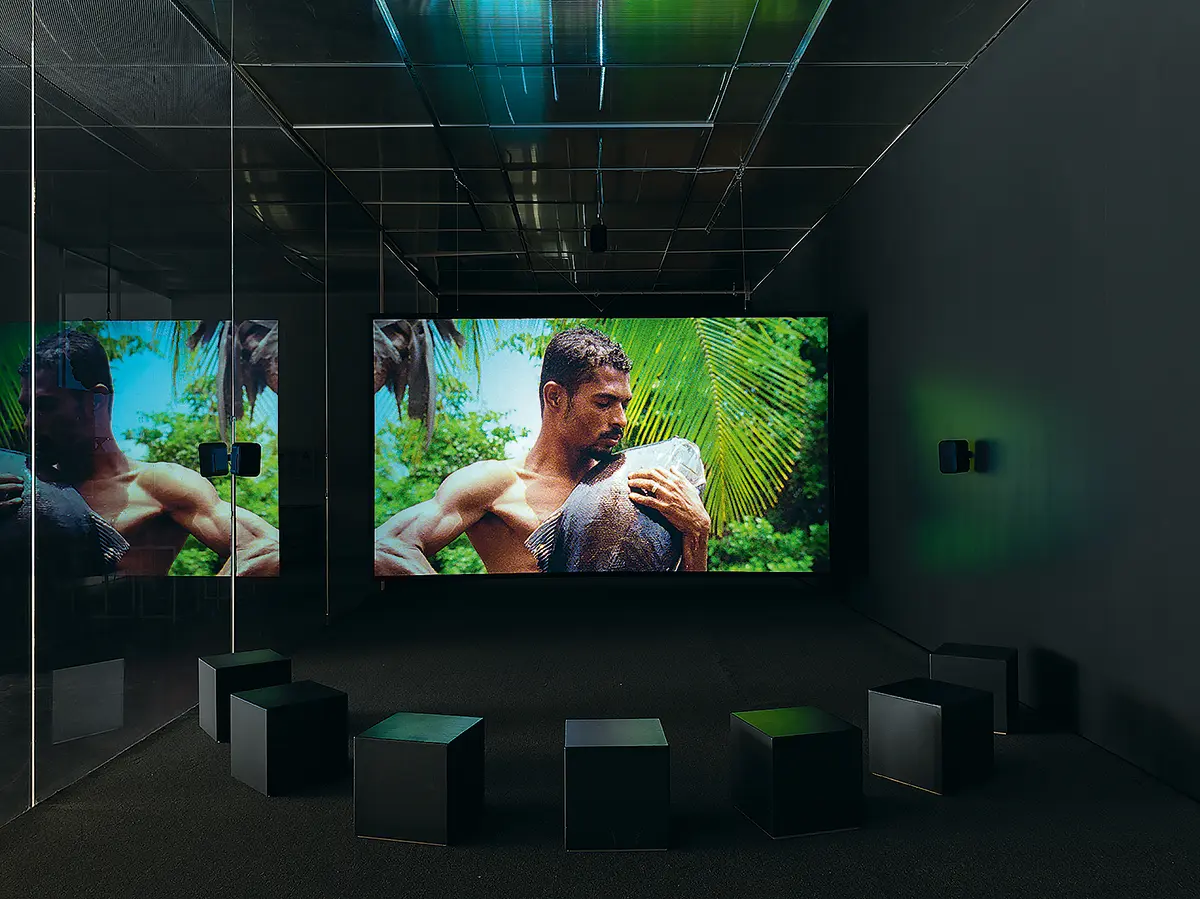
Curated by Natalie Bell, this was de Andrade’s first solo exhibition in the United States. It is worth noting that the work was also presented last year at the 32nd São Paulo Biennial, curated by Jochen Volz. The 16-mm video was on exhibit, on a loop, in the museum’s lower-level gallery. The gallery text informs us that what we are witnessing is fiction: a ritual of the artist’s own invention. Any visitors who skipped this warning would be misled by the video’s ethnographic/anthropological documentary style into taking the images for an ancestral practice from the Brazilian Northeast. In this way, de Andrade’s work proposes an uncomfortable interplay between fiction and reality.
In a series of consecutive sequences, de Andrade’s video presents ten fishermen of varying ages, one for each sequence, preparing their gear and waiting until a fish is caught. Once this happens, a private action begins where the fisherman holds the fish in his arms, petting and even kissing it softly, and accompanying its passage towards death. The man offers the fish succor in its dying moments, tenderly calming it down. The narrative of these sequences also includes moments of quietude, when the sound of water, the tropical landscape, and the wind produce an idyllic atmosphere.
In contrast with this harmony, a farewell is an ambiguous act: the very fisherman who on the one hand takes the fish’s life, on the other cares for it until the end. This ritual (invented by the artist) illustrates a relationship of power and domination that becomes central to the work. With each repetition of the ritual, the relationship between man and fish, predator and prey, is enriched, since the gesture—as tender as it is violent—is not devoid of eroticism and sensuality. De Andrade often records the fishermen’s strong, bronzed bodies in close up. Emphasizing their muscles, their eyes, and their manliness. They are not actors but real-life fishermen responding to the artist’s premise, which once again blurs the boundaries between fiction and reality.
Along the same lines, O Peixe dialogs with Museu do Homem do Nordeste (Museum of the Man of the Northeast), a 2013 work where de Andrade imagined a fiction based on the ethnographic museum of the same name in Recife. In this multi-component work, the artist designed and printed fake posters with images of men he had recruited from the classifieds and in the streets. While this work was conceived in connection to the context of an ethnographic museum, it is less focused on the language of anthropology than on the language of advertising. Part of this material was seen at the Guggenheim Museum in New York City, as part of the exhibition Under the Same Sun: Art From Latin America Today that Pablo León de la Barra curated in 2014.
Previous works by de Andrade feature video and media like photography and installation. In his works, he deals with socio-political issues connected to identity, the exoticization of the Other, and the realm of work. His artistic practice critiques preconceived ideas that humans develop about their relationship in and with the world, particularly in the Brazilian context. The O Peixe video, with its careful technical execution a great visual potency, can be understood as condensing different concerns that emerge from his previous work. It presents us not only with a hybrid of fiction and reality but also a romanticized image of what could be an ancestral community could be. The intense beauty of this work produces an audience captivated by the tenderness of the fictional ritual and, at the same time, sorrowful at the fragility of life.
VERÓNICA FLOM