
Old Havana’s Factoría Habana presented Diógenes y la luz (Diogenes and The Light), a large exhibition that is difficult to summarize in a brief review. The show is complex in terms of ideas and features highly elaborate artistic artifacts. It is a two-person presentation, with works by Octavio Marín and José Toirac, and while the conceptual resources and visual solutions on display lean towards Toirac’s forceful trajectory, we are also aware of how indebted they are to the experience of sculptor Marín and his stories, which have been the documentary basis for the entire exhibition. Toirac/Marín presents us with a quest for honesty, and to that effect, they hark back to Greek philosopher Diogenes of Sinope’s parable of the lamp; it is said that Diogenes walked around the city of Athens with a lit lamp in his hands, searching for “honest men” without ever finding a single one.
The first work visitors encounter is literally a lamp (Cristian), albeit a threadbare one made out of old, used sports shoes. Salvaged by the artists, these are shoes, Toirac assures me, that “children and young people hang them from electrical cables in order to demarcate their play territories.” Such is our entry into the exhibition, an artistic game that prompts us to emulate the barefoot philosopher, donning the garments of poverty, reducing our needs to the bare minimum, and eschew all honors and riches—to become, in sum, true cynics in the orthodox sense of the philosophical school that bears that name.
This first gallery is organized with charm. At the center, a long red “carpet” that, like a path of the kind laid out for the famous and the powerful, takes us to a sofa that resembles the seats often occupied by exalted personages to receive solemn adoration by the masses. To both sides of this path, which may well fascinate all viewers, art is placed on the walls in a rigorously symmetric decorative pattern. But our lamp, the metaphorical extension of an instrument for the pitiless critique of luxury and ostentation, allows us to see that this is all a mirage of human vanity and hubris. It is impossible to walk on this “carpet” (Red Carpet). Built from 80 kg of red cans, empty and crushed, it goes nowhere and comes from nowhere; it is only a collection of the dross we leave behind in the course of our lives. These are “dead” objects, as defined by archaeology, which makes a metaphor of the still life genre, of the vanitas that refers to the uselessness of all pleasures and frivolities in the face of our knowledge of the inevitability of death. As an extension of this, the couch is nothing more than a repurposed garbage container as a hard-backed chair. It is the throne as a garbage can.
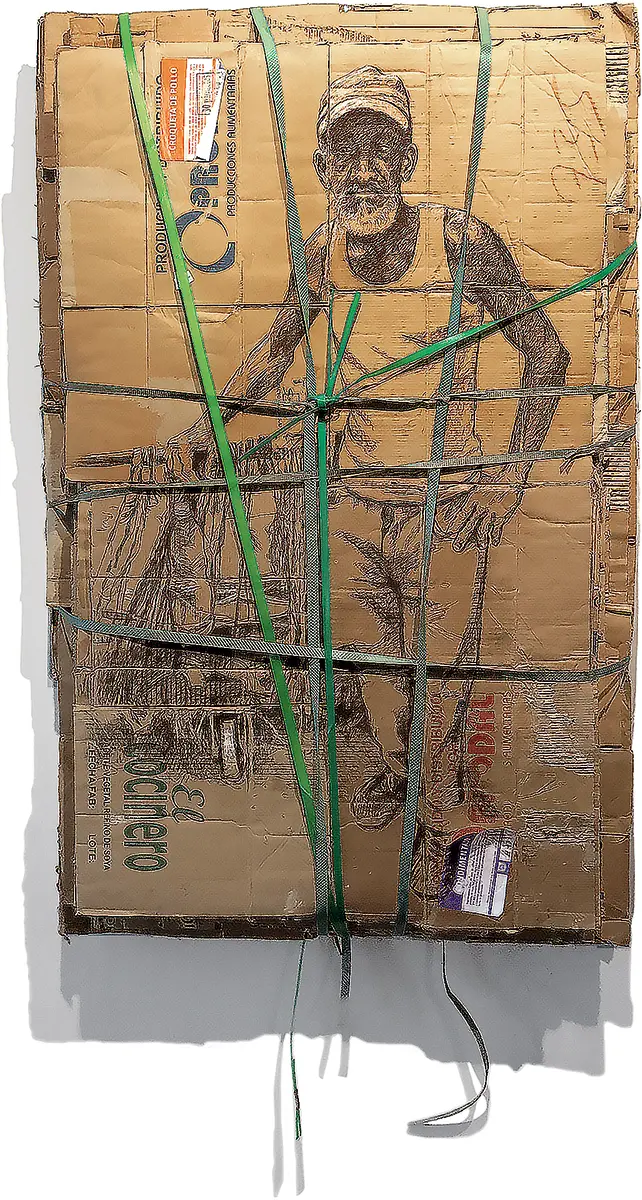
The art on the lateral walls is a series of portraits of real-life characters who have nothing to do with the glamour of power. There are common people, the unrepresented who lack an official story, usually with no higher education and whom “one can run into in the day-to-day of the streets of Havana,” people whose lives are, more often than not, marked by the lack of financial resources. People as penurious as Diogenes but devoid of his wisdom, intent on acquiring by any means those material comforts that the philosopher abhorred. There are also portraits of successful professionals and individuals from the most varied walks of life.
In the next level, there are portraits, or object-based references, those among the dead that are more or less exalted by history, or at least taken into account for its interested writing according to at any given political moment. They are multifarious characters spanning a broad spectrum of the Cuban chronicles. From the enslaved African and the Chinese immigrant to the millionaire entrepreneur; from the patriots who fought the War of Independence to the defenders of the colonial order; from the suicidal politician and the policeman of the President who became a dictator to the assassinated union leader; from the President of the Republic and foremost Leader of the Revolution to the young internationalist who died in Angola; from the prisoner and the junkie to the poetess and the cook. All exposed to the light of the threadbare lamp.
When we reach the upper level, we are surprised by a confounding and intricate dialog between the exhibition’s final two installations. On the one hand, an archaeological, broken show harking back to pagan ages; on the other, an iconic Christian-era last supper. La luz de Diógenes comprises the remains of a vessel or jar, accompanied by a text on the wall with the philosopher’s biography. It is a direct allusion to the cynic’s home, but it is derelict, like Havana buildings. Modelo presents a table with 24 small aluminum jars, alluding to school lunches, filled with non-consecrated communion wafers, and engraved with the image of Che Guevara. Depending on your knowledge or ideological affiliation, you can make here diverse and divergent readings. This area of the exhibition brings to the fore the attempt to bring closer together the paradigms of the politician and the philosopher: the construction of the New Man and the search for an honest man. The result seems to widen the chasm between them to gigantic proportions. It is said that Alexander the Great, astounded at the philosopher’s shrewd answers to his questions, came to this conclusion: “If I were not Alexander, I should like to be Diogenes.”
JOSÉ RAMÓN ALONSO LOREA