
Dos islas vecinas (Two Neighboring Islands) is the title given to this exhibition of works by José Vera Matos (Lima, 1981) at Casado Santapau Gallery. In it, Vera Matos explores issues that have marked his production: post-colonial theories, the status of the work of art, archaeology, and the relationship between knowledge and power. José Vera Matos studied at the Instituto de Artes Visuales Edith Sachs and later at the Escuela Superior Autónoma de Bellas Artes, both in Peru. He has exhibited his work in Lima, Mexico City, Brussels, Basel, New York, London, and most recently at the Museo de Arte de Lima (MALI).
The work from which the title for the exhibition is inspired consists of two museum display windows with pottery pieces. The artist worked with a potter in the conception of these pieces, which are copies of a pre-existing model. Following Walter Benjamin’s analysis of the copy and the original in The Work of Art in the Age of Its Technological Reproducibility, Vera Matos probes the realm of museology and the exhibition context. How does the reception of a work of art change when we see it contained inside a display case, in a privileged position but also one that is enclosed, constrained, stationary? The unique work of art is characterized by its fixed position and its status as a producer of knowledge.
Does the display alter the work itself? The vases on exhibit at Casado Santapau appear deformed, squashed, and useless for their original purpose. Does it make sense to exhibit functional handcrafted objects that were conceived for a specific task? Does aesthetic contemplation alter the status of the object? And with respect to the exhibition devices, what is the meaning of the display windows? This question, extensively probed in contemporary art, has found many answers, yet all of them hinge on the condition of the unique work of art, authorship, and admiration. Let us remember the etymology of “admiration”: from the Latin admirāri, looking upwards. A display case or window is the system of legitimization of the art world, which seems to finds its justification in the exhibition of things that are potentially commoditized.
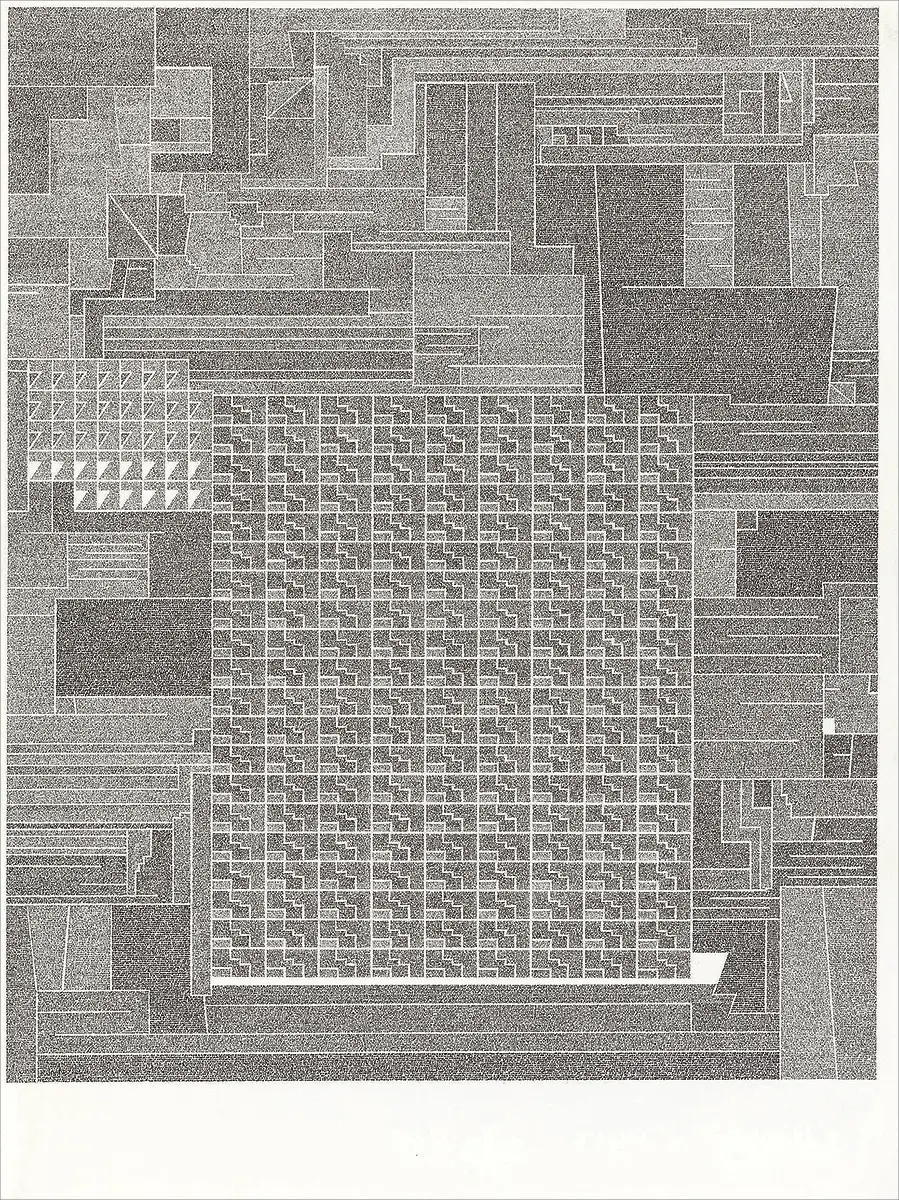
Adhering to a certain way of doing things that brings to mind 1960s minimalism, the exhibition continues in two dimensions, featuring drawings and writing. Vera Matos appropriates works that have to do with structuralism and post-colonial theory and transcribes them following aesthetic patterns that overflow the boundaries of text as knowledge and take us to different visual locations. For example, the artist takes the text of Levi-Strauss’ Tristes Tropiques and transcribes it manually following a repeating modular structure, in search of the coldness and tedium that minimalism deployed in the 1960s. The resulting geometry reminds us of figures in pre-Columbian textiles and pottery, for example, those left behind by the Moche culture. The text as a weaving, Roland Barthes would say, and depth as surface. Here, lexical content becomes an unfolding of signs intended to examine and understand the mechanisms by which knowledge is constructed, on the basis of tradition and along specific channels.
There is an allusion to the binary savage vs. civilized, this is to say, to culture as a system for the standardization and control of the unknown, of what causes uncertainty. Other authors make an appearance: Michael Taussig with Shamanism, Colonialism, and the Wild Man and Alberto Escobar with Lenguaje y discriminación social en América Latina (Language and Discrimination in Latin America). In the case of the latter, the paragraphs give shape to a compositional order that refers to Inca architecture and its perfectly fitted geometry of outsize rocks. In this way, a bridge is posited between two worlds: the Inca civilization and European colonialism, and the text become a compositional and constructive element, as though it had spatial value in itself. There is a gesture of appropriating the authorship of others, a common procedure in the early years of postmodernism.
We know that writing, rather than reflecting, constructs, and that language shapes reality. Vera Mato’s manual transcription of Louise Rosenblatt’s Literature as exploration insists on that idea. We know also that as well as a mode of political domination, colonialism involved an occupation of language, points of view, systems of knowledge, and of cultural references.
The chasm of the unknown, of the other, bursts through in Reading Paths. It is a kind of music score where language acquires the narratives of jazz, like syncopation. We see circular lines, graphic signs, scribbles, numbers: a writing code that here seems more or less arbitrary and yet, interestingly, is the most rigorous in the entire exhibition, as it emphasizes an inescapable truth: writing, art, is always an approximation, never a faithful record.
ANA FOLGUERA