
Multiple realities coexist in Argentinean artist Leandro Erlich’s conceptualizations. His works reveal this and in turn prompt a variety of perceptions, such as magic, cleverness, serenity, distress, playfulness, nostalgia, shifting states, connections with aspects of everyday life, the perception of changes that are not entirely believable, a transition beyond life, and the insecurity that derives from changes in that which is not seen as changeable. One work that exemplifies these developments is Erlich’s intervention on monuments like the Buenos Aires Obelisk. The Obelisk is a symbol of the city and the country, and a distinctive site in the Argentinean capital. Who would have thought that a visual artist was capable of modifying a monument with such physical and symbolic characteristics? In fact, anyone familiar with the history of Argentina knows that stability, as a word and as a situation, has been in the process of “de-existing” for a number of decades. The anguished way of life that has taken hold in the entire world was foreshadowed in Argentina. It is common to detect the legacy of each country of origin in works of art, and Erlich is not exempt from the high intellectualism and the habits of his native Buenos Aires. In terms of his professional training, Erlich emerged from workshops and studios of more recent vintage rather than from the traditional Art Academies, and he did so in dialog with notable Argentinean artists such as Luis Fernando Benedit. He has lived in New York and Paris but needs Buenos Aires, the city that fuels his fantasy. Erlich’s sophisticated fantasizing, with his highly personal—and even somewhat puerile—creative tone, finds nourishment in that land.
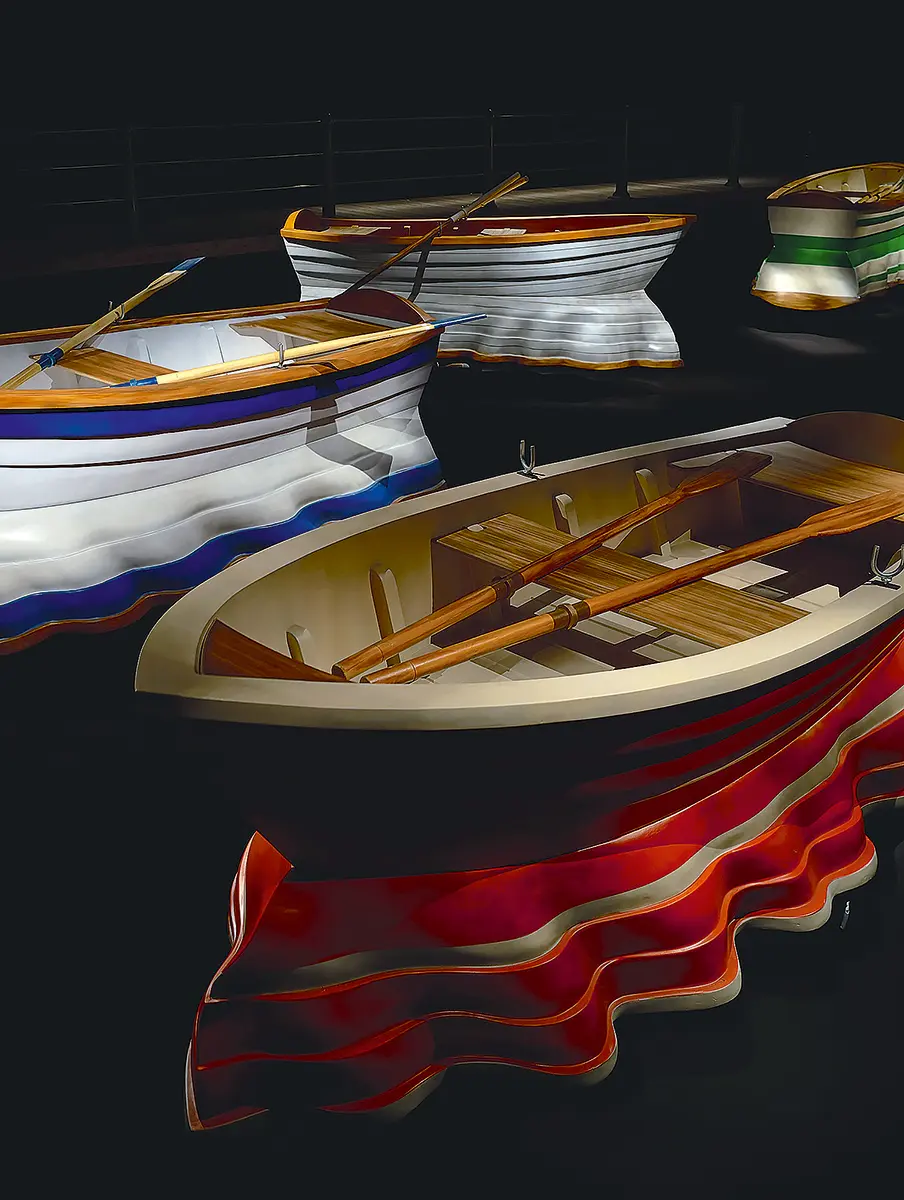
A visitor who entered the Port of Reflections exhibition without any prior knowledge of its components would first encounter a white-dominant, spacious museography of objects, sculptures, and photographs, and would then proceed to a second space, dimly lit and seemingly abandoned or in the middle of construction. Only after deciding to find out what lies on the inclined plane of the largest and farther wall would this visitor begin to realize what is happening here. At the edge of that threshold, a small card informs us that we are about to enter a mixed-media installation created in 2016. We also learn that the installation is on exhibit courtesy of the artist; the National Museum of Modern and Contemporary Art, Seoul; and the Museo de la Universidad Nacional de Tres de Febrero (MUNTREF), in Buenos Aires. A few more steps and we notice that Leandro Erlich dedicates this presentation to his friend and colleague Matthew Mahoney, who died in 2009. As we climb the ramp, the darkness grows and we arrive at a curtainless hole. The option is to turn left and enter a rather magical space, occupied by what seems to be a rectangular construction in the shape of a swimming pool with boats in it. The water is still and dark. It could be a scene from a Venetian canal; given that we know it is inside a museum, two realities clash. This nocturnal scene is forceful; it does not resemble a dollhouse game like the display cases and the photographs that Erlich took and modified in previous situations, exhibited in the brightly lit first gallery.
Erlich’s work is transconceptual and transsurreal, in the sense that it belongs in both categories in their Twenty-First Century versions. This is a declaration of aesthetic change that cannot be fully detailed in the space of this review. In Erlich’s exhibitions, what drives visitors to disquiet and prompts them to wonder about the how of the art on display is, more than direct viewing, their perception. Erlich’s art is not direct, but gradual. Uninterested in magic as such, or in mocking or tricking the viewer, Leandro Erlich offers immersions of a diverse nature: in water, in altered architecture, in physical escalations. Perhaps another key work is La pileta (The Pool), from 2004, where visitors were submerged underwater yet remained dry and breathed unimpeded. In the same way he “takes” viewers to other experiences—to shifts in situations that we often take for permanent or impossible—Erlich takes his works to other places. He thinks in situ. However, he must also retain itinerant adaptability, which has become necessary given the growing interest in his work.
The experience that Erlich produces is somewhat cinematographic, having to do with motion; it produces surprise and feeds the imagination. He is a visual artist but makes use of several auxiliary sciences, such as architecture and engineering. We must note Erlich’s patience to obtain the permits required in every instance. Erlich won the Roy R. Neuberger Exhibition Prize this year, which includes a show and the publication of a catalog (the artist’s first fully illustrated one in English) by the Neuberger Museum’s own publishing arm and by Purchase College of the State University of New York.
GRACIELA KARTOFEL