
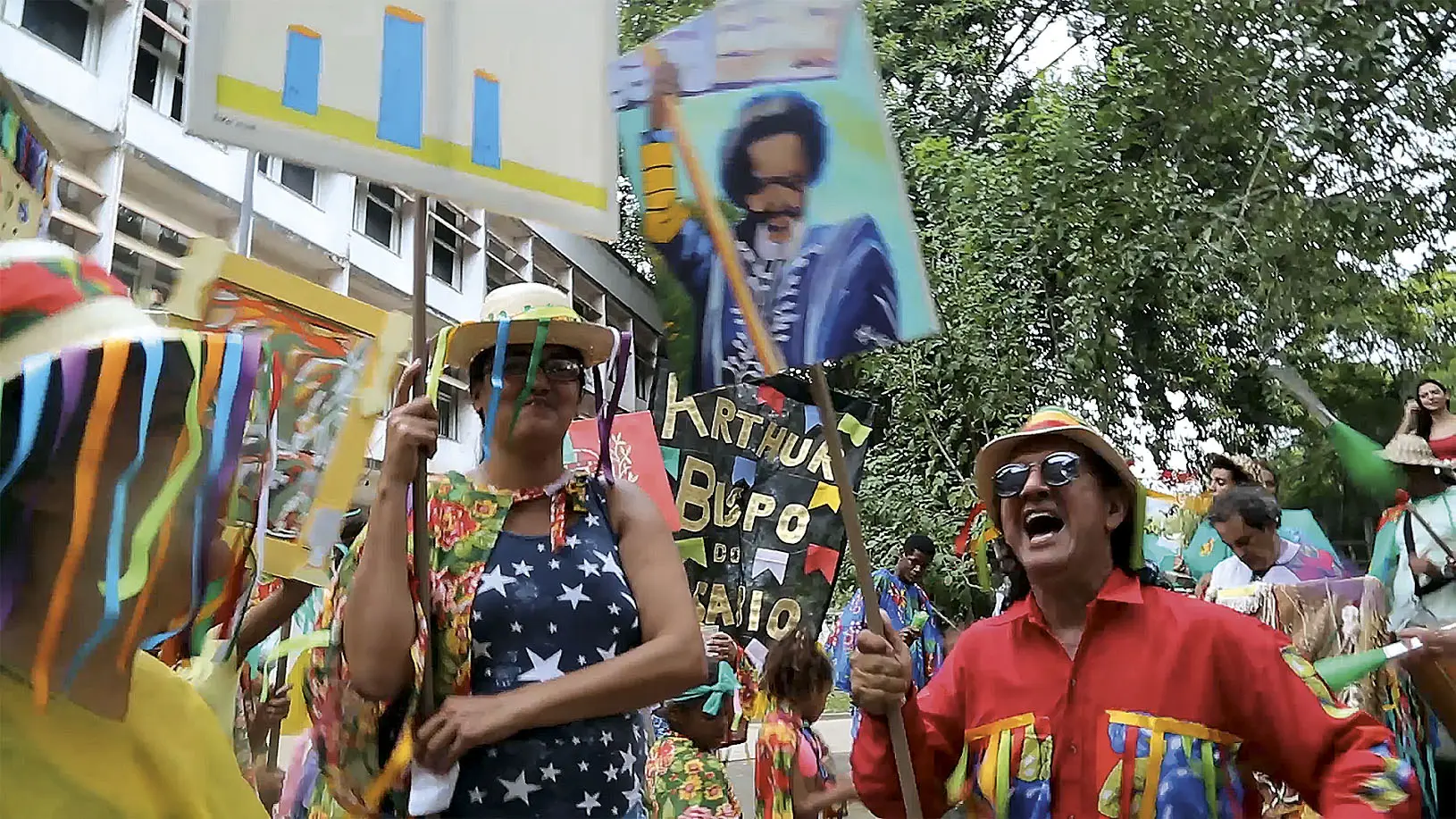
How is it possible for art and madness to meet? What are the boundaries between psychological delirium and artistic creativity? Do the expressive potencies of disturbed minds reveal an aesthetic condition? The answers to these questions can be found in the exhibition Lugares do Delírio, open through September at the Museu de Arte do Rio (MAR), featuring works of art that reflect, expressively and in political and ethical terms, about madness and art.
Conceived by Paulo Herkenhoff and curated by Tania Rivera, the exhibition presents nearly 150 works of art—installations, maps, performances, paintings, and objects—by such diverse figures as Cildo Meireles, Laura Lima, Anna Maria Maiolino, Arthur Bispo do Rosário, Fernand Deligny, Raphael Domingues, Gustavo Spiridião, Fernando Diniz, Cláudio Paiva, and Geraldo Lúcio Aragã, among others. "The intention is to suspend the separation between what is seen as normal and what is deemed mad,” says curator Tania Rivera, a professional psychoanalyst and a professor at Universidade Federal Fluminense (UFF), “what art and madness have in common is a power to transform reality, and this is represented in the exhibition.”
The research for the show was directed towards exploring deliriousness in art and artistic thinking is madness. Another determining factor was an attempt to break with the quarantining of psychiatric patients’ productions and to discuss their representations alongside those exhibited in traditional gallery and museum circuits. This attempt was successful, as proved by the high quality of the dozens of artists included in the exhibition.
According to the curators, the word delirium means something that deviates from the norm and creates new configurations of the real. This is why the term is used in the title of an art show that included works by artists diagnosed with some form of psychiatric disorder, alongside names of well-known figures who reject traditional ways of representing, or who critique in any way that is commonly understood as “madness”. Also included are the results of work done by visual artists in collaboration with psychiatric patients.
The unsettling debates around these topics, which mainly concern the health sciences field, seem to have been set temporarily aside in this proposal, where the artworks were arranged so that they interconnect and communicate in space. There is a certain horizontality in every one of the exhibition’s actions. “We want to present a playful, unexpected aspect of the transformation of reality, and to deliberately organize the works into a visual contamination,” says Tania Rivera.
Exploring deliriousness in art and artistic thinking in the madness are the purposes that guided the curators’ research, and the exhibition was organized taking into account a wide variety of genres and languages. “We are bringing out emblematic artists, like Arthur Bispo do Rosário, committed for more than fifty years in a psychiatric clinic, but also others who are less well known by the public, like Luis Guides, from Porto Alegre; Mauricio Flandeiro, from Ceará; and Fernando Lima, from Belém. The dialog here with important contemporary artists like Cildo Meireles, Laura Lima, and Anna Maria Maiolino, for example.”
Such seemingly dissimilar artists are brought closer together by the humanistic aspect of their oeuvres and the transcendence of the work of art. Analyzing these poetics means overcoming any static understanding of art and of mental health, in order to bring into focus the alterity between the two fields. This is what drove critic Fernando Morais, for example, to engage with the work of Arthur Bispo do Rosário, about whom he wrote articles and presented exhibitions (most recently, he participated in Arte Além da Loucura [Art Beyond Madness], organized by the psychoanalyst and researcher Flavia Corpas). Despite his repeated psychiatric crises, Bispo produced a body of work in a language that responds to the great questions of contemporary art. He used objects and discarded materials gathered in the everyday experience of his clinical commitment to make miniatures, mummified sculptures, and embroidered panels—a profoundly beautiful inventory of the world, widely celebrated in the international scene for its aesthetic achievements.
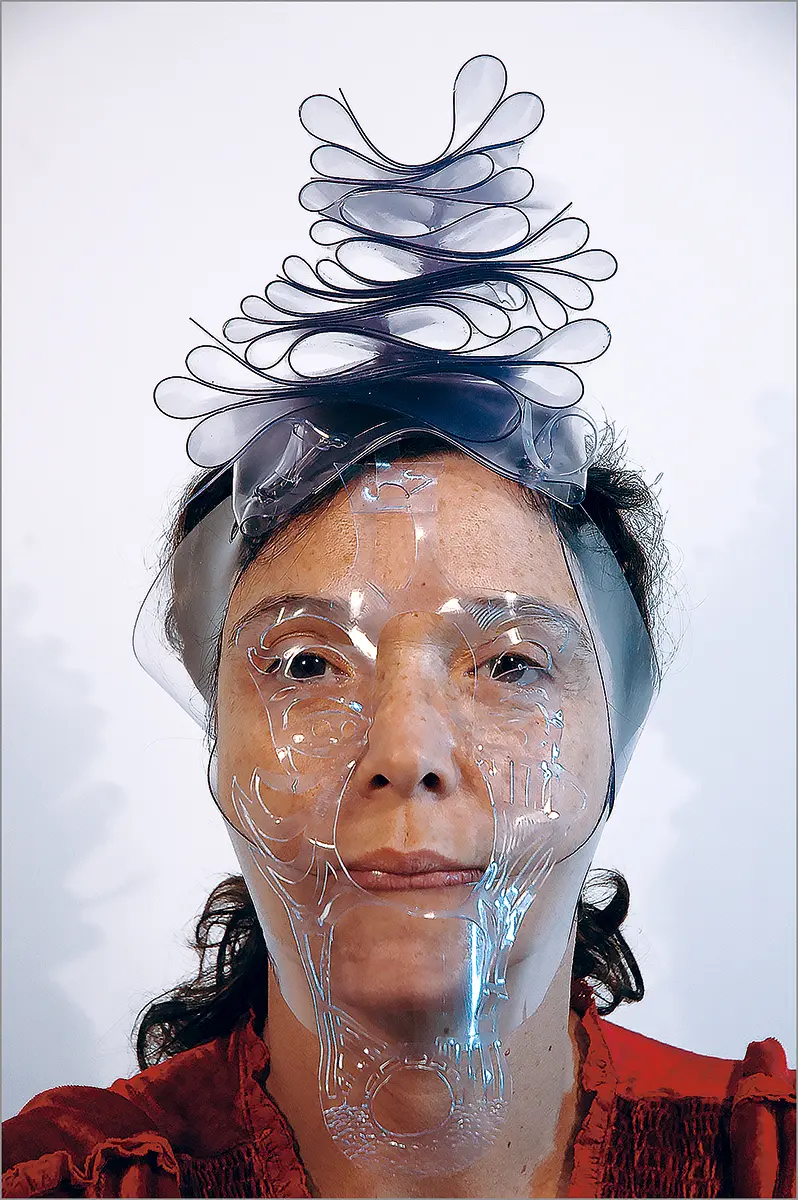
At the exhibition opening, Anna Maria Maiolino staged, with the participation of Sandra Lessa, her performance In Atto, about a woman’s progress towards freedom as she breaks the ties that bind her. The performance presents the torturous process of a bound and gagged body attempting to break free from the giant girdle that imprisons it. The performers’ screams bring to mind an anguished psychotic episode. Meanwhile, Laura Lima—who explains that accompanying her brother during a psychotic break was key to her decision to become an artist—presented Novos costumes (New Outfits), a selection of sculptures-garments in vinyl glass that the audience can wear, thus enjoying the artistic experience in full.
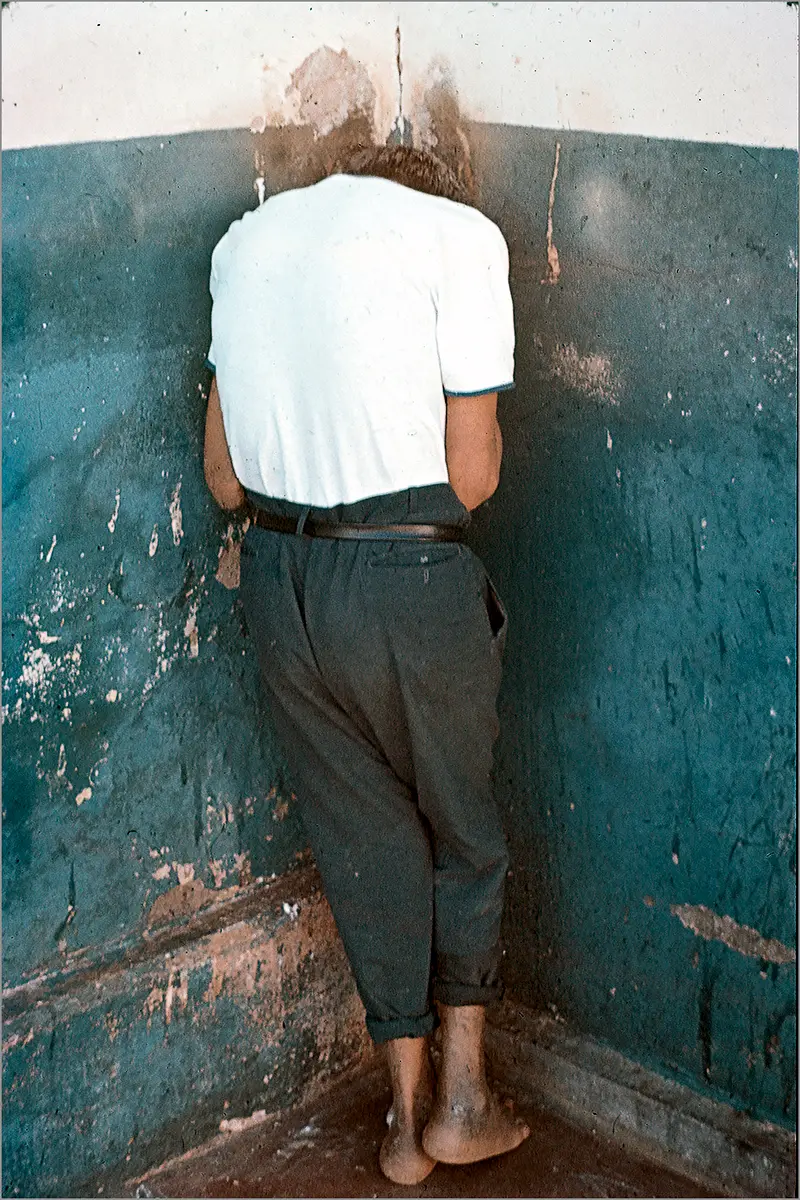
Psychiatrist Nise da Silveira, who saw schizophrenia as “one of many possible states of Being”, as Tania Rivera notes, is remembered in the exhibition via works from the collection preserved at the Museu de Imagens do Inconsciente (Museum of Images of the Subconscious), which she established in 1952 at what was at the time the national Psychiatric Center, or Engenho de Dentro. Included in the exhibition are works by Fernando Diniz and Raphael Domingues. Also on exhibit are photographs and drawings by Geraldo Lúcio Aragão, who frequented Nise’s art workshops in the late 1950s. These are works of significant poetic power.
Along with her counterproposal for psychiatric treatment—which at the time was based on electroshock, excessive chemical sedation, surgical interventions on the brain, physical punishment, and the like—Nise brought a new dimension of the arts into the mental health field. As psychoanalyst João A. Frayse-Pereira put it in his article “Nise da Silveira: imagens do inconsciente entre psicologia, arte e política” (Nise da Silveira: Images of the subconscious between psychology, art, and politics), the process created by this revolutionary psychiatrist was anchored to free expression, to the creators’ joy in their creativity, “a practice with poetic implications of great emotional and cognitive intensity that was also a threat to the stability of disciplinary institutions, intrinsically oriented as they are towards anesthetizing sensibility, paralyzing thought, taming the body, and punishing the spirit.”
The recontextualization of the work of Cildo Meireles is one of the exhibition’s highest points. Meireles’ Razão-Loucura (Reason/Madness, 1976), specifically rebuilt for the show, could be read as a poetic definition of the exhibition as a whole, a meditation on the subtle distinction between reason and madness. The work is a diptych. In Razão, a key is presented on a keychain, and a lock is out of reach. In Loucura, the keychain reaches the lock and is able to open it. Originally made under a military dictatorship, this work was intended as a political critique, but above all, it forcefully highlighted the senselessness of a regime whose legacy is one of torture and death.
Also on exhibit are 42 images from Meireles’ Cottolengo series, made in the Vila de São José Bento Cottolengo Hospital in 1976. One of these images was used in Cero Cruzeiro (Zero Cruzeiros), of which the latest version is featured here: Cero Real (Zero Reals, 2013). Another work by Meireles included in this exhibition is Liverbeatlespool, created in 2004 for the Liverpool Biennial; in it, a bicycle outfitted with speakers circulates around the museum blasting a continuous soundtrack of overlapping Beatles songs, played backward.
Lygia Clark is also represented in the exhibition, with her emblematic but little-known Camisa de Força (Straightjacket, 1969). This work is part of a selection of Clark’s “relational objects,” the generic term she used in the sessions for her Estruturação do Self (Structuration of the Self), the work that resulted from and crowned her research into audience participation and bodily experiences as preconditions for the creation of a work of art. In this case, Clark reinvented the straightjacket, bringing it into the realm of art, which could be understood in terms of what French critic Nicolas Bourriaud defined as a “relational aesthetics”: the work of art is produced by means of the freeing of the body and the mind and in the direction of a sensible and collective way of living.
“This exhibition asserts that the places of delirium are many and diverse, and in this way attempts to probe and critique the boundaries between the normal and the pathological, between art and life, between the museum and the world,” says Tania Rivera, who gives continuity to the Arte e Sociedade no Brasil (Art and Society in Brazil) project that included the shows O abrigo e o terreno (The Shelter and the Terrain, 2013) and Há escolas que são gaiolas e há escolas que são asas (There are Schools that are Jails and Schools that are Wings, 2014). This exhibition also explores the work of French educator Fernand Deligny, who died in 1996 and greatly influenced authors like Gilles Deleuze and Félix Guattari. At the frontier between clinical treatment and art, Deligny’s collaborators made maps with the gestures and motions of autistic children and teens, in shared living spaces the educator maintained since the late 1960s. The exhibition features journals with reproductions of drawings and text fragments.
Resulting from the collaboration between Paulo Herkenhoff and Tania Rivera, the Lugares do Delírio exhibition illustrates and expands at its very point of origin the relationship between two different realms, art criticism (Herkenhoff) and psychology (Rivera). The originality of its execution offers, above all, a contemporary humanistic view of social relations. Ultimately, artists moved by mystical delirium would be normatively placed “outside society,” following the dictates of the social theorists of an older era who would attach to them the stigmas of exclusion and marginality.
In the current state of cultural production, where the multiplicity of identities generates a rich landscape of encounters, this exhibition fascinates its audience precisely for the way in which it reveals the need to revise social and aesthetic values, along fluid boundaries that encompass inclusion and many different visions. Above all, it honors a process that is inherent to contemporary art: the placement of artists and audiences at the same level of experience and understanding of the “other.” Life and art complement one another in this exhibition, a true celebration of difference.
ALESSANDRA SIMÕES