
Luiza Baldan, who lives and works in her native Río de Janeiro, presented her latest solo exhibition—titled Estofo (Stagnant Water)—in the central space of the city’s Anita Schwartz Gallery. One of the gallery’s walls was taken over by a text, an unanticipated event when compared to the use made by Rochelle Costi of the same space, which she occupied with large-scale photographs and a video-installation that set the places depicted in her work to dialog with a defiant height of the gallery’s architecture. Baldan seems to want to make almost the opposite gesture, one that is certainly more private and that invites the audience to a physical journey and a painstaking observation.
For the text mentioned above, the artist painted on one of the walls a series of phrases about her recent experience exploring and shooting photographs around Guanabara Bay, an essential part of the landscape on which the image of Rio de Janeiro and the identity of its denizens are built. Baldan’s text, however, was not informational; like the waves on the bay, it discoursed in meandering lines. “Who knows where a fascination with the ocean comes from,” read the first sentence; later, a different fragment—“the tide that drops and the stench that rises”—broke with any Romantic view of a natural space overwhelmed by pollution and waste. The very waters that in a remote past must have been a paradise for the local indigenous population, have been increasingly overrun and spoiled since the arrival of European vessels, and today hold the Río-Niterói bridge and a number of oil rigs. As Baldan’s text also says: “Each one of the bridge’s spans is a photogram. The oil rigs compete with the mountains and join the stars.”
Baldan’s intelligent use of the text certainly grabs the viewer’s attention and suggests trans-historic mental images of the iconographies and physical sensations experienced in Guanabara Bay. The impact of these words and of the imaginative respite offered to the reader is such that one does not perceive in this exhibition any anxious rush to fill up the white cube. Its emptiness can be filled existentially by each reader of Baldan’s words, or not; perhaps the best thing to do, after the reading/contemplation, is to cross the city and go meet the bay.
In the course of her 15-year institutional career as an artist and researcher, Baldan has been known mainly as a photographer, although her video projects have also been constant. It is interesting to note in her production the relationship between photography and the construction of inhabitable spaces. Some of her projects have focused on buildings, apartments, or details of the natural landscape where human and even industrial presences are noticeable, however discreetly.
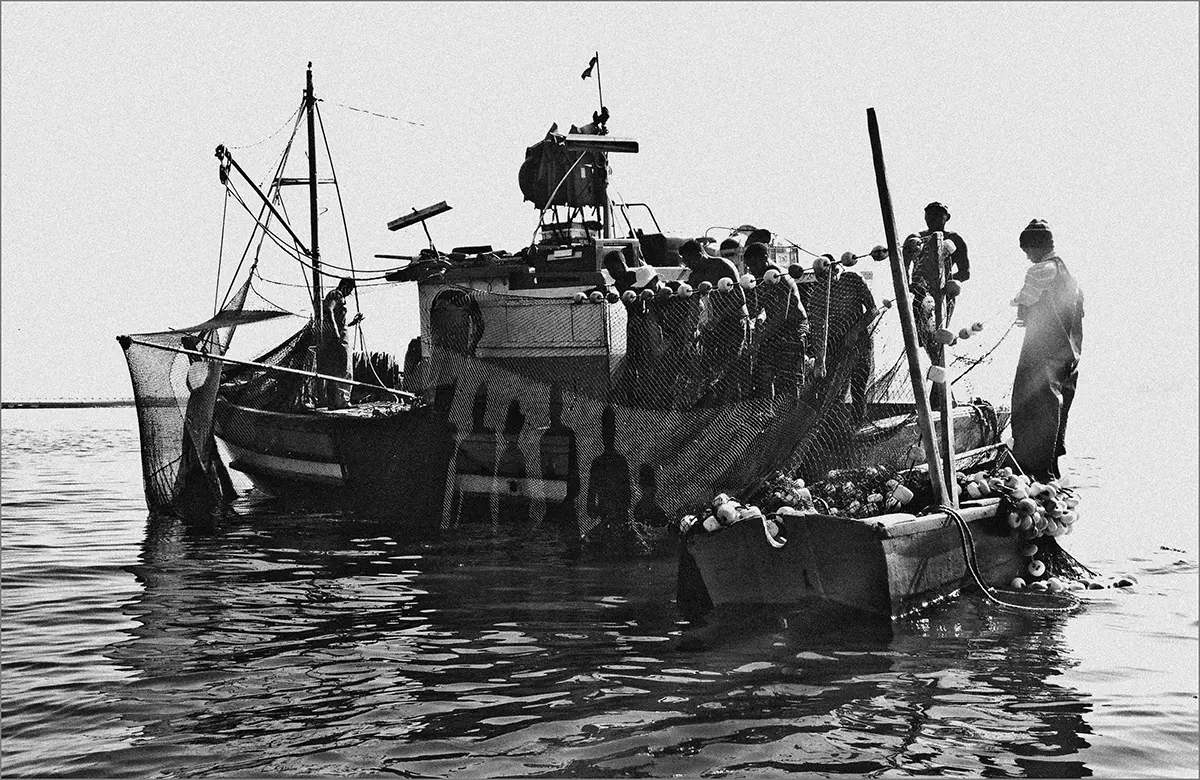
The photoengravings on display in Estofo command attention, then, for the way they bring forth images where our gaze remains unobstructed by anything in the background; there is little space for any suggestion of enclosure for whatever was photographed, and our eyes traverse those fragments of a landscape in the same way in which a ship glides on the surface of the water. It is equally interesting to observe how this aquatic space can be associated with diverse human activities and labors that range from bridge engineering and oil extraction, mentioned in her text, to more primary ones like fishing and sailing.
Guanabara Bay and the bustling city of Río de Janeiro appear discreetly in Baldan’s images also as a site for encounters and differences. A seminude fisherman emerges in the only image in which the lens is fixed upon a human body, and is able to work every day alongside a person who helms an oil tanker and hides his body inside the machinery. The Bay, in consequence, is a space for the coming together of anonymous individuals, for the clash of the different uses that capitalism makes of the landscape, and also for silence, as suggested by the pointed absence of drama in the photographs on display.
This silence is aided by an atypical element in the artist production: the exclusive use of black and white. The combination of this chromatic option and the use of photoengraving (rather than traditional photographic printing) situates Baldan’s images within a tradition of representations of Guanabara Bay that extends back to the Nineteenth Century, a moment in history marked by a boom in images of Río de Janeiro. Back then, European audiences avidly sought panoramic views of the mysterious tropical city, while today the artist’s vision is much more fragmentary, and her narratives only suggested.
In the exhibition’s central space, visitors were able to see both the photoengraving matrices and the printed images, manipulable using gloves. In the upper space, the artist resented a new video-installation where images and sounds were only intermittently connected. Also in black and white, a camera moved in sync with the speed of the waves in the bay and captured, by means of a close-up of an architectural detail of the Río-Niterói bridge, the meeting of concrete, water, and light. This solitary perspective enveloped the viewer’s body as she found herself, after enjoying the fragile photoengravings in the gallery’s lower level, overwhelmed by the sinuosity of the images as well as by the careful editing of the sounds captured at the site. It was clear that Guanabara Bay can also be a physically violent, even dangerous space.
To return to Luiza Baldan’s own words, Estofo brings to its public “The letter that sways with the motion of the ship.” In that swaying motion, and despite its pollution and decay, Guanabara Bay persists and continues to dominate the landscape of Rio de Janeiro. Its life force, added to the power of the artist’s gaze in her photographs, her text, and her video installation, becomes mystery and uncertainty, essential elements to confront the routine excesses of the present.
RAPHAEL FONSECA