
Upon arriving at Plaza de la Santa Veracruz, one stands before the beautiful building—built over 500 years ago—that houses the Museo Franz Mayer. It is a place that continually offers surprises unbound by time periods, classifications, and styles. To go through its glass door implies an expansion of the gaze, which wanders through the cloister until stopping before a staircase that leads to the temporary exhibition area. There, the museum presents exhibitions that are not exclusively about visual arts but also center on design and other original and creative forms of expression—as stipulated by the museum’s own regulations. Mario Martín del Campo (Guadalajara, Jalisco, 1947) is the perfect figure to exemplify such symbiosis. This Mexican artist is a fundamental referent for artistic creation brought to a utilitarian form, a fantastic and humorously rendered vision of reality, the production of scenographies, and the willingness to master every technique employed in the creation of his works. In addition to the variety of techniques and materials, Mario Martín del Campo tackles works approached from several dimensions, from puppets to set designs for operas, from sculptures and objects to feathers and jewelry. At first glance, the piece titled Calígrafo Zarampahuilo CMYK appears to be a bird that reveals a feather where the functional facet resides. Although his works are predominantly three-dimensional, some creations also rely on drawings and prints. Both drawing and engraving are disciplines that he employs in two-dimensional works with the same grace and imagination that characterize the rest of his work.
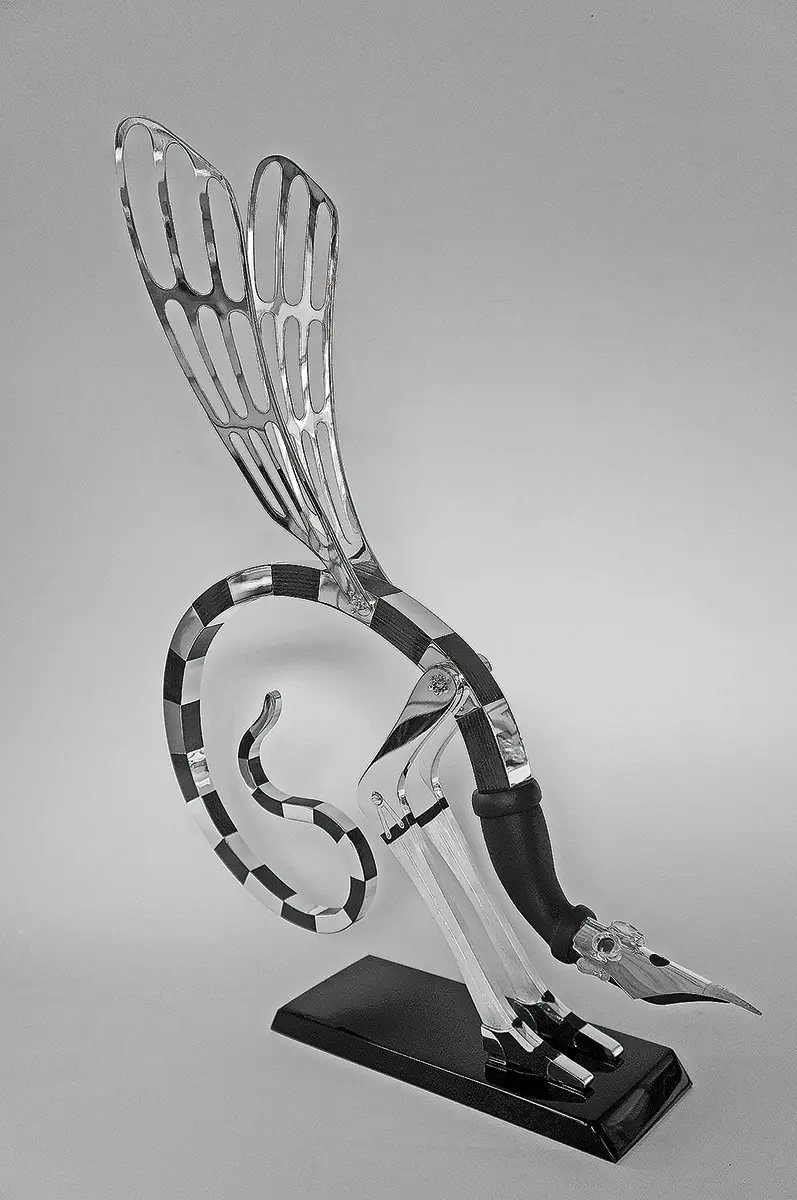
Underscoring Martín del Campo’s technical abilities is not to say that his work does not have other great qualities. The thematic richness of his works is to be admired as much as his masterful use of materials. About this, Mario Martín del Campo says: “One gradually collects images internally, knowing that they will eventually come out. I do not look for particular themes or characters, they are invoked by my imagination and then I begin a journey with them in each work.” He is a sorcerer of sorts, and so are the characters of some of his works. The perfection with which he renders the head of a horse or a pelican’s figure is therefore not the most important aspect of his work. Every work is inhabited by beings that do not belong. From their sharp interactions, the artist generates a series of correspondences and incoherence that provoke admiration and amusement in viewers.
The exhibition space opens the visitors’ eyes as if a wonder-room door that has been left wide open in a clear invitation to enter. An endless number of cabinets join forces or fight each other to grab our attention. We feel as if they are too many and we are trapped in a jungle from which we do not really want to escape. Nature becomes present in Mario Martín del Campo through a few rocks of a certain type. The fantasy proposed has made many consider him a surrealist artist. Indeed, his work contains certain surrealist elements. But he is an artist from a different time, original and authentic when exploring fantasies that do not conform to any manifestos. Other components or labels that could be drawn from the works included in the exhibition Walked Path at the Museo Franz Mayer—or from any other works—represent facets from a magic realism that is both Mexican and universal. Ostrich eggs—those millenary and magical elements rendered in a variety of ways by different cultures, and also by modern and contemporary artists—stand almightily as a few birds, or a fetish, throw threads and finishes through the air aim a fantasy that is hard to believe. Many viewers will wander about these technical-expressive achievements that Mario Martín del Campo presents like antennas with which to communicate his fantasies.
He is undoubtedly a multifaceted artist who, in some of his works, reveals his excellent taste in music. It is not in vain that he worked with prominent orchestra directors in complex operas. Mario Martín del Campo also includes musical instruments among his creations, like Chelo para un Atardecer (Cello for a Sunset), in which a sort of small dachshund incongruously stretches upwards, more than three times its height, and is articulated through a cord with a semi circumference, a buckler and other additions to the assembly. Although there are several more details to mention, I would like to focus particularly on one aspect: the cord and arch to play the music are similar to the cords used on puppets and vice versa. This association is no accident. It allows us to understand the coherence in the imaginative creations by the artist featured in this article. Mario Martín del Campo draws from the great Flemish painters, from Leonardo, and from hallucinations based on Mexican traditions involving the metamorphosis of man into an animal. Martín del Campo respects the goldsmith, the cabinetmaker, the puppeteer, the scenographer, and the humorist; all of whom converge in his multifaceted creations.
GRACIELA KARTOFEL