
On a nude torso, two narrow red lines curve from the shoulders to the center of the sternum and then follow a precise, rectilinear downward trajectory, detouring only momentarily around the navel. In the lower portion, the lines extend beyond the boundaries of the image. Their inscription on the body, which at first could seem a poetic gesture thanks to the qualities of the photographic image, is, first of all, a remnant of the sinister. This work by Mauricio Esquivel (El Salvador, 1983) is titled Líneas de referencia (Lines of Reference, 2010); in it, the artist decided to tattoo himself and to document the entire process, bringing to the fore the place of the body in the process of violence that has ravaged El Salvador in the last few decades. The lines represent the cuts that medical examiners make during their autopsies of the many corpses they receive on a daily basis, given the high incidence of crime in the Central American nation.
Titled At the Borders, the exhibition at Lokkus gallery features a selection of artworks dealing with violence, migration, and the informal economy, issues that are common throughout Latin America and that in no way happen in isolation, but as a complex lattice of social relations. This show, Esquivel’s first in Colombia, can be seen as the synthesis of a process carried forward by the artist since 2010, focusing on the subject matter mentioned above. And of these topics, it is perhaps migration that most occupies the works on exhibit.
In 2010, in use of the Ibero-American and Haitian Creators Grant he had been awarded, Esquivel traveled to Mexicali, in Mexico, in order to develop a project about problems associated with the border and with processes of migration. Intent on making the crossing and documenting the entire process, the artist subjected himself to physical training for several months. Along with his exercise routines, Esquivel traveled to border spots to scout their geography and terrain, and to study the strategies used for those who risk the journey between Mexico and the United States. In the course of his research, he encountered unique situations that prompted the development of objectual works. For example, the “risk maps” distributed by the Red Cross, which Esquivel skillfully brings to an objectual resolution via prints on circular saws, an object that refers to the construction business that employs a large number of these very migrants once they reach their destination. Ultimately, Esquivel decided against making the crossing, a decision that defines his work as what he calls “a preparation for failure.” Beyond whether the journey took place or not, the work, titled Border Lines, puts on display stories that belong to the reality experienced by those who inhabit such “non-places.”
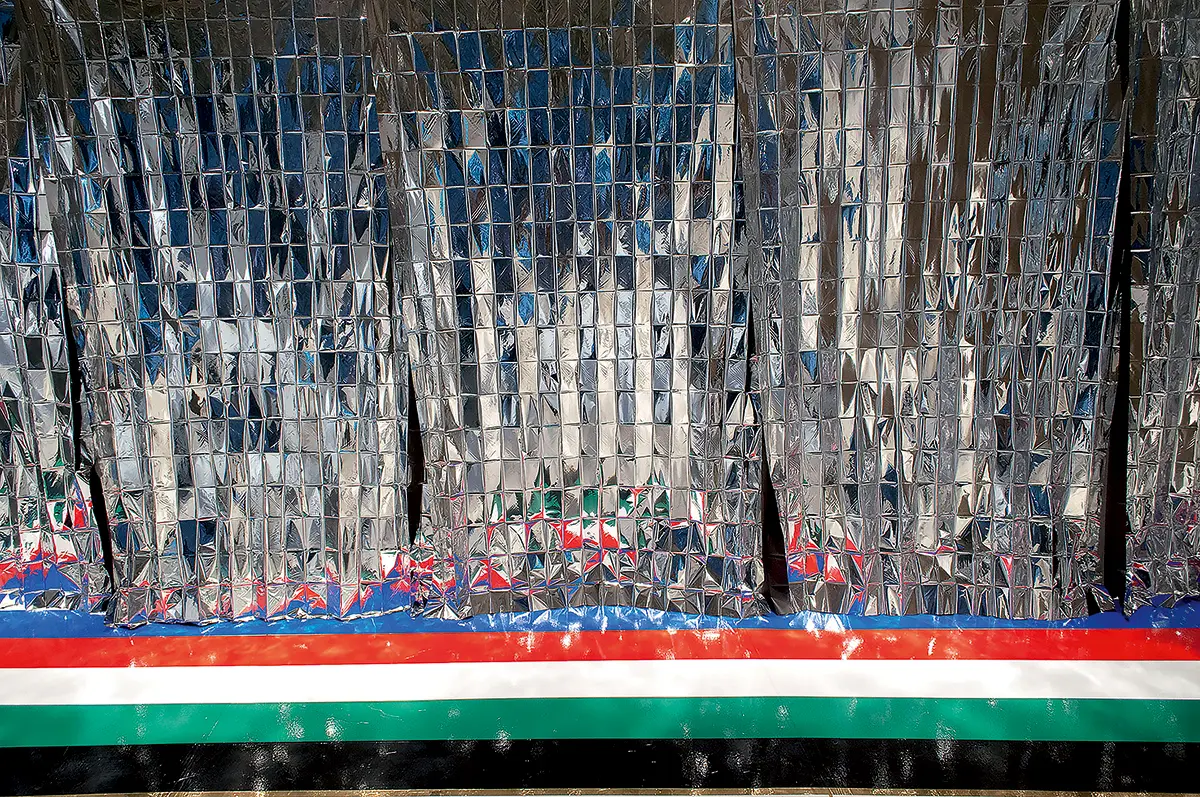
One of the show’s most interesting works, specifically created for the occasion, is Bandera (Flag), an installation situated at the entrance to the gallery. Made from thermal blankets of the kind distributed to migrants after they are rescued, this work probes and critiques the fragile identities that traverse the problem of migration. Several of these blankets with their many creases and wrinkles are installed on the wall; on the floor are color ribbons corresponding to the flags of the migrants’ countries of origin or of destination. An observer standing in front of the metallic material is confronted with a diffuse figure, indiscernible at first sight, an almost-hybrid identity like those produced by the economic relationships that Esquivel has engaged in several works since 2010. We could say that he finds, in places of diffuse boundaries, possibilities for the unfolding of existence.
The exhibition also includes the presence of three artists invited by Esquivel to participate, both for their status as migrants and for the site of enunciation of their works: Nataliya Petkova (Bulgaria-Canada); Nuttaphol Ma (Thailand-USA); and Michael Conti (USA-Alaska). This show adds to Lokkus’ efforts to refresh the art scene in Medellin since 2013. With the purpose of providing artists with a space for the promotion, circulation, and commercialization of their work, Lokkus has presented exhibitions that foster new readings of the visual production of local, national, and international figures. Among the artists whose work has been seen in this space are John Mario Ortiz, Aníbal Vallejo, Luisa Roa, Juan David Henao, José Moreno, Jaime Franco, Alberto Lezaca de Paz, Simón Vega, and Abigaíl Reyes.
JORGE LOPERA