
In one of the interviews given by Miguel Cárdenas (Bogotá, 1973) about his exhibition Metamorfosis (Metamorphosis), he was asked about what the experience of living in New York City has given him. “The possibility of thinking way beyond something that cannot be done, that cannot be conceptualized,” he answered. He was talking about the advantages of seeing extreme things in the context of the frenzied city where he lived until very recently—things that would perhaps be merely impossible dreams if he had not traveled. Impossible and extreme things that he releases in large doses. After more than a year back in his native Bogotá and three solo exhibitions since his return, Cárdenas’ work is a forceful affirmation of the challenge posed by the Big Apple. Using a fresh, unprejudiced language that is open to experimentation within the framework of such commonplace practices as painting, drawing, and sculpture, Cárdenas revises and unsettles artistic languages rooted in recognizable historical movements like the Surrealism of the inter-war period, a sufficiently subversive move so as to, in my view, not pass unnoticed. On the other hand, and precisely by means of his pickings from the past, he has been able to develop a vision and a language of his own in order to reveal and narrate stories about the world he inhabits and how it will be seen in an archeological future.
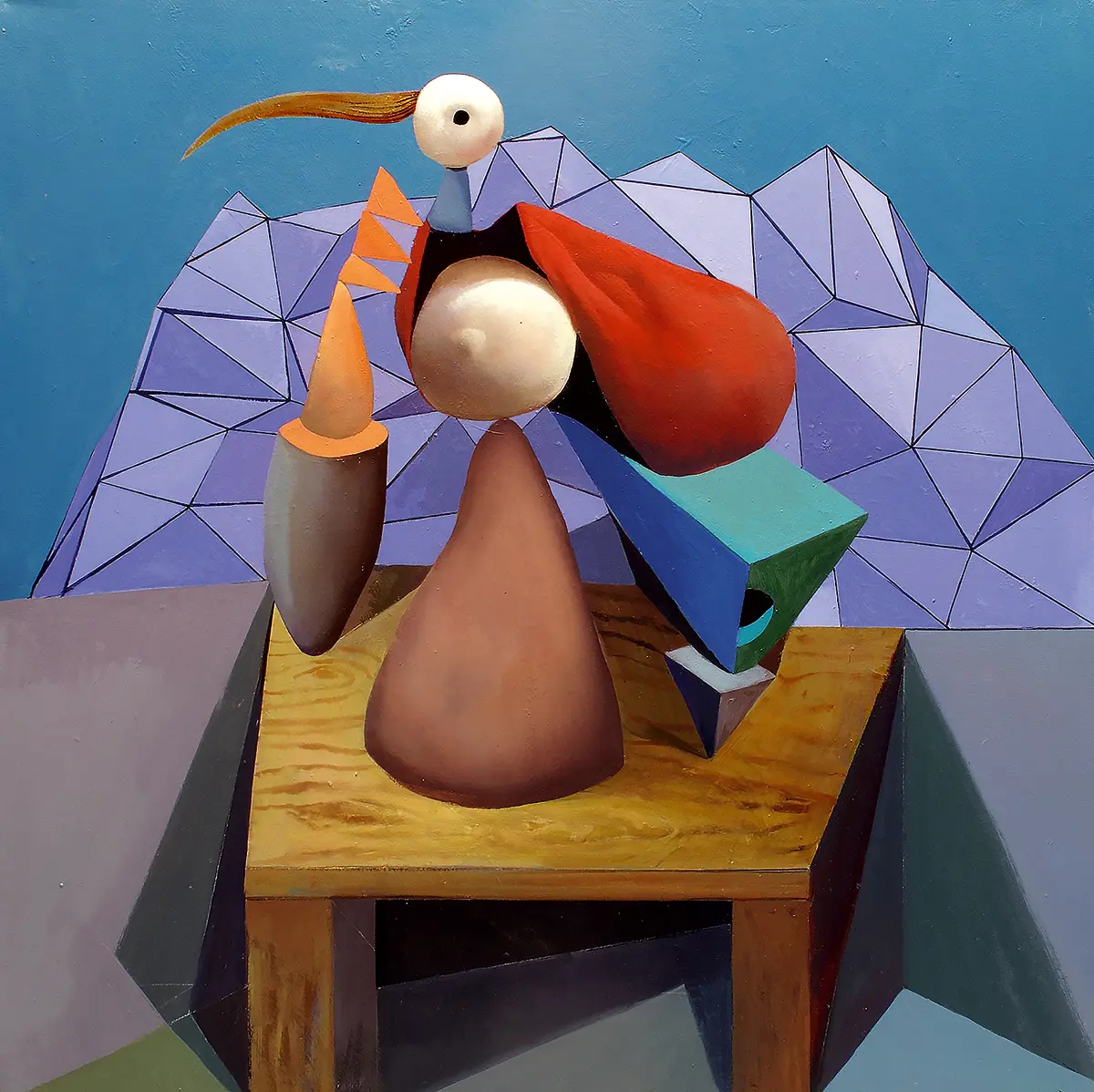
Although works of this kind appeared in previous exhibitions, not too long ago, it is perhaps this compilation of some fifty artworks at La Balsa Arte that best materializes Cárdenas’ mature personal vision. His work escapes labels and regionalisms; he can hardly be said to be a typical representative of Latin American contemporary art since his vision points towards something universal, a post-Anthropocentric world where Man and Nature have become one, or at least a world where Man does not rationally dominate our days. We encounter a world that emerges from fragments from the history of art and avant-garde primitivism, presenting us with hybrid bodies, half-man, half-animal, as in Sueños del mandril (Dreams of the Mandrill), or fragments of bodies that come alive, like eyes, chests, and mouths that come to represent, as parts for the whole, almost recognizable beings, as in El Descubrimiento (The Discovery) or Figura y sol (Figure and Sun). We also encounter sculptural installations that refer to the museum apparatus, especially of Natural Science museums, that Cárdenas uses to deploy his idea of evolution on Earth and of humanity, on which the origin and evolution of art are rooted as though they were archeology for the discovery of our present.
In Metamorfosis, Cárdenas has intended to return to a very primary language, which, although realistic, seeks to communicate more abstract concepts. In other words, Cárdenas’ realism—filled with humor, playfulness, and markedly Miró-like on occasion—is a vehicle for talking about the return to an instinctive and intuitive animal world that uncovers what lies beneath the thinking man shoehorned into rationalistic society. In that sense, the surrealistic references are very appropriate as a metaphor, as they connect with the idea of the subconscious, of the irrational as an invisible engine of our being and our actions. We encounter slobbering dogs, dentate genitalia, eyes or jaws instead of faces, landscapes where human traces, if any, appear in the shape of bones, as though Man were a future archeological find, as in Fósil en el desierto (Fossil in the Desert), and the reality of the present were that purely animal instinct. Besides situating human beings in the position of archeological remains transformed into animal instinct, Cárdenas pursues an interest in nature and the landscape that developed precisely from being at a sufficient distance from both, as he has explained in interviews. Despite that distance, nature does not represent the romantic and nostalgic vision of a more pristine and unpolluted world; neither does it situate us in a post-apocalyptic world resulting from natural disasters caused by humanity. The nature of Cárdenas’ world exists by its own rights, proudly standing in the future in which humanity has left nothing more than a slight traceable mark. There is no trace of nostalgia, either, in Cárdenas’ salvage of the surrealist aesthetic of the historical avant-garde, or a desire to glorify a European tradition. Rather, Cárdenas makes conscious affirmative use of his sources, since his work corresponds to a contemporary dream intent on moving forward and imagining the impossible, beyond the established, deeply rooted traditions seeking to negate the contemporary in art, even if disguised as that very thing.
CARIDAD BOTELLA