
Norman Mejía (1938-2012) established himself as a signal figure in the history of Colombian art in 1965, at the age of 27, when he won First prize in painting at the 17th National Artists’ Salon with La horrible mujer castigadora (The Horrible Punishing Woman). He is a signal figure, a landmark if we take into account what that recognition meant, on the whole, a point of reference to understand the paradigm shift promoted by Marta Traba, who was a member of the Salon jury that year. Also winning awards alongside Mejía was Pedro Alcántara Herrán, in Drawing, and Feliza Bursztyn, in Sculpture, which triggered a raging debate in the media, to the point that Traba renamed the Salon “the 17th Battle.” It was all in response to Traba’s bold gambit in favor of three young artists in whom she found a significant point of difference with respect to what others were producing.
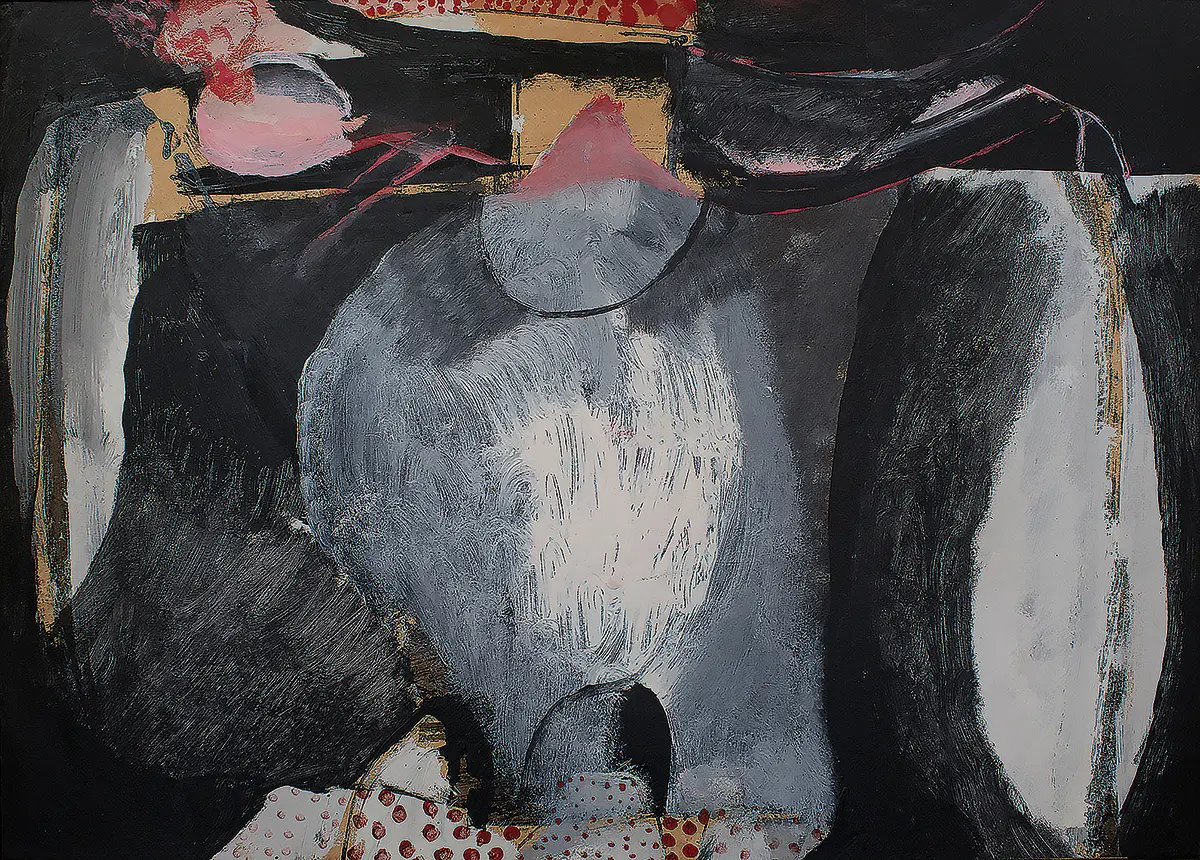
At the time, every review and critical assessment written about Mejía’s pictorial work focused on the abjection and the violence it represented. A quick recount of the adjectives used will reveal many terms signifying excess, such as “macabre”, “tempestuous”, “pessimistic”, “terrible”, “visceral”, “laughable”, “brutal”, “raw”, anti-Romantic”, “unstable”, “anguish-inducing”, “horrid”, “dramatic”, “irrational”, “absurd”, “helpless”, “bled dry”, among others. This is perhaps why in 50 años, Salón Nacional de Artistas, a book published by Colcultura in 1990, there is a comment about the evasiveness of Propal when it came to adding the Prize-winning work to its collection. This entire episode is the “origin myth” for an artist who was highly sensitive to the dark historical period the country had just lived through in the 1950s—a painting that is seen as reflecting the era’s pessimism and as an expression of the brutality and the violence coming from all side in the conflict.
The exhibition at Museo Rayo, curated by Miguel González, features 22 paintings from the period between 1963 and 1966, the most characteristic and significant in Mejía’s oeuvre, which continued away from the circuits, events, and exhibition spaces of the art world. It offers a perfect opportunity to revisit the debates of the 1960s around his work and to consider, at a historical removal, the implications of art as a document (if we see Mejía’s work as a barometer of violence in Colombia) and its potential when it is studied with the acuity of a Marta Traba. Rather than reinforcing or countering the arguments of the critics, this exhibition presents us with a unique case in the history of Colombian art, one that unfolded between Traba’s attempt to radically change the local landscape and the results of a work of considerable rawness and shock value.
Mejía had his first solo exhibition in 1964, at the Museo de Arte Moderno de Bogotá. The titles of some of his works were controversial and uncomfortable for the audience: No disparen, que somos dos (Don’t Shoot, There’s Two of Us); No disparen, que estoy muy herido (Don’t Shout, I’m Very Hurt); La horrible mujer castigadora (The Horrible Punishing Woman); Desequilibrio de la horrible mujer castigadora (Imbalance of The Horrible Punishing Woman). These linguistic experiments were an essential component of the pictorial proposal, triggering connotations that made it entirely unimportant what movement or specific genre the works belonged to; although landscape, the body, abstraction, realism, and expressionism all melted into these paintings, outlining the boundaries of a style was no longer necessary, and the purpose became to undo all conventionality into a deformed amalgam that reached beyond even the most personal domains.
Marta Traba’s battle, in which Norman Mejía was one of her weapons, consisted essentially of awards not given to long-established artists and painters whom she saw as domesticated and mannered in contrast with the activism that the era demanded. Her gamble for emerging artists represented a paradigm shift, later reflected in young-art salons, in changes to the pace at which artists became established, and the faster circulation that came with contemporary art starting with conceptual proposals, seen as “young”. Another argument built around Mejía’s work was its character of “symptom” or “expression” of a macro-historical spirit, embodied, in the international painting context, in a kind of exacerbated sensibility reactive to global stimuli materialized in the particular. Mejía’s interest in color, in the varieties of gray, in exploded figures halfway between abstraction and figuration, was taken to be a rejection of the harmonious; his difficult, anti-schematic compositions were a response to the global political context of the Cold War, US interventionism, the emergence of the Colombian guerillas and the evolution of the original Liberal vs. Conservative violence of the 1950s. Nothing was OK, and art knew it.
BREYNER HUERTAS