
The horizon line is the calibrator of our visual perception. But that horizontal trace that surrounds the world also curbs the progress of our senses. “The horizon represents the failure of vision because it is only a referent of that which we think it is. This is why we must go beyond the horizon,” says multidisciplinary artist Oswaldo Maciá (Cartagena, Colombia, 1960), a sculptor of space who shapes the environment through the creation of an artistic imaginary of aromas and sounds, as he invites us to expand our sensitive horizon and transgress the confines of our gaze.
His exhibition titled Equations (Olfactory-Acoustic Sculptures), currently shown at the Sala San Antonio Abad-Centro Atlántico de Arte Moderno (CAAM) exhibition space in Las Palmas de Gran Canaria, consists of three artistic installations of visual, sound, and aromatic environments that question the hegemony of the gaze and challenge the rest of the senses to awaken the dormant territories of our poetic memory. “This is the question that has always intrigued me: from what you see, what do you think you know?” stated Maciá in his Guía para Crear Una Pregunta Incómoda (Guide to Create an Uncomfortable Question), written on one of the walls at the San Antonio Abad space. “The visual world is saturated with simplistic symbolisms easily recognizable and debatable using what is known. The vision is full of ‘I know.’”
Confronted with the reductive “ocular-centric” curtain, Maciá’s work reformulates the concept of art as a sensorial experience in which to read the space with the senses. “Sculpture does not exist without space and vice versa. This is the reason why each viewer becomes, consciously or unconsciously, a unique part of the sculpture. And this is how the sculpture progresses. I like the idea of a work in progress that involves and questions viewers and continuously creates new forms of reflection and knowledge,” affirms Maciá.
Created expressly for the Sala San Antonio Abad, his first proposal welcoming visitors at the CAAM exhibition in Las Palmas de Gran Canaria is the acoustic-circular composition titled La Fábula del Viento (Fables of the Wind). It consists of a large red curtain that upholsters 32 meters of wall and covers a recorded sound map of winds from Europe, Latin America, and the Caribbean roaring from sixteen audio channels. This sample of sound textures floods the space with the howling of “the migratory winds moving back and forth across the Atlantic,” recorded by Maciá himself in borders and along coastlines in different corners of the world. The motif of the red curtain gravitates around acoustics, a notion developed by Pythagoras that consisted of teaching his classes behind a curtain so that his disciples would not be distracted by visual stimuli. This enveloping atmosphere in La Fábula del Viento creates an allegorical space at the Sala San Antonio Abad that evokes and projects universal notions such as emigration, the journey of ideas or the music at the borders, like a metonymy that establishes at the same time the things that bring us together and those that divide us.
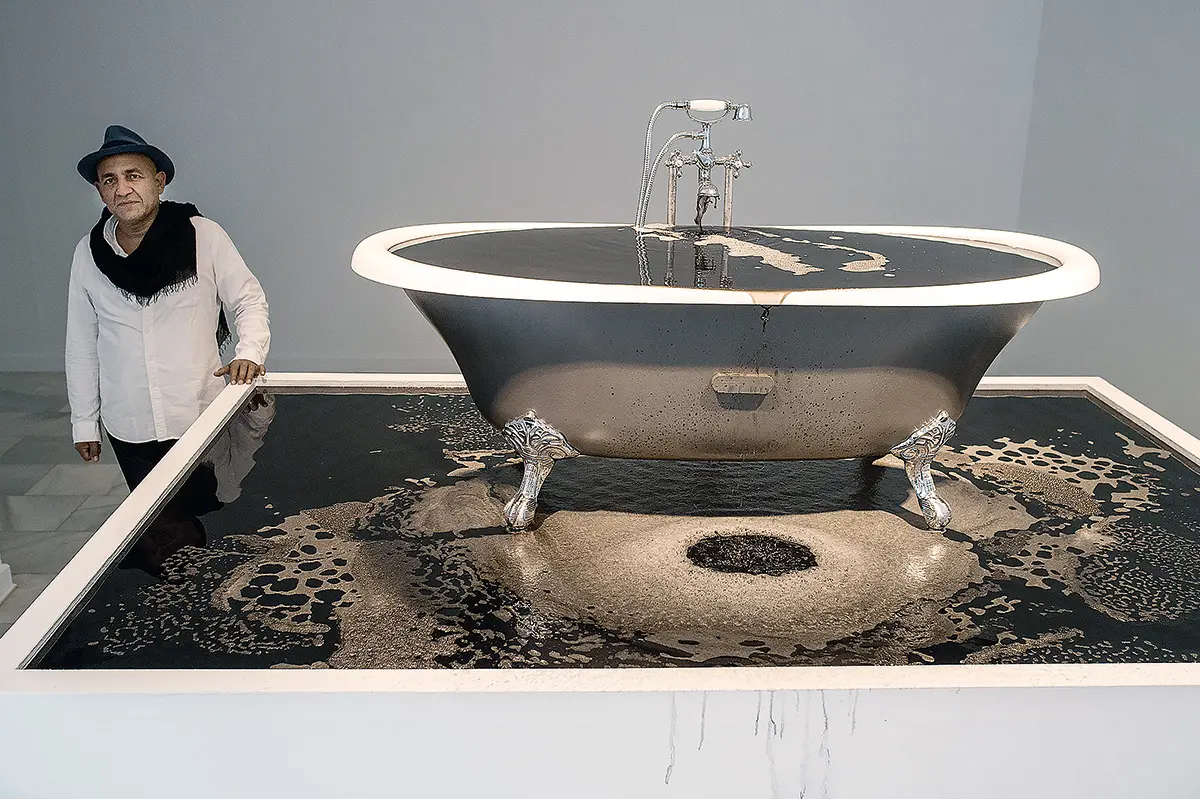
The second proposal in Equations (Olfactory-Acoustic Sculptures) is titled Bajo el Horizonte (Under the Horizon). It is articulated around a white bathtub overflowing with a black liquid perfumed with aromatic molecules, where a new repertoire of sound symphonies and synesthetic connections are interwoven. The placement of this mundane household furniture in semidarkness reinforces an almost cinematographic mise-en-scène that challenges viewers to explore the horizontal nature of the space through smells and sounds. Once again “the immeasurable horizon line is used to navigate from one place to another because it is a line where the vision is calibrated. And we have to go further.” Maciá vindicates color because “it does not have a language, it is the most democratic of the senses and sets the other senses in motion.” Maciá reveals that his olfactory-acoustic sculptures are directed to the qualia, which in Latin means “the response of the perceiver, the individual experience that awakens and is unique in each person.”
The last piece of the exhibition is the sound-visual piece titled Volucrarios (Volucrary). There, ten impressions on the canvas, depicting birds in the process of being extinct or already extinct, pay tribute to the medieval bestiaries on the symbology of birds. The proposal drew inspiration from the book Le Jardin de santé written by a German doctor and naturalist Johannes de Cuba (1430-1503). In the book, Cuba described more than 122 birds with characteristics assigned by the most relevant research by the classics. Vertically designed in the patio of the cultural center, this section reclaims the symbol of the border and flight by drawing analogies with birds given that, according to Maciá, “there is nothing more universal than migratory birds.”
NORA NAVARRO