
The mediums and materials used by Anabel Quirarte and Jorge Ornelas for the construction (I believe this noun is fitting) of their pieces play with the ambiguity ultimately implied in their supports. The idea prevails over the material. The presentation is like a ghost repeated between the lines and shadows of the geometric figures rendered either with acrylics on canvas or through concrete castings. Left behind, for the time being, is their reliance on conventional objects (from stools and pencils to cassettes and books) that came to characterize their work (which also continuously evidenced the materials that they pretended to negate with their constructions), but the duo’s goal—if it can be called that—remains the same and they approach it from a place where the ideal and the abstract cannot be told apart. In the field of meaning that opens (or closes, according to the intention) in their work, the “place of” has been replaced (or relocated) by more subtle materials (not to say more obvious or suitable). But it continues to be a questioning of the materials (which, I insist, can be passed as conventional) and can be described as a reflection that sets the sense of representation against its material substrate.
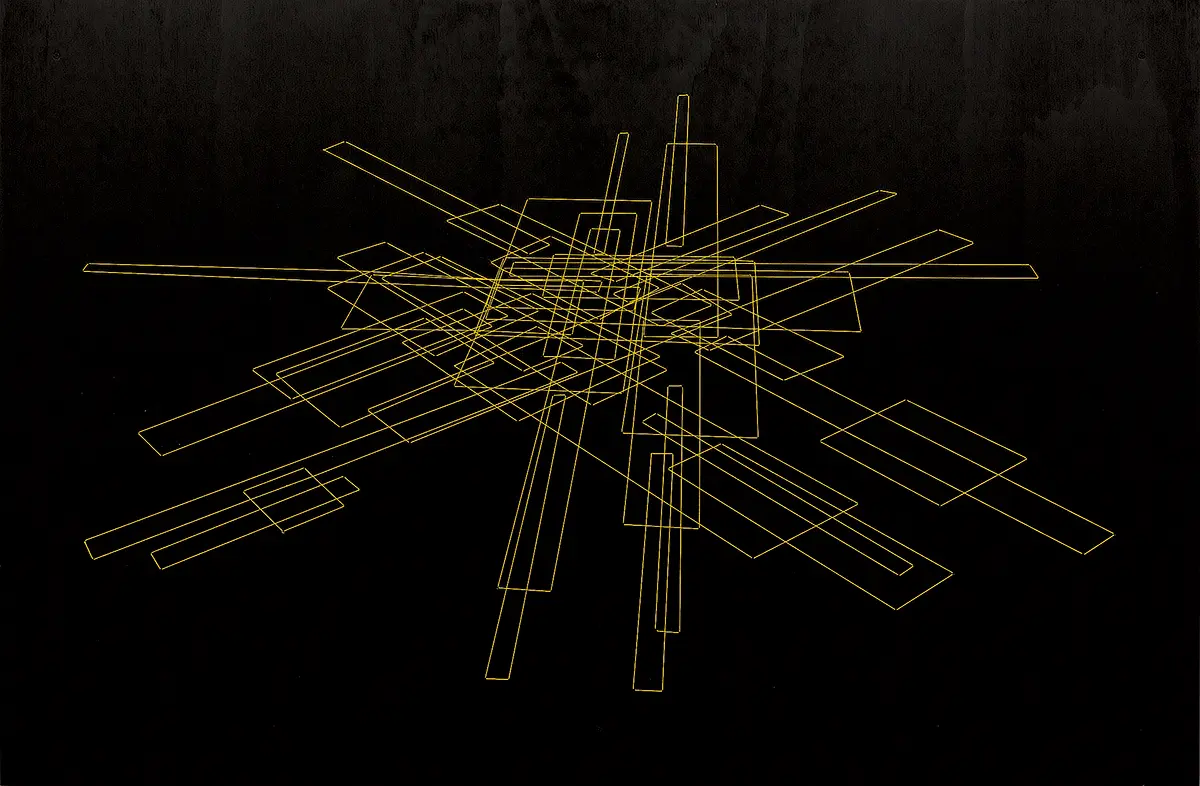
Quirarte and Ornelas sublimate something that could be described as a rhetoric of the assembled. Throughout their work, such rhetoric has analyzed, unfolded, and substituted the bodies and lines that define the geometric tensions to their pieces into plays where chiaroscuros have substituted the superimpositions, leaving only the illusion or appearance of three-dimensionality. This intent becomes more dramatic, for instance, in the concrete castings in which geometric bodies have been foreshortened (to become the appearance of the evident) through plays of light and shadows. Here, as if making a grab for the essential, the duo continues to face with more or less humor the paradox that is the materiality of the elements that play a role in the composition of their works (and that are and are not the work itself).
Materials, substrates, and intentions are defined depending on the generic titles that they choose to give to their works, whether they are extrapolations, modular professions, or constructive planes. The case-specific extrapolations were assembled thread or PVC and wood. They consist of sculptures (they could be described this way) put together through the superimposition of black, white, grey, and orange surfaces (whether virtual or not) that generate different patterns and compositional tensions.
Following the conceptual play of substitutions that the work by Ornelas and Quirarte project beyond the geometric, I find a simile in the ambivalence between matter and content that defines the work—that which the work is and that which which which it replaces. The definition of “extrapolate” found in the dictionary of the Real Academia Española (RAE) is as follows, “To apply to a given sphere conclusion obtained in another.” But it is also “To find the value of a magnitude for values of the variable that are outside the range.” The word “extrapolate” is formed—as it is explained—by replacing the prefix “inter” found in “interpolate” for the prefix “extra.” If their extrapolations can be described based on the first definition, then there is the temptation of wondering whether the definition of the mathematical extrapolation applies in this case; in that “place of” outside of the material that constitutes (or wants to constitute) the final work, and that it is accomplished by replacing the elements and the values that they are given in one field (the immanent one) or the other—which weighs in (and instead of) the material.
The modular progressions are representations of compositions created from geometric bodies with two mediums: acrylic on canvas and concrete casting. The illusion of three-dimensionality found in the former contrasts with the hollowness that characterizes the latter (formats are similar). This allows us to observe an apparent continuity between the plays that are possible between the second and third dimensions. The materiality of the work becomes a wrap or film that covers that (idea or concept) which is absent. The constructive planes, armed with hemp wire and acrylic on three-ply, are transcriptions of the compositional fields of tension that we observed in the extrapolations. In appearance, they are reduced to a two-dimensionality (the thickness of the hemp wire) that it never actually is. Once again, they have replaced the works as physical manifestations (or transfers into the material realm).
RICARDO POHLENZ