
Escultura impermanente (Impermanent Sculpture), by Rita Ponce de León (Proyecto Amil), contrasts the different temporalities of the work of art and of experience, exploring the relationship between motion and perception by putting it in play in the works on exhibit.
In a very overt way, Ponce de León connects drawing—the format that dominates the exhibition—with the body, establishing symbolic bridges between the production and the reception of art, which is to say between the artist and her audience.
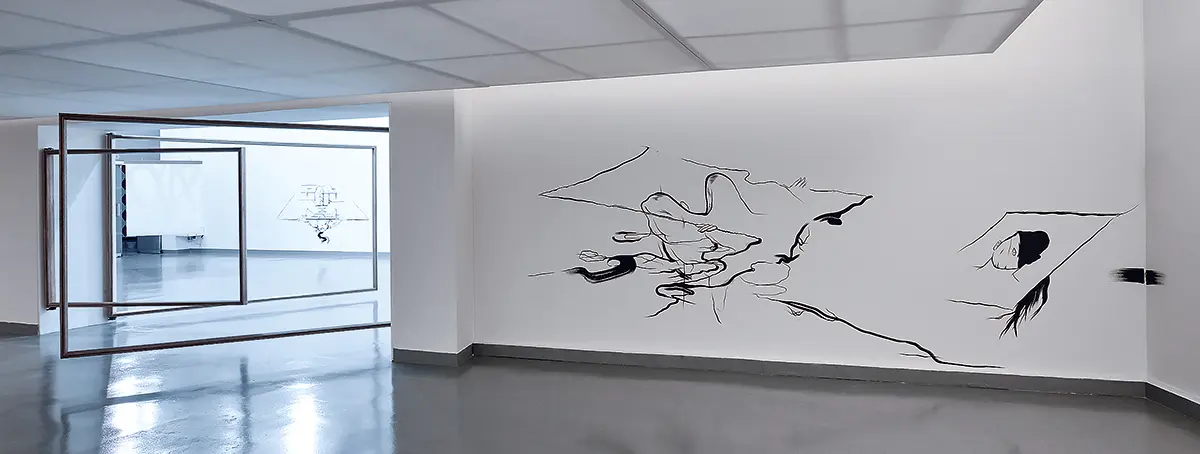
To that end, Ponce de León deploys both graphic elements (figures, frames, perspectives) and formal resources (scale, materials), as well as display strategies (placement, lighting). The vastness of the motion that is involved in the drawing is registered in the different scales employed, be it in the large China ink mural painted directly on the gallery walls or in Ponce de León’s small pencil on paper drawings. This game of scales guides our motion across the gallery, bringing us closer or driving us away from the works in order to appreciate images small or large. In this way, our spatial trajectory functions as a correlate to the artist’s own motion in the production of these works, be it her body moving along the walls (murals) or her hand on the paper (drawings).
This idea is iconographically reinforced in the murals on exhibit in the first gallery: En prisión (In Prison, 2017); El infierno es blanco y resbaladizo (Hell is White and Slippery, 2017); Infierno (Hell, 2017; and ¿Por qué nos erguimos? (de dos patas a una sola pata) [Why Do We Stand Erect (From Two Legs to One Leg), 2017]. These seem to activate the subject of spatial trajectories and locations via the use of horizon lines, truncated planes, and games of perspective.
Our passage to the second gallery is regulated by a new version of ¿Cómo desaparecer una puerta? (How to Disappear a Door? 2017), which comprises three large wooden frames attached to the threshold like overlapping doors. These frames create a porous boundary that nevertheless sets up a transit space that must be engaged by auction or negotiation. In the first case, to the degree that the frames must be moved or one must pass through them; in the second case, because for two people to cross the threshold simultaneously, some kind of agreement about the positioning of the frames is required.
The experience provided by the second gallery is markedly distinct from the first one. It has been transformed by the artist, who lowered the ceiling significantly and switched from cold to warm lighting. This makes it possible for the architectural space to be experienced more in accordance with the body and its proportions.
The false ceiling covers a good portion of the gallery area, but not its entirety. It leaves three free sides through which we can see the system employed: the ceiling is revealed as a floating surface, almost like a horizon line. Situating ourselves on one of those sides allows us to see at the same time both architectural scales—referred to the different perceptual experiences—that the installation contrasts, as they converge on these intermediate zones.
A large untitled mural (2017) depicting an extended upside-down landscape covers the back wall almost in its entirety. This mural is at first seen from below the false ceiling, which at times truncates the image; as we come closer (and leave the area covered by that ceiling), we can see the mural in its full height, but cannot apprehend its entire horizontal extension. This seeming limitation of architecture invites us to reflect on the relationship between body, architecture, location, motion, and perception.
A different range of relationships is proposed in Reúne vida, mientras cuelgues de esta tierra (Gather Life While You Are Still Hanging From This Earth, 2017), an installation that prompts us to establish connections between touch, gaze, and body. On a square table surrounded by six chairs are six warm ceramic sculptures (they have been set atop warmers), and across from these are six drawings. We are invited to manipulate, associate, and play with them, and to dialog with other visitors.
In Escultura impermanente, Rita Ponce de León calls upon us to reflect openly about perception in context. It is a context that, rather than exhausting itself in the concreteness of a given physical and temporal situation, unfolds as a dense grid of connections—emotional, intellectual, sensorial—that mold our perception of the world and of our place in it.
MAX HERNÁNDEZ CALVO