
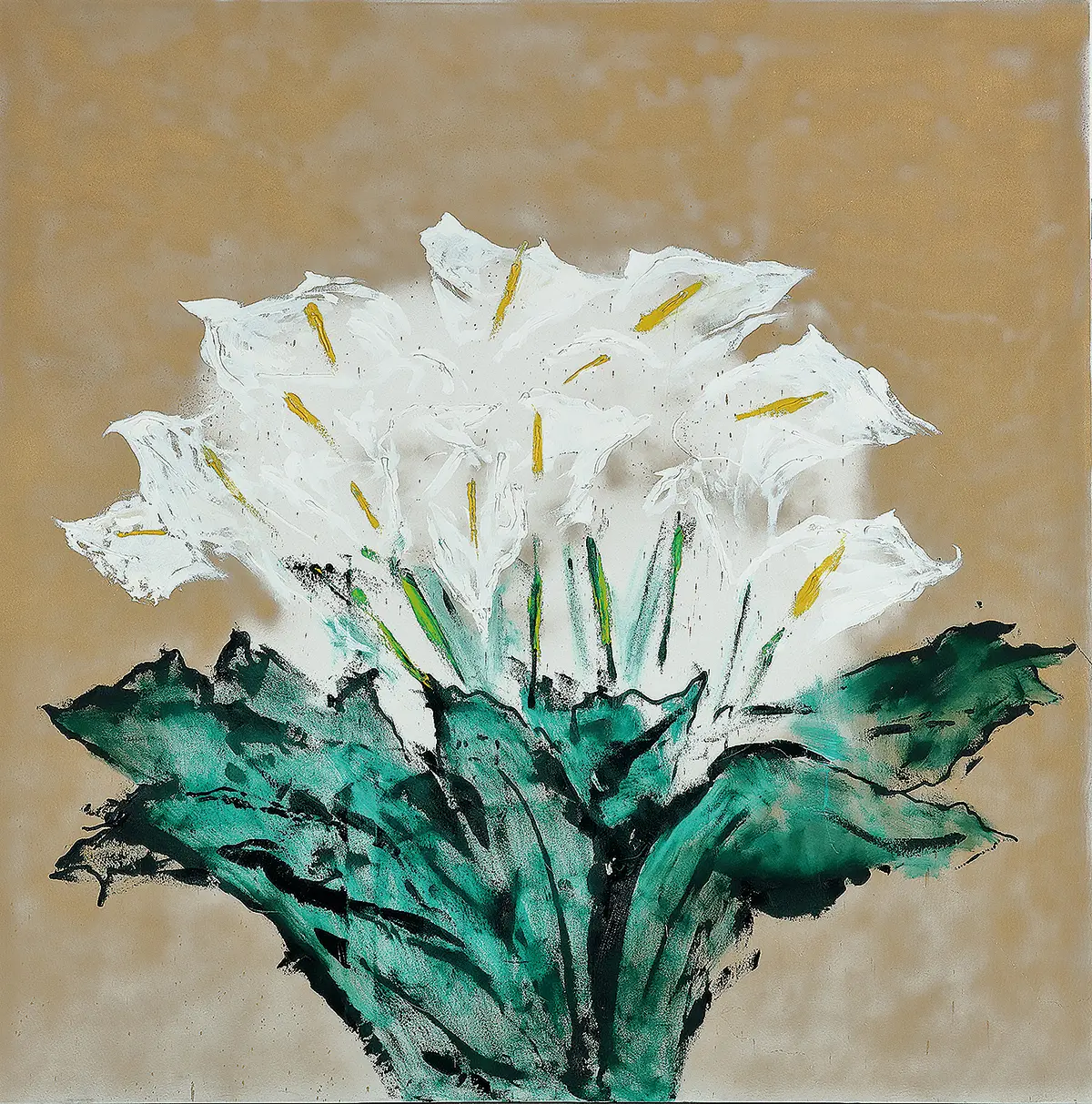
The outstanding Rómulo Macció passed away in early 2016. Shortly before the first anniversary of his death, the Vasari Gallery presented Pinturas 2015 (Paintings 2015), five large-format works that the artist created during his last year. Macció had just landed in Buenos Aires, coming from the placid seaside town of Punta del Este (Uruguay), when he collapsed as the taxicab drove him home from the airport. He never recovered. An artist who for almost sixty years was a relevant presence in the local contemporary art scene and, who made with his works much-enduring noise, left us thus in silence.
Born in Buenos Aires in 1931, Macció was a self-taught artist who from an early age developed connections in advertising and theatrical set design. He began to exhibit solo in 1956, at Galatea Gallery, showing paintings of an abstract bent, populated by blotches, shapes, and signs rather than by tidy geometries. Later, after a brief detour into surrealism and informalism, he began to emphasize the human figure with a renewed focus on the gestural. Working in that direction and also influenced by abstract expressionism, Macció was one of the founders of the Nueva Figuración (New Figuration) movement alongside Ernesto Deira (1928-1986), Jorge de la Vega (1930-1971), and Luis Felipe Noé (1931).
This symptomatic rupturist movement emerged in 1961 and evolved over the early years of the decade, a period marked by significant political, social, and economic shifts across the world. Engaged in a deep quest for creative autonomy, producing a kind of art that was tormented and scathing, the group rebelled against prejudices and opened the door to a freer style of painting, negating the antagonism between figuration and abstraction. New Figuration was one of the most meaningful avant-garde movements in Argentinean painting, although all of its members also developed paths of their own.
In the course of his long career, Macció preserved and protected this freedom because, as he put it, “in painting, painting is what matters.” After the dissolution of the group in 1965, Macció traveled to Europe and began a series of working sojourns in Paris, London, Medinaceli (a peaceful town in the Castilian plateau), New York, and Punta del Este. A citizen of the world, he also worked in the La Boca neighborhood, where he established a home-studio in 1983. Those city-and-water landscapes—large-format oils and acrylic—reveal an evident joy in painting while embracing the fears and expectations of immigrants, the beautiful immensity of the river as well as its pollution, the exhilaration of the area as well as its decline. Nostalgia and desolateness, along with light and motion, recreate stories of abandonment and beauty.
Macció’s 1967 retrospective at the mythic and influential Instituto Torcuato Di Tella—a multidisciplinary experience that lasted from 1958 to 1969 and fostered new ways of making and seeing art in Argentina—brought him early recognition. Macció’s work, born—in his own words—from the “simultaneous process of action and reflection,” received repeated awards and traveled to the São Paulo, Paris, and Venice biennials; it was exhibited internationally and was acquired into museum collections across the world.
The works on view at Vasari condense, in a way, Macció’s lifelong efforts and gestures and once again refute the oft-hyped death of painting. Here we find the features of his multifaceted production, which at various times included exuberant impastos of vibrant colors and figures that resemble industrial devices in the middle of large empty spaces, and focused mainly on the alienation of contemporary men and women, with a repertoire expressed with intense sensibility and far from any rationalization.
Curator Mercedes Casanegra says that Macció’s intent with these five final paintings was not to achieve realism, but something much more ambitious: to evoke—via pure abstraction, dense impastos, an accumulation of matter taken directly from the jar and modeled into fleshy petals—that mysterious quality of painting that is the transformation of the real into the supra-real, into a category bridging the visible and the invisible. A heartfelt farewell, Pinturas 2015 invites us both to a sensorial experience and an intellectual reflection.
VICTORIA VERLICHAK