
Dan Cameron’s curatorial proposal for the 13th Cuenca Biennial, held between November 2016 and February 2017, was Impermanence: The Mutation of Art in a Materialistic Society. Cameron’s concept can be interpreted as a critique of the drive to preserve works of art, which has given the material object and its containers a central role in history to the detriment of the experience and the memory of art. The latter can be common to all human beings, not only to the owners of artworks or collections.
Cameron’s curatorship appealed to the Buddhist notion of “impermanence” in order to reflect on the themes, media, and languages of contemporary art. But it also presented us with a specific way to relate to the works. Instead of holding on to an idea of durability that renders artworks as something akin to the monumental constructions that perpetuate the symbols and subjects of power, the proposal was to flow along with the shifting nature of real phenomena. Approaching art in that way attunes us to the fragility of the human body and favors an acknowledgment of the importance of the present. Against the conservationist drive, strongly connected to the ownership of works of art and their speculative trade in the global market, Cameron emphasized the human side of artistic creation and the possibility of using art as an instrument for the analysis of the reality around us and for the sharing of worldviews.
The selection of works in the Biennial set these ideas in dialog with the exhibition spaces. The sites were organized into two circuits: “Historic Downtown” and “Tomebamba River.” This arrangement responded perhaps to logistical needs, but it also underscored the urban reliefs of a city that sways between its historical memory (heavily tilted towards the colonial period) and its privileged relationship with nature, in particular with its rivers. Cuenca unfolded like a stage for the experiencing of art. The Biennial’s visitor walks can be understood as practices of appropriation of the city—its textures, traces, and narratives—along paths that differ from those imposed by real-estate capitals and service providers.
In connection with the curatorial concept and its critique of the commercialization of art, Cristóbal Zapata, Executive Director of the Biennial, assumed responsibility for eliminating all financial compensation from the competition. From now on, awards are honorary and named in reference to the country’s cultural memory. This decision had deep repercussions in the local scene. On the one hand, some saluted the refusal of a monetary yardstick in the valuation of art, but others raised their voices to argue that the move was not appropriate in a local context where sources of support for the arts are extremely scarce.
The jury conformed by Guadalupe Álvarez, Gaudêncio Fidelis, and Bernard Marcadé granted the Biennial’s Awards to José Carlos Martinat (Peru), Oswaldo Terreros (Ecuador), and Cao Fei (China), and Honorable Mentions to Carlos León, Oscar Santillán (Ecuador), Ignasi Aballi (Spain), and Asli Cavusoglu (Turkey).
The roster of Latin American participants included both well-established figures and emerging artists; this was particularly true of the Ecuadorian delegation, whose proposals appealed to domains of art that, in their complexity and difference, exceed the symbolic borders of the Biennial. But before reviewing some specific examples, let us consider the particularities of the Biennial’s inscription in the Ecuadorian art scene.
A Biennial in Process
For three decades, the Cuenca Biennial has called upon local and international artists to think contemporary art from Ecuador. Each edition has sought to foster encounters and exchanges with cultural agents from across the region, in order to confront the debates that occur inside the country with an external gaze. Many specialists and artists were invited1 to collaborate in the construction of the Biennial, yet the event always encountered difficulties. It was born directionless, devoid of a horizon of ideas of its own, and it evolved over several years as an event instead of as a long-term project. The Biennial’s history is the history of cultural institutions in Ecuador, albeit with better fortune. Since its establishment in 1987, the Biennial’s activities have been uninterrupted despite the dearth of official policies in support of the arts or an established market that could promote the involvement of the private sector.
Yet, in spite of these conditions, the Biennial’s contributions are not limited to programming content for shows and events. The efforts of the team led by Cristóbal Zapata have responded to the need to generate educational processes via the arts. The period between biennials functioned as preparation in that sense, with the organization of exhibitions and curatorial projects devoted to subjects like the Jewish presence in Cuenca, the local scene in Loja, or the role of movie theaters in the collective memory. Paraísos perdidos: revisitando los cines de Cuenca (Lost Paradises: Revisiting Cuenca Movie Houses) was a public-insertion proposal involving emerging artists in the city. Such initiatives evince the will to expand the Biennial’s lines of action, a welcome attitude in a cultural scene suffering from deep structural problems.
It is hoped that the new Organic Law for Culture helps strengthen the arts landscape in Ecuador, but the fact remains that emergent cultural agencies are best expressed by citizen initiatives. Such is the case of the Cuarto Aparte (A Separate Room) project, organized in parallel to the Biennial since 2009. It is an alternative space based on collective collaboration and participation, and it takes advantage of the presence of the Biennial’s public to activate an agenda that would otherwise not be met with the same response.
The existence of Cuarto Aparte confirms that the Cuenca Biennial does not represent the contemporary art produced today in Ecuador, nor does it reflect in their entirety the debates that take place in its many scenes. No single cultural project could today claim such political function all for itself. Although the Biennial is the country’s most visible contemporary art event, its key contribution rests not on its representation of an idea of art but on the configuration of space for the coming together of diverse local and international publics. This coming together takes place around high-quality curatorial, publishing, and educational proposals, and it plays an important role in the projection of Ecuadorian artists into the international scene.
An art biennial is a cultural-political project supported on specific criteria2 about art and its spaces, histories, and memories. Does this make sense without a legal framework that guarantees the cultural rights of individuals, however? Ecuador’s forward-looking Constitution is only weakly reflected in the practices of the country’s institutions. The Cuenca Biennial is not immune to these problems, but it does have the merit of persistence. It is the only public institution in Ecuador that systematically promotes the circulation of contemporary art. Let us now turn to the curatorial proposal for its most recent edition, and to what it tells us about the art of our times.
In the Labyrinths of the Political
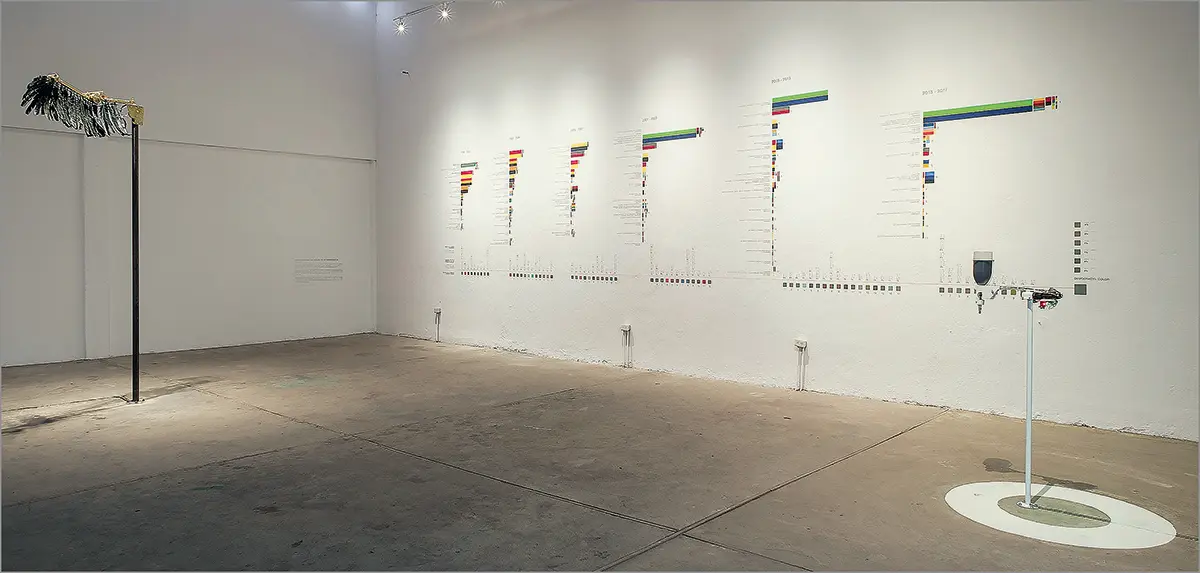
Ecuador’s recent political history was the starting point for Juan Carlos León’s multimedia installation Estrategias para encontrar el color de la democracia (Strategies for Finding the Color of Democracy), which deals with three important aspects of the country’s political life today: the nation-state; democracy; and the exercise of citizenship. The proposal was comprised of three elements that dialogued inside an exhibition space. The first element was a data visualization of the colors used by every political party and movement elected to a legislative function in Ecuador from 1998 to the present. The proposal sought to “find the color of democracy” by mixing the pigments that dominated each period. The result: a greenish-grey hue that gestures in the direction of Alianza País, Ecuador’s current governing party and also the majority party in the National Assembly for a number of years.
The second element in León’s installation, a prototype for a robot condor wing (in reference to one of Ecuador’s national symbols), moves according to tweets published by State functionaries in their social media accounts. The third element is a “liquid” data visualization. Using this technique, León launches a critique of the construction of images of the contemporary nation, and of representative democracy as an effort towards social equality that becomes increasingly problematic in the face of contemporary differences.
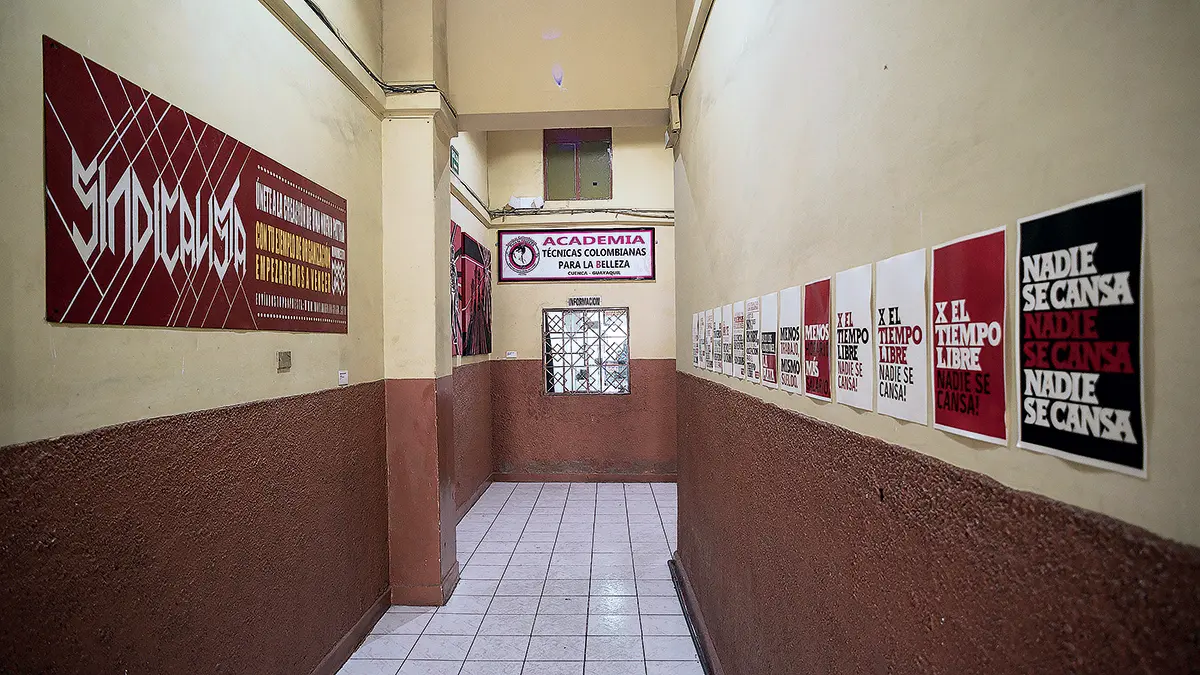
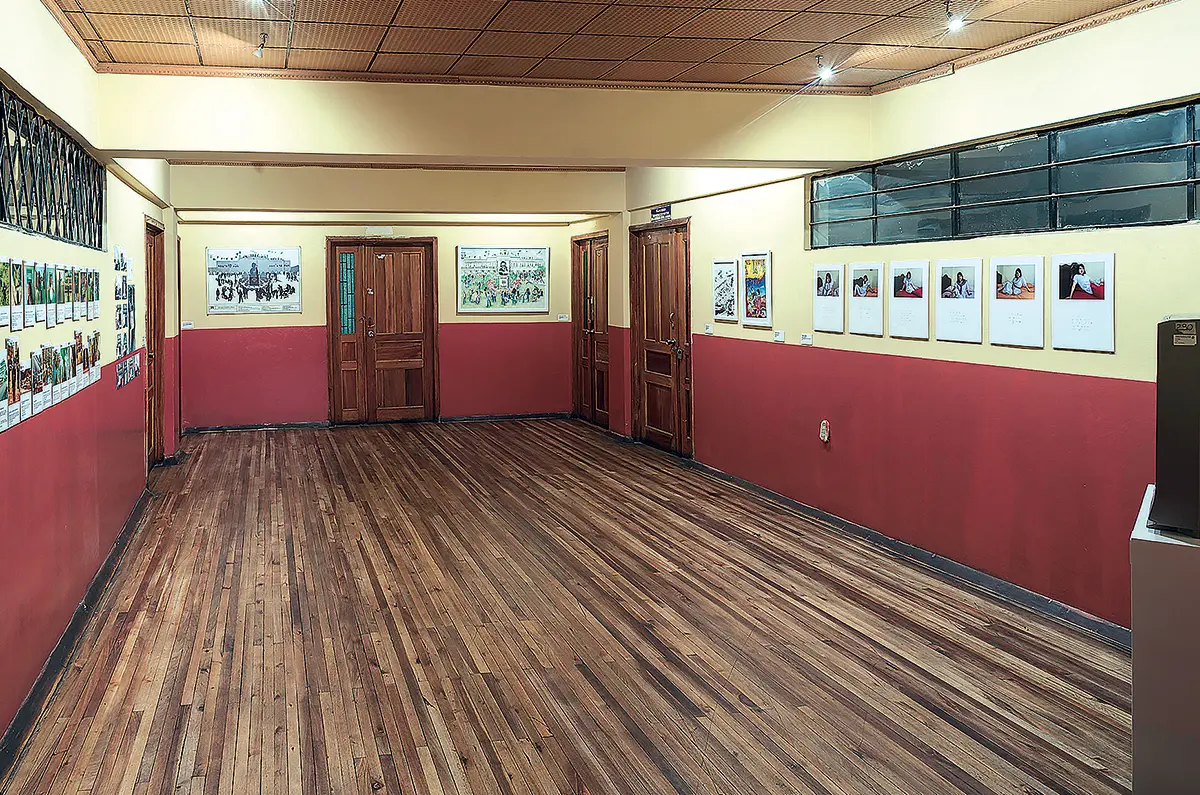
Along different political lines, Oswaldo Terreros presented his Gran Encuentro Capítulo 6: Sede Social para el libre esparcimiento del Movimiento GRSB (Great Encounter Chapter 6: Social HQ For the Free Relaxation of the GRSB Movement) at the headquarters of the Azay Workers Federation. The GRSB “movement” is, in reality, an artistic project developed over the course of more than seven years on the basis of a critical reading of Latin American political propaganda, Russian constructivism, and graphic design. In accordance with the Biennial’s concept, the curatorship for this show posited the need to recover the notion of free time from the capitalistic logic of salaried work, indoctrinating education, and the entertainment industry. The show included a number of local artists and had as its centerpiece Entrega del progreso al pueblo (Delivering Progress to the People), a mobile mural that gestures towards the legacy of 1930s social realism in Ecuador and its influence on the workers’ movement.
In these proposals, the political emerges as a reference but also as a critique of history and social reality. For Dan Cameron, however, “all art is political,” which must not be confused with a reference to the content of the specific works, or what they say. There are nevertheless positions that transcend the artistic sphere. Such is the case of Pablo Cardoso, who is also an activist committed to the protection of natural ecosystems.
Nature and Culture: Art at the Boundaries
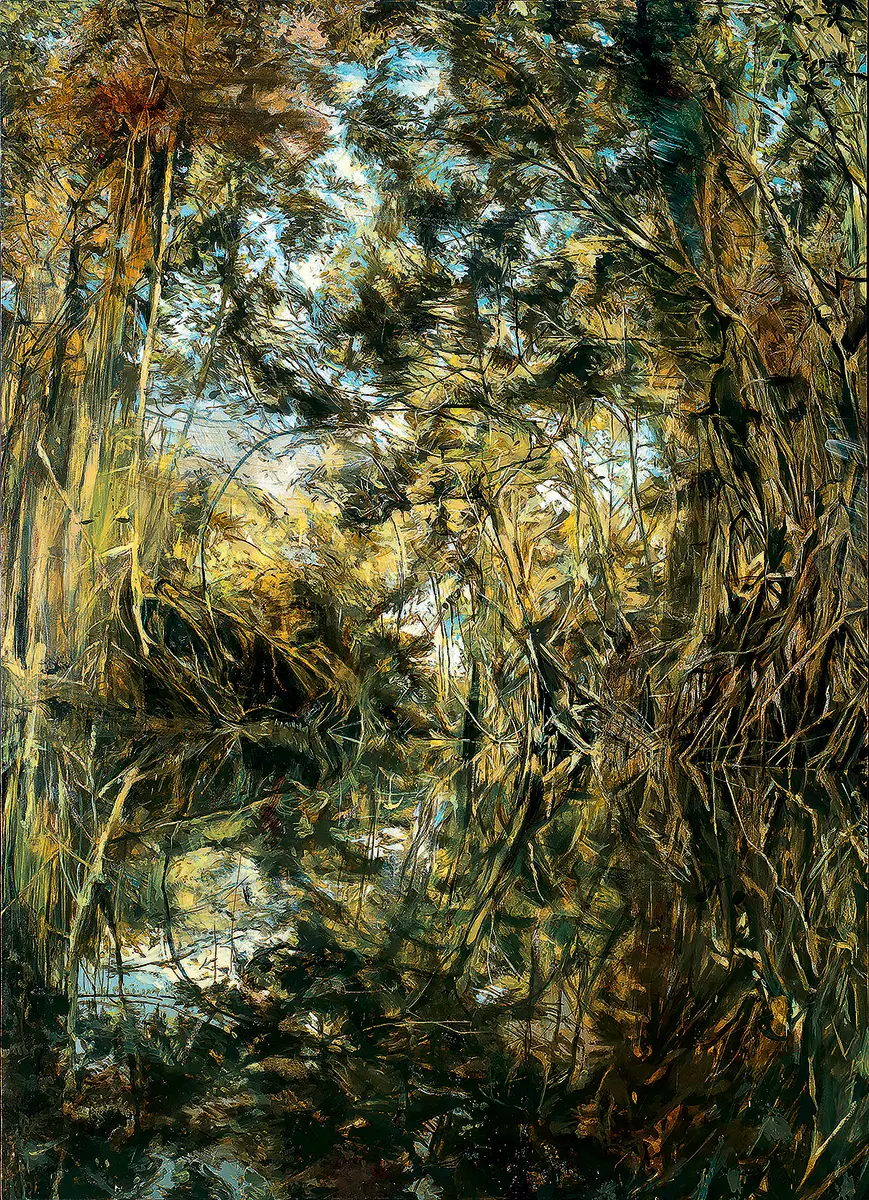
At this Biennial, nature played a central role ranging from a purely contemplative aesthetic interest to environmentalist concerns. Cardoso’s work brought together both aspects. Caudal (Flow, but also fortune, in the sense of accumulated wealth) depicts bodies of water that are not only natural spaces but also territories for cultural memory in Ecuador. In previous works, Cardoso’s passage through the country’s geographies resulted in the transformation of “non-places” into “anthropological places” (following Marc Augé). In the work on exhibit on this occasion, rivers and estuaries acquire meaning as they are framed in the photographs on which the paintings are based. These reveal the artist’s gaze, his experience, and a gesture that we can connect to his struggle against the pollution of the waters.
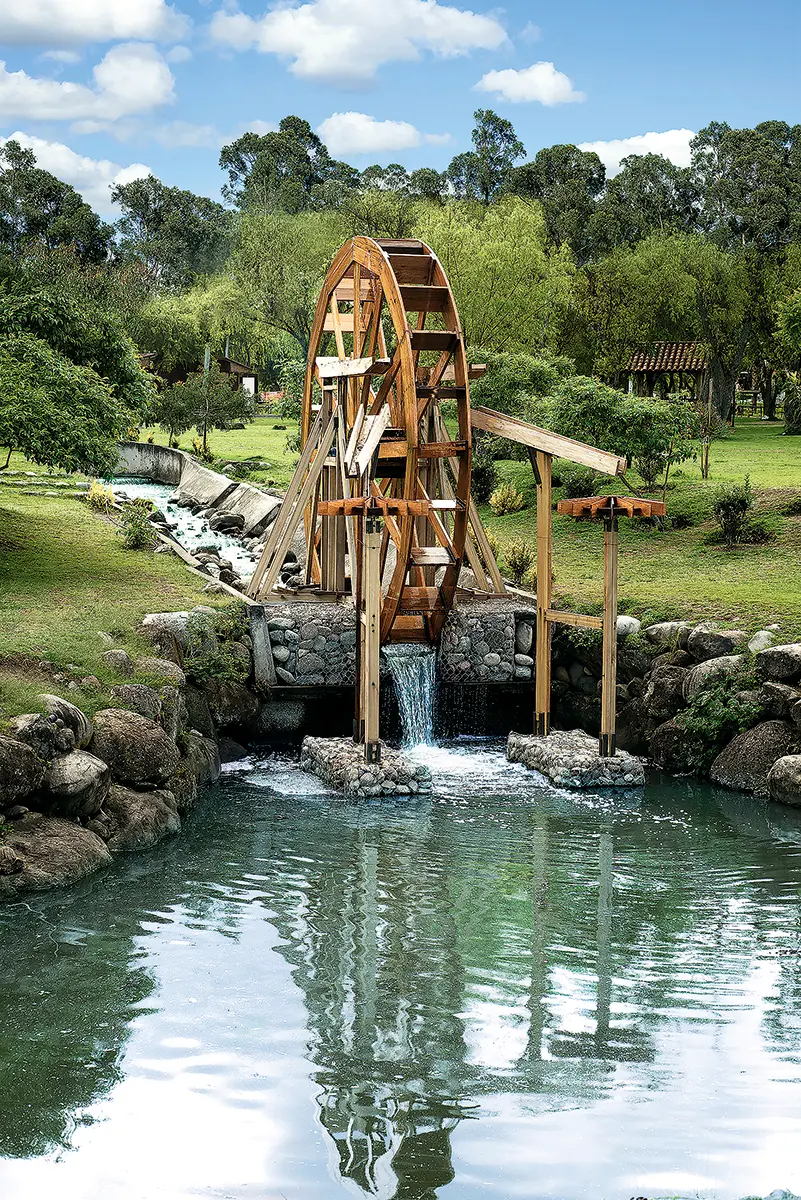
Chorreras (Spouts), by Colombian artist Miler Lagos, was a water mill located in Cuenca’s largest recreational park. As it happened, the drought conditions and insufficient rains in the region during the event caused unexpected problems, but Lagos’ work served its purpose. It connected with the city’s memory, harking back to a time when such environmentally sustainable devices were used in the production process.
La edad de la Tierra (The Age of the Earth), by Chilean artist Gianfranco Foschino, presented a view of the bottom of the sea around the Galapagos Islands, a Natural Heritage of Humanity site. Foschino’s video installation was based on fixed shots of the archipelago’s natural ecosystem. The “out of field” images produced a sensation of realism, with each screen functioning as a clear window into that universe. The high-definition videos were recorded by the artist.
In Search of Memory
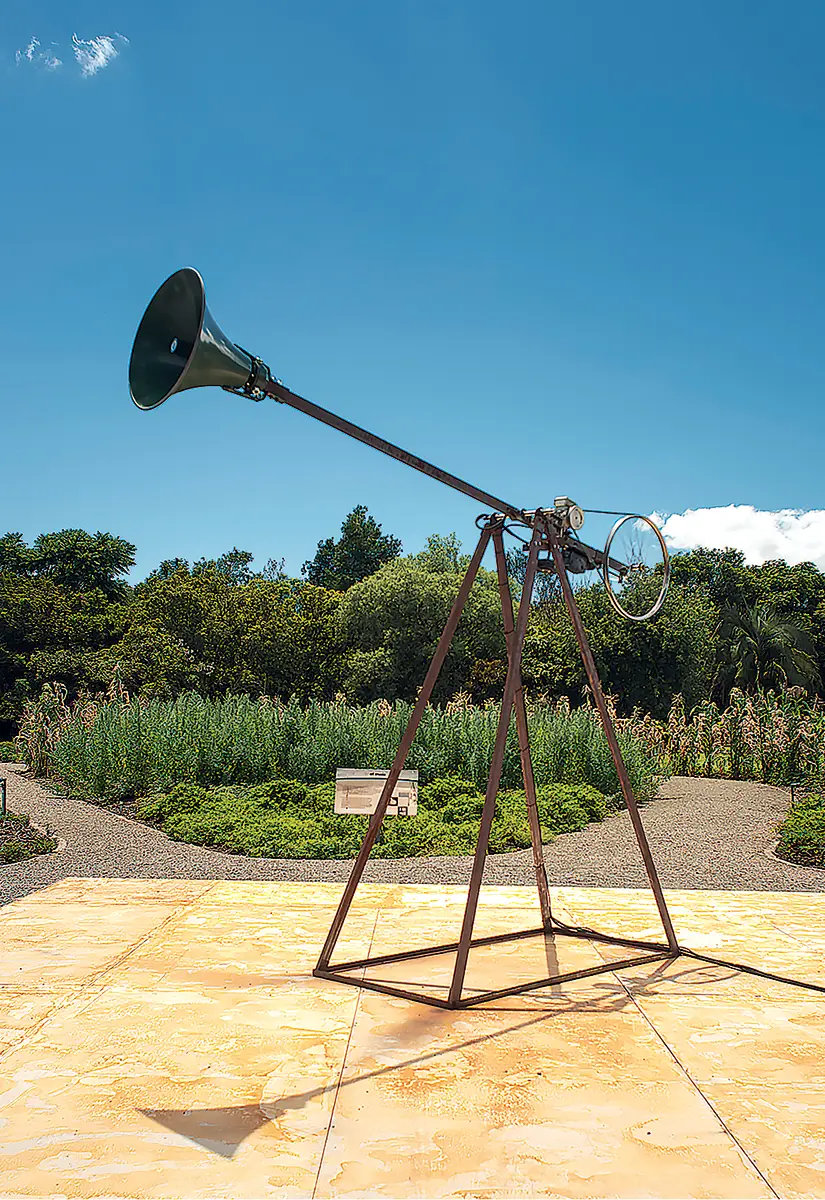
Oratoria (Oratory), by José Carlos Martinat, was installed at Pumapungo Park, an archaeological site featuring remains of the Cañari-Inca culture. Martinat’s work is a pendulum made from a megaphone and a bicycle wheel that turns as it reproduces ideas about the past, the present, and the future, all gleaned from Internet searches. In other events, this work has used art-world references, but here it alluded to time and memory. The location gave it historical meaning in connection to the pre-Hispanic past of the territory on which the city was established. Like other cities in Ecuador, Cuenca has an unpaid debt with its original peoples; hidden under its modern surface are colonial mentalities that contemporary cultural expressions often bring to the fore. Works like Martinat’s shed light on such contradictions. The motion of the pendulum can be associated with the progressive time of Western modernity, but also with the cyclical time of Andean rationality.
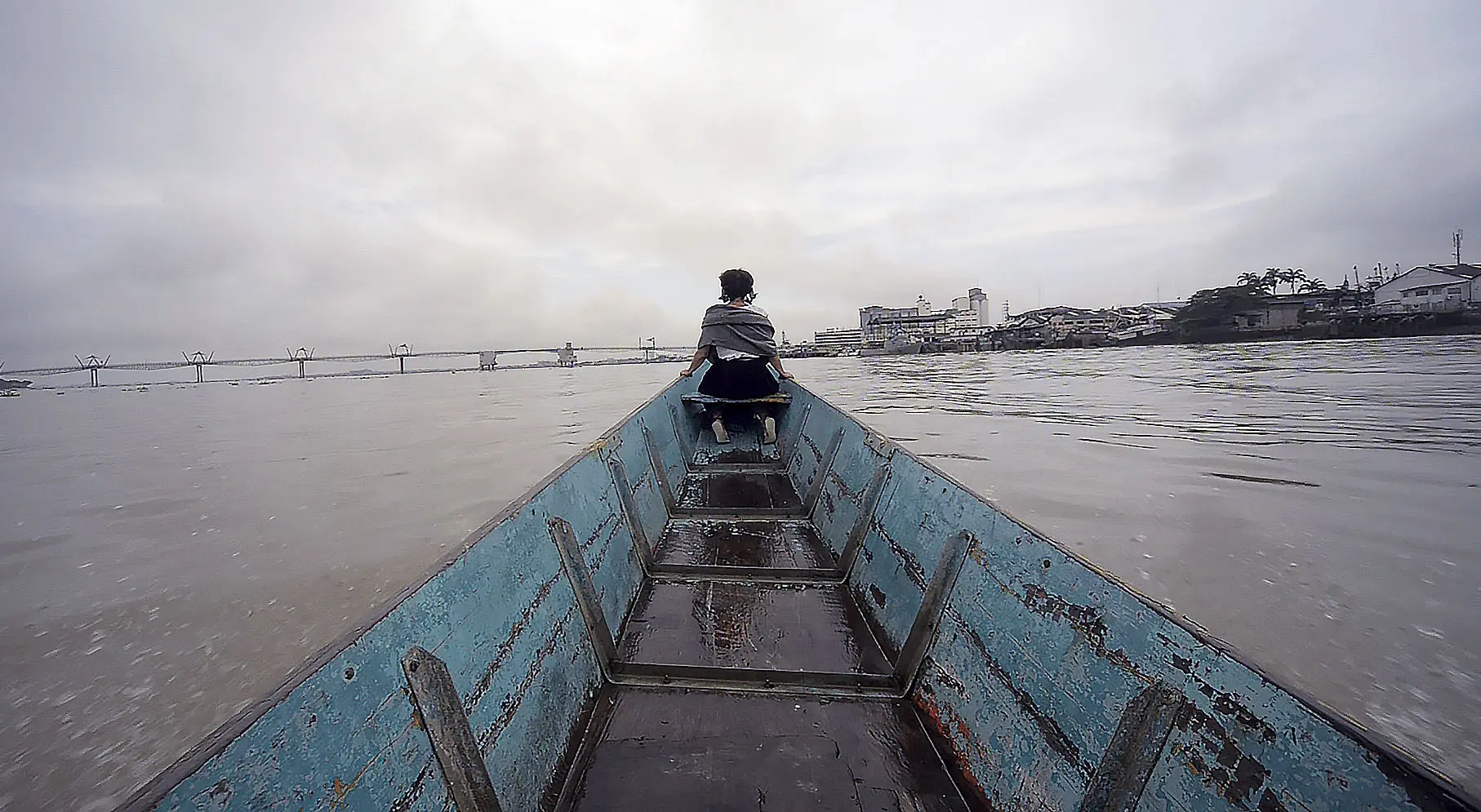
Karina Aguilera Skvirsky’s proposal alludes with even greater precision to a search for memory. Presented like a film short, El peligroso viaje de María Rosa Palacios (María Rosa Palacios’ Dangerous Journey) tells the story of the artist’s great-grandmother, who in the early Twentieth Century traveled from the Chota Valley (Imbabura province, in Northern Ecuador) to the port city of Guayaquil. Here, Aguilera Skvirsky “embodies” her ancestor, while conversing with long-time denizens of the Valley and its surrounding areas in search of clues to the possible route her great-grandmother might have followed. As she negotiates the obstacles to reconstructing her own memory, the artist walks tirelessly. The journey of that Afro-Ecuadorian woman who migrated to an unknown, strange place in search of a better life, takes Aguilera Skvirsky to natural spaces, rural settlements, and urban environments; it includes a short railway trip and ends with her arrival, by riverboat, on the country’s coastal region.
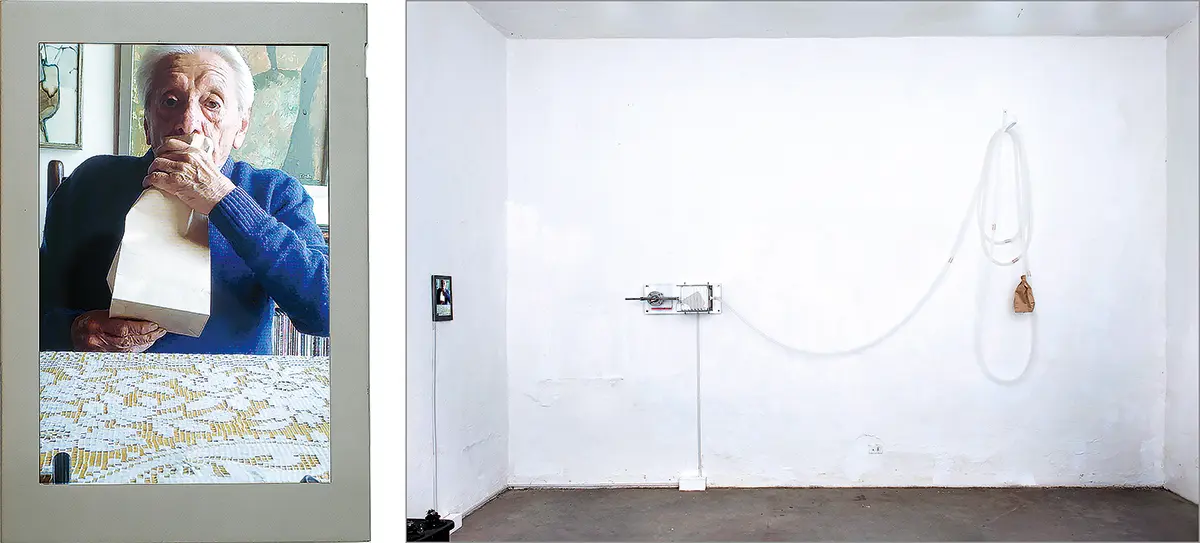
Rafael Lozano Hemmer’s Last Breath presented a local version of an earlier project that consists of preserving the breadth of relevant cultural figures, like Cuban singer Omara Portuondo. Ecuadorian poet Efraín Jara Idrovo was chosen for this unusual portrait. Lozano Hemmer’s work is a technological installation that keeps the breath flowing between a paper bag and an artificial respirator. In its poetry-laden motion, it prompts thoughts about the importance of safeguarding our cultures’ living legacies.
A Budding Educational Perspective
In closing, it is worth noting that the 13th edition of the Cuenca Biennial included an educational section, curated by Cristián G. Gallegos, as well as a program for art students, held prior to the event and titled Fuera de clase (Out of the Classroom). A publishing line was also established: a book on Ecuadorian artist Eduardo Solá Franco, written by curator Rodolfo Kronfle Chambers, appeared in the Los Nuestros series, and the Nomadismos series, devoted to key Brazilian authors and texts on contemporary visual matters, remains ongoing.
The Biennial’s educational focus is still in a developmental stage, but it offers a clear path to counteract those patterns of cultural consumption that seek to make art synonymous with entertainment. Art biennials can play that role: to conceive the circulation of art as a process of convergence, dialog, and learning. In Cuenca, the path is already laid out.
NOTES
1. International specialists like Juan Acha, José Roca, Justo Pastor Mellado, Tamara Díaz, Jorge Villacorta, Jacopo Crivelli, Gerardo Mosquera, Gustavo Buntinx, Virginia Pérez-Ratton, and Santiago Olmo, among others, participated as curators or jury members, alongside local actors like Rodolfo Kronfle Chambers, Mónica Vorbeck, Enrique Tábara, María Guadalupe Álvarez, Lenin Oña, Juan Castro y Velázquez, Hernán Rodríguez Castelo, and Mauricio Bueno, among others.
2. A growing number of critics and theorists insist, like Guadalupe Álvarez, that a museum is not a series of collections, a space, or a set of infrastructures, but a set of criteria in connection to the field of knowledge of which it participates. This idea is equally appropriate to assess an art Biennial.
ANA ROSA VALDéZ
Curator of contemporary art, art critic, and cultural manager.