
A rich, humble, and contradictory title gave by a great artist to his intellectual and sensible exhibition: Episteme. This philosophical term, rooted in ancient Greek thought, refers to knowledge and science as the intellectual comprehension of many aspects, be it political, biological, ontological, metaphysical, ethical, and/or aesthetic. Why do I say that this is a "rich" title? Because those who visit and explore this exhibition encounter a wide variety of materials, techniques, and proposals. I call the title "humble" because Vik Muniz only says “hand-made,” without noting the complex process that takes him to the results on view in the exhibition. And I describe it as contradictory because it encompasses dual vectors, one that addresses sensations and one directed towards experimentation; one set towards photography and one focused on alterations of photographic technique. All this to explain, for those who have not seen these works by Vik Muniz, that their aesthetic proposal demands deep attention, and that a quick and superficial view will only provide us with very limited information. Muniz’s work proceeds in successive steps, and we must take it apart as such; we must know it, explore it perceptually, understand its aesthetic arguments, and reason about it.
Vik Muniz proposed an approach to the sculpture before taking us along his unusual paths in photography. Once he was fully engaged with the latter genre, in the late 1980s, he started to mark those paths with chocolate, with diamonds, with sauces, or with garbage, among other materials. Muniz’s photography is not documentary, despite the deep social concerns that drive him (and also despite the fact that photography "always" documents). His works do not seek to distance themselves from this situation. So much so that he even developed a project with a group of catadores, who selected recyclable materials from large garbage dumps. In 2010, he produced Waste Land, a documentary that has received forty-two awards, among them the Audience Award for Best Documentary at the Berlin Film festival, Amnesty international’s Human Rights Award, and an Academy Award nomination as Best Documentary.
There is a degree of illusionism to Vik Muniz’s work, including an understanding of the work of art as a magic resource. Muniz’s experiences as a citizen induced him to develop modes of communication as a defense, option, or resource. Latin America itself has had intense experiences in that regard. Today it is not only our region that suffers from a lack of peace and respect; a large part of the world finds itself in the same situation. Muniz has often said that we are always interfacing between the world of things and the mind. Most of his works are based on perception and illusion. While it appears to be figurative, connected to art history, and responsive to the vision of what is a work of art, Muniz’s works lean on an alteration of techniques and systems of representation. The reader has learned that he is a photographer, and this is true. But the description does not suffice: Muniz arrives at his results via complex process, and through the inclusion of non-artistic materials. This process situates him in a transconceptualization. He is not strictly a conceptual artist, but one who transgresses against the academic traditions he seems to be paying homage to and celebrates above all those marginalized by Brazilian society, whom he presents as the mirror of suffering in a contemporary global society.
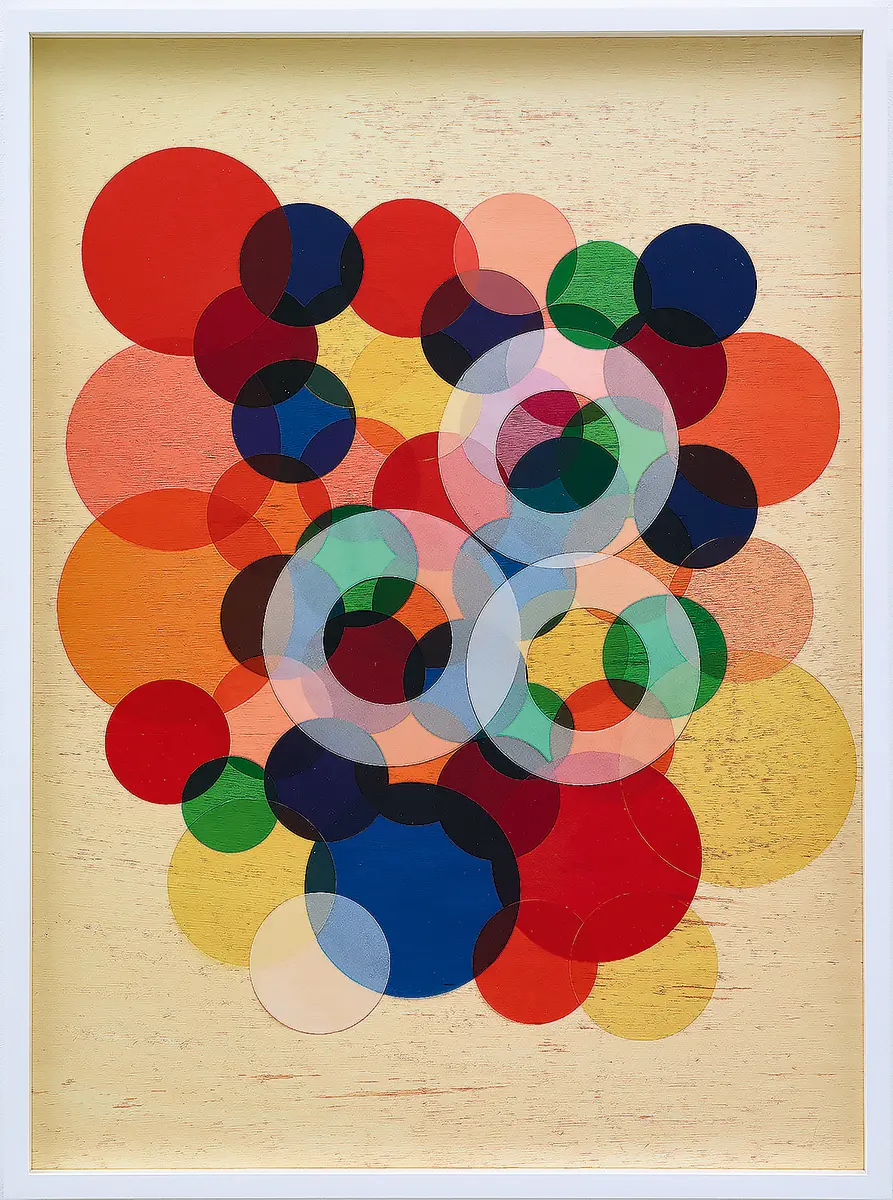
Muniz experiments with interventions on each photographic print, then photograph the results, and on that basis, he alters our episteme and shifts our perception. There is a subtle reference to humor, doubt, and unawareness, accompanied by a degree of certainty; disorientation and illusion accumulate in the series Handmade. Muniz is deeply respectful of his audience, never mocking and never playing tricks, yet he does bring into play altered signals in order for people to realize the error of trusting their simple perception of the environment. Vik Muniz does not seem to present us with overtly political works, yet his art is socio-political in nature. In the fifty-four works included in Episteme, color, paper, and textures illuminate a tunnel of abstract perceptions. What seems a collage is the artist’s characteristic interactive process: to photograph, to intervene, to modify, and to photograph again. As a way to expand the illusion, the works are carefully framed as works on, in, and with paper, unlike what is often the case with some contemporary photographs, which are exhibited without a frame of any kind.
GRACIELA KARTOFEL