
Following an invitation extended last year by the Testsite space in Austin, Texas, which since 2003 has functioned as an open studio and temporary residence for artists, Yoshua Okón (Mexico, 1970) joined critic and curator Edgar Alejandro Hernández for a collaborative project that explored the holdings of the University of Texas Library’s Benson Latin American Collection, focusing on the delicate topic of US interventionism in Mexico.
The result of this investigation is Miasma, intended to enunciate, in a prospective way, the fall of global capitalism by means of a body of works born from the artist’s interest in questioning the contemporary world’s political and economic structures.
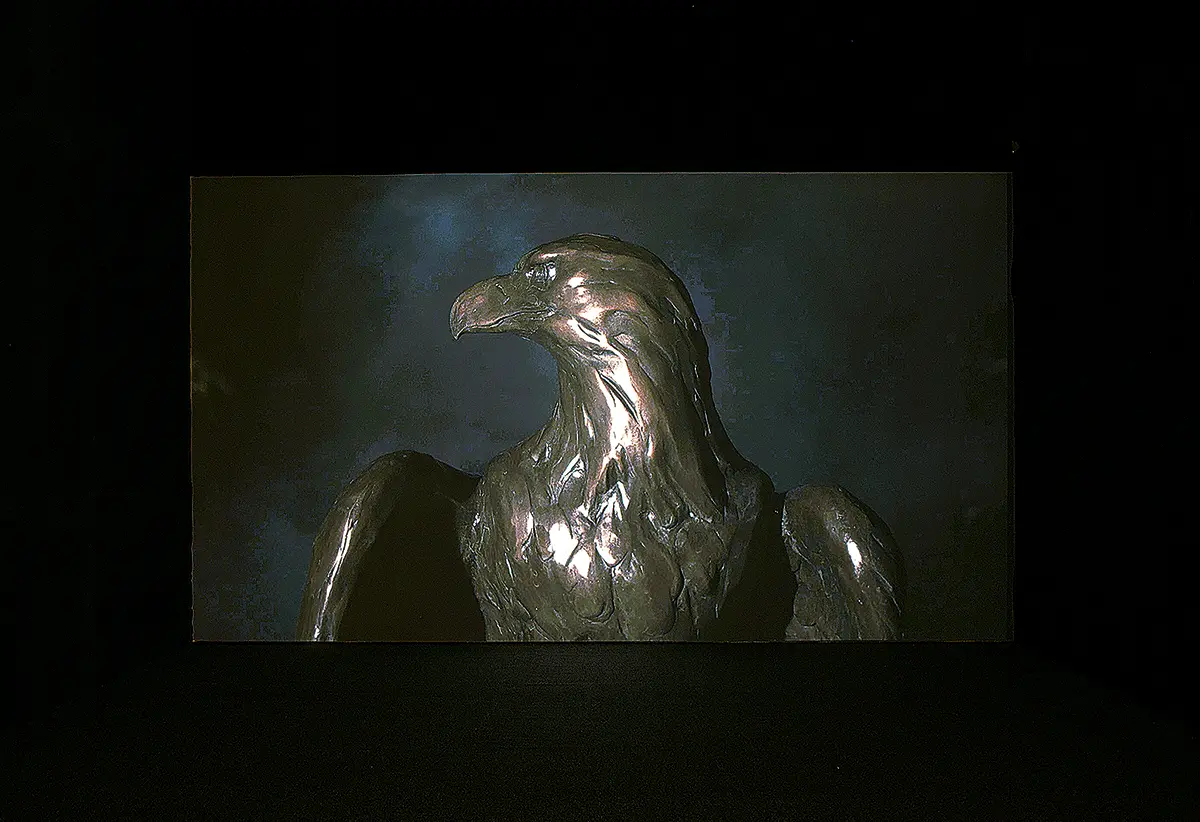
There are two main characters in this work. First, George Herbert Walker Bush, the 41st President of the United States (and before that, between 1976 and 1977, the Director of the CIA) who is one of the iconic figures and central operatives in the imposition of US neo-liberalism across the world.
Inside the exhibition, Okón reconstructs a public sculpture from Houston, Texas by means of artworks that place one foot from the everyday reality of that city and another in the fiction created by the artist. Along with his work in video, these works highlight the crumbling of the original image, as though the bronze sculpture were collapsing in the same way neoliberal policies are collapsing today.
In Okón’s proposal, George H. W. Bush embodies a metaphor for neo-liberalism as an aggressive, regulation-free economic model that has impacted public welfare schemes and democracy itself across the entire world, causing international crises and financial instability in many markets, while his idealized image seems to remain untouched.
Based on this, the artist creates a series of photo-sculptures that underscore the fragmentation and collapse of the original structure, but retain a superficial appearance of stability. In these works, the gaps between the image and the density of the form acquire special relevance and emphasize the illusion of a metaphor for the consumer society, where the Welfare State and individual freedom are nothing more than a facade.
The works make reference to a system in which the image projected does not match the structure that supports it, something that has been a characteristic interest in Okón’s work as it permanently played with the boundaries between reality and fiction. Here we are also represented with a video that plays with Bush’s visage in a darkened context, as a reference to the hidden, backroom negotiations of neo-liberalism.
The second protagonist of this exhibition is journalist Manuel Buendía, who in 1984 published a book titled La CIA en México (The CIA in Mexico), a large selection of essays about the Agency’s espionage and infiltration activities in the country previously published in “Red Privada,” his column in Excélsior, El Día, El Sol de México, and El Universal newspapers, and even in some foreign media.
A few months after the book came out, Buendía was assassinated with five bullets. In his writings, he left a long roster of both secret and overt functionaries connected to the spy agency.
Miasma also includes a series of drawings and a campaign of three thousand posters based on the cover of Buendía’s book, which will leave the gallery space to be placed in the streets as a reminder of the premise of the economy of social collapse evident today is a consequence of the US’ many covert operations in Mexico, which were not limited to political or economic issues but also included other realms, such as the cultural world. Among the holdings in the Benson, archive are letters and documents by José Gómez Sicre, a Cuban lawyer and critic who, to judge by these items, used Mexican artist José Luis Cuevas in the 1950s and 1960s to counter the ideals promoted by the Mexican School of Painting.
With this exhibition, Yoshua Okón produces a highly opportune reflection for the contemporary moment, when it has become necessary for Mexico to rethink its relationship with its neighbor to the north.
ISAURA RUIZ