
Much has changed between the 2014 Whitney Biennial and its succeeding edition, which sort of like the 2016 leap year, occurred three years later rather than two. If one lived in denial of social and political realities, however, it may seem that the most anticipated difference between one biennial and the other was the Whitney Museum’s relocation to a meticulously designed space by Renzo Piano in lower Manhattan’s West Village. This came at a time when museums and the so-called art world were going through identity crises in which the former resisted art’s entertainment value and the latter succumbing to the market, which was in contrast to the sustained belief in art’s viability as a cultural force capable of revealing the world’s social and political contradictions. These tensions were indubitably exacerbated by the presidential election of Donald Trump and signs of this came from disparate sectors: Trump’s victory had an initial positive effect on the stock market because there was now an unabashed, corporate businessman in the White House; to Richard Prince who was so vehemently anti-Trump that he wanted to buy back one of his own work’s from the President’s daughter that was part of her collection; and then there was the revelation that some collectors and upper-tier gallerists were not only supportive of Trump’s presidency, but in the case of one well-known collector, actually donated money to Trump’s presidential campaign. Thus, the 2017 Whitney Biennial had the potential of being one of the most politically charged biennials in addressing Trump’s policies that were seen by many as xenophobic and dangerous, including a ban on Muslim immigrants from targeted Islamic countries, and a proposal to build a wall along the border between the U.S. and Mexico. Some of these issues were addressed in the 2017 Whitney Biennial, but what occluded them was controversy around a painting by white American artist Dana Schutz that depicted the brutal murder of a black teenager in the Jim Crow south by white racists acquitted of the horrific crime.
While the racial flashpoint of the painting will be discussed below, there were many works in this year’s biennial by 63 individual artists and collaborative groups that spanned a wide array of media selected by the Whitney Museum’s in-house curators: Christopher Y. Lew and Mia Locks. Although there was no title to this year’s biennial, which would allude to a thematic arc, its general narrative framework seemed to lack specificity. This is underscored, for example, in a Whitney Museum press release leading up to the biennial’s inauguration: “The formation of self and the individual’s place in a turbulent society are among the key themes reflected in the work of the artists selected for the 2017 Whitney Biennial.” Regardless of this rather ambiguous proposal, there were some interesting curatorial decisions including giving more space to individual artists amounting to what appeared to be micro solo shows within the larger, biennial constellation.
This format was successful in an interesting presentation by the Vietnamese-born, Brooklyn-based artist An-My Lê. Consisting of a series of large-scale lush photographs, the works focused on Louisiana’s checkered Confederate past vis-à-vis an exploration of the reception of historical monuments within our contemporary milieu. One photograph appeared to be taken on a film set about the Confederacy evinced in camera and film crew replete with boom mics and special effects explosions, which evoked notions of history’s opacity while reminding us that we are shaped by history as much as we shape history through our narration of it. This dialectic was the subtext of another photograph consisting of a commemorative sculpture of a Confederate soldier within an environmental wasteland, possibly implying the connection between slavery and those who bore the brunt of the damage brought upon by Hurricane Katrina: African Americans. In contrast to this powerful series of works were other rooms that were not altogether convincing in embodying any of the biennial’s key themes. A case in point was a group of paintings by Jo Baer.
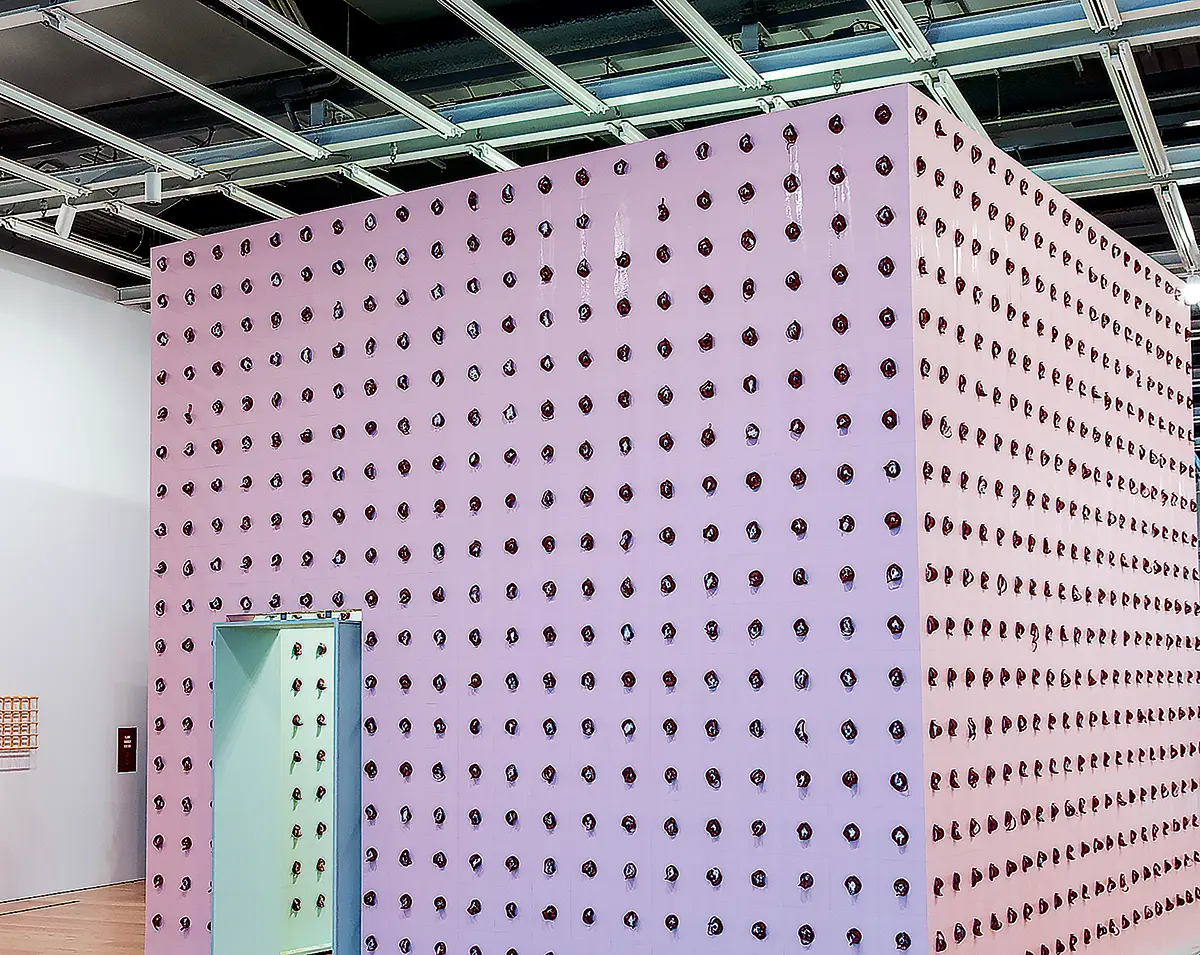
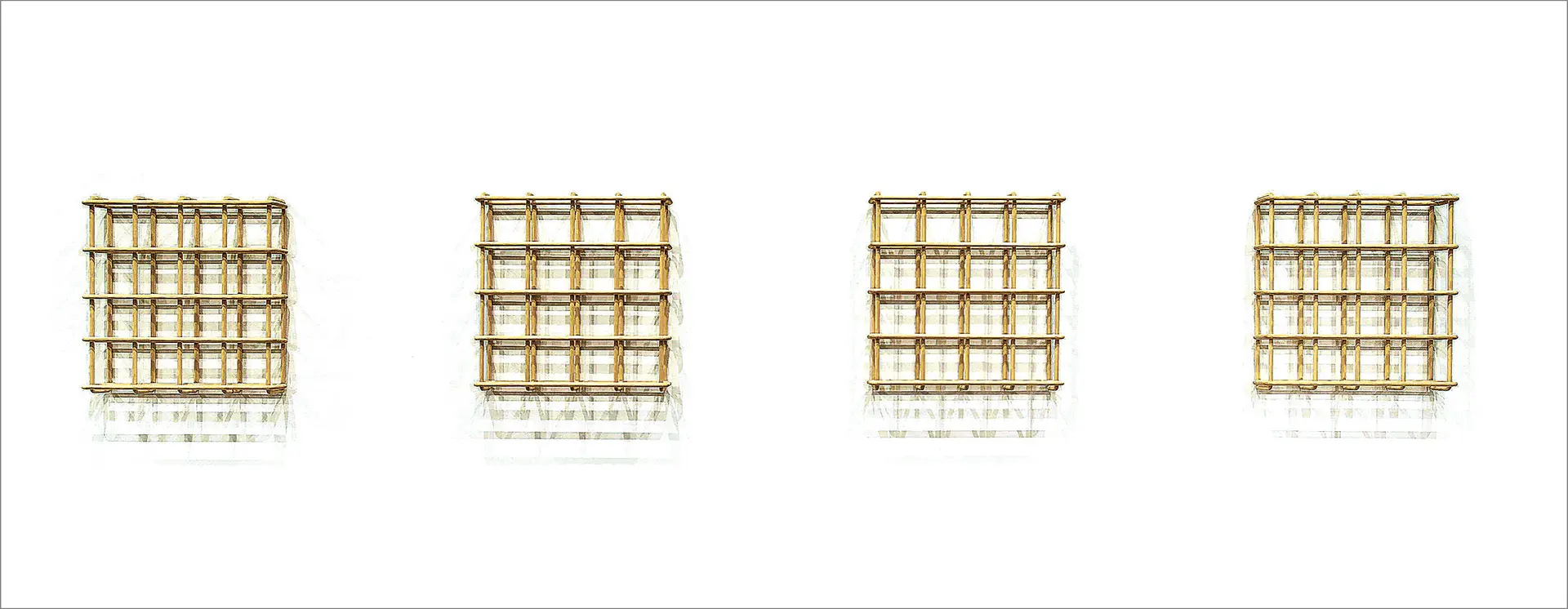
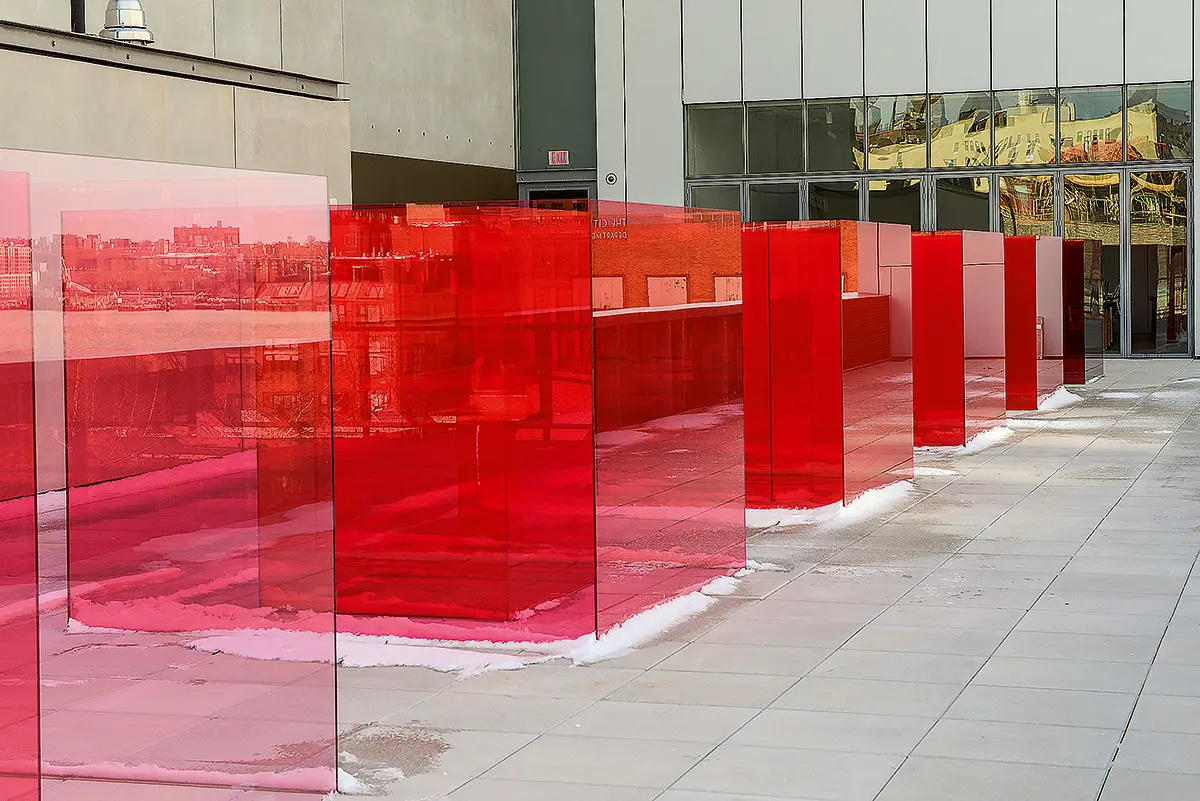
Jo Baer was first known for her non-representational, geometric Minimalist paintings and by the late 1970s, began to shift to a more figurative vocabulary. The works were very engaging regardless of the exhibition, but within the context of the biennial’s opaque curatorial narrative seemed gratuitous. Ditto with another artist of Baer’s generation such as the iconic Light and Space sculptor Larry Bell whose inclusion, too, did not seem to have much curatorial rationale. How do six, large red transparent glass cubes within lighter-hued glass enclosures have anything to do with the “formation of self and the individual in a turbulent society?” This was also the case with the small intriguing wooden sculptures by Matt Browning dispersed in various parts of the museum as well as the accomplished biomorphic, purely abstract paintings by Ulrike Müller. In both instances of non-representational art, that by any other means are quite compelling artworks, how could they possibly transmit the biennial’s thematic? When moments of such incoherence manifested, they were also the result of the placement of artworks. Often in previous biennials, curators would use the elevator’s opening onto the exhibition floors to their advantage. In the case of the 2017 Whitney Biennial, as soon as one exited the museum’s elevator on the fifth floor, one was confronted by a large-scale painting by Dana Schutz consisting of people in an elevator. The proximity of one to the other seemed simplistic and akin to museum restaurants where the décor on the walls may consist of reproductions or actual artworks that have something to do with food. On the other hand, the painting that caused biennial controversy was by the same artist and one should at least commend Schutz for her positionality, albeit that it was rather misdirected and an example of the responsibility artists often are not aware of of or disregard under the aegis of freedom of expression.
In the 2014 Whitney Biennial participating artist, Joe Scanlan assumed an artistic alter ego similar to Marcel Duchamp’s Rrose Sélavy, but in Scanlan’s case, it was a fictitious African American woman named Donelle Woolford. This not only resulted in some of the biennial artists boycotting their own exhibition, but one would think that after this incident the Whitney Museum would have been more sensitive to racial and cultural appropriation. There was also the controversy in 2016 at the Contemporary Art Museum in St. Louis that led to the resignation of its Chief Curator, in which members of the African American community were offended by a similar type of cooption by a white artist in one of the museum’s exhibitions. In the case of Schutz, the Whitney Museum exhibited her painting of a disfigured Emmet Till in his open casket after he was brutally murdered. Till’s mother published the graphic image of his fatal and mutilated injuries taken at his funeral in Jet magazine, whose readership is primarily African American and was the basis for Schutz’s painting. Not unrelated to those in the art world who hold naïve views of race relations are the covert Trump supporters. In the recent Frieze Art Fair in New York, an art magazine website published an article about a collector at the fair’s VIP opening who was visibly joyed that Obama’s Affordable Care Act was repealed by Trump. What the newly elected president offered in its place would translate to a tax cut in billions of dollars for the very rich by gutting allocations to the poor and elderly. It seemed that the realities of the world could not escape global art institutions such as the Whitney Museum, and fortunately, there were some artists in the 2017 biennial who confronted these issues; sometimes directly and other times in more oblique and roundabout ways.
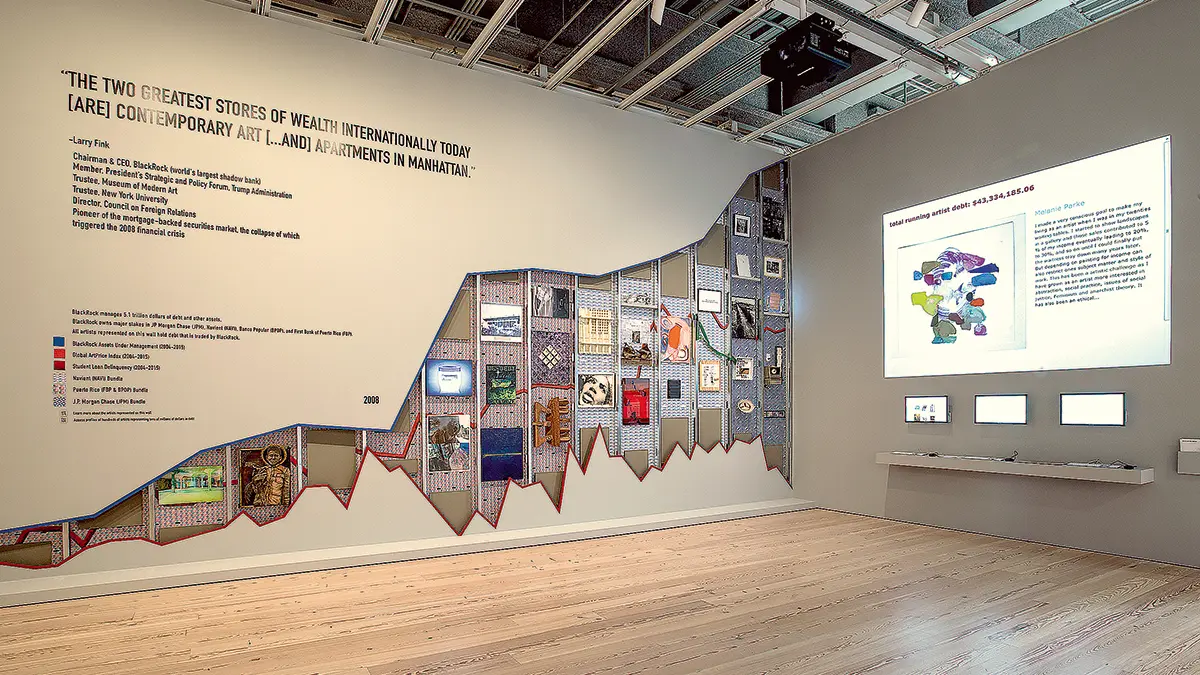
This was certainly the case with a collective known as Occupy Museums. Consisting of artists who work individually in diverse media, they may be the most visible heirs to Institutional Critique originally associated with such artists as Hans Haacke, Renée Green, Fred Wilson, Andrea Fraser, and the Guerrilla Girls, among others. Occupy Museum’s manifold projects investigate art and its broad infrastructure including institutions and their intended or unintended reproduction and sustainment of conservative politics and consequential questionable policies. For the Whitney Biennial, Occupy Museums presented Debtfair (2017), which consisted of artworks by 30 Puerto Rican artists exhibited within the context of the discrepancy between art as the status item and the debt industry that is consciously created for financial gain. One of the results of Puerto Rico’s intended deficit from foreign lenders is the plummeting of its real estate market, allowing rich foreigners to buy land at a fraction of its original cost and displaced Puerto Ricans in their wake. Other artists in the biennial who engaged the political sphere but in less overt ways include Chemi Rosado-Seijo, Raúl de Nieves, and Beatriz Santiago Muñoz.
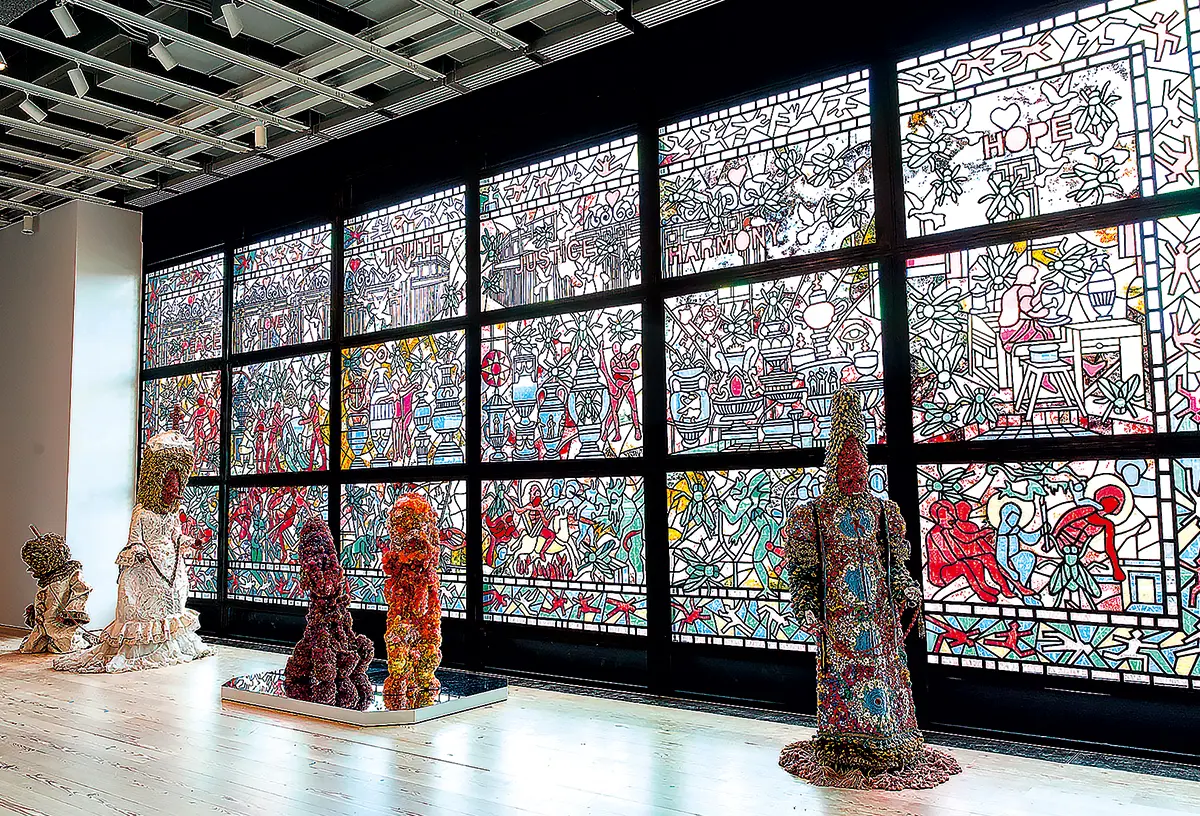
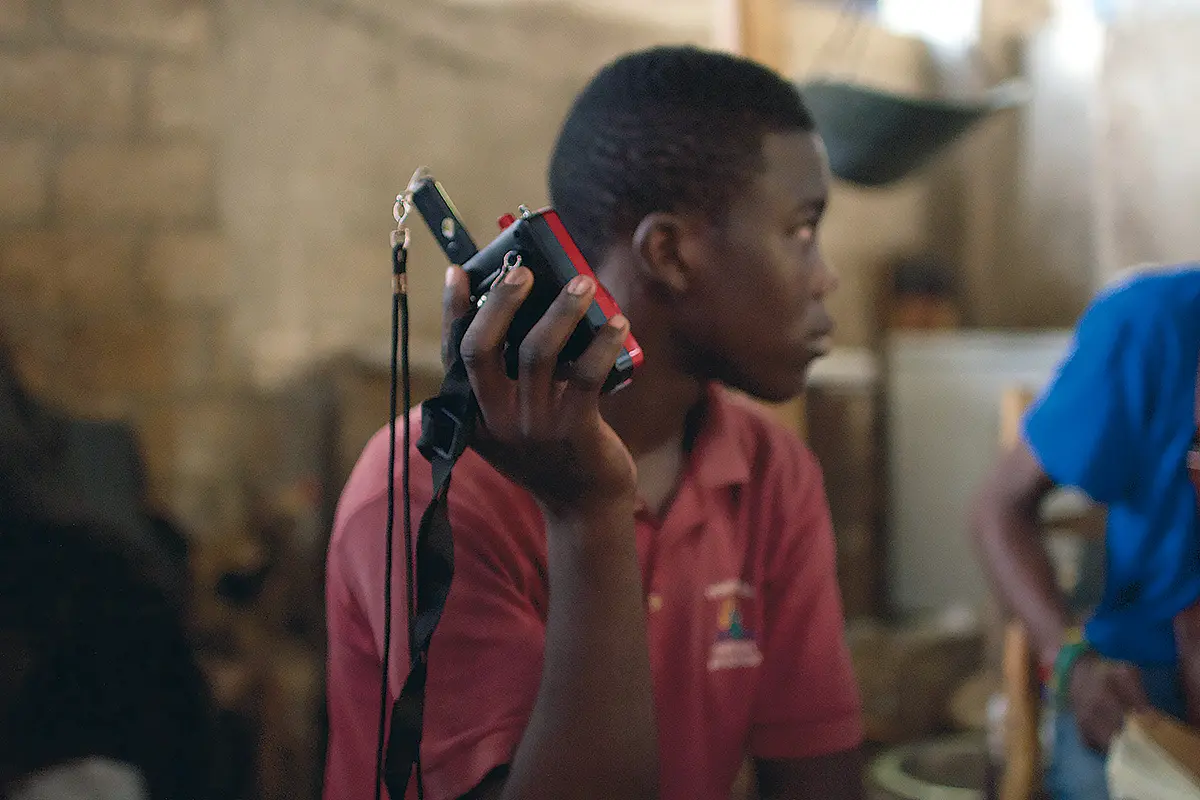
Chemi Rosado-Seijo’s contribution is an astute example of how so-called socially-based art is a multifaceted practice that does not have to eschew the aesthetic for something akin to community-based social service. Titled Salón-Sala-Salón (Classroom/Gallery/Classroom, 2017), Rosado-Seijo’s installation entailed the transplanting of a Whitney Museum gallery space with a classroom from the Lower Manhattan Art Academy and vice versa. The educational turn took on an interesting dimension as students from the academy not only played the role of bona fide artists but as teachers too in that the museum audience now became individuals being taught. The pedagogical component of this installation is rooted in Joseph Beuys’ lectures as art performances, or maybe even Rainer Ganahl’s seminars in which the artist served as a conduit for the transmission of knowledge in books that were read by participants as a collective endeavor. Raúl de Nieves also created an installation, but his modus operandi encompassed the convergence of design and craft; that is to say, a hybrid art form that seemed to undermine what was often Modernism’s sine qua non of medium specificity. His exhibition area was strategically adjacent to a large window that the artist transformed into a kind of street art meets gothic cathedral window. De Nieves meticulously covered the gridded window from floor to ceiling with acetate, paper, and other materials to create a vibrant stained glass trompe l’oeil, evoking myriad connotations from the religious, to the Day of the Dead’s papel cortado or cut paper, Tiffany-like lamp shades, Christmas lights, and vernacular architectural facades. The sublime, site-specific polychromatic installation was punctuated by other works by de Nieves consisting of life-size, anthropomorphic sculptures constructed from an array of materials. The dizzying details and minutiae of bric-a-brac were very rasquache and ultra-baroque in its subversive kitsch. In seeming antithesis to de Nieves’ over-the-top formal exuberance was the meditative solemnity of Beatriz Santiago Muñoz’s films.
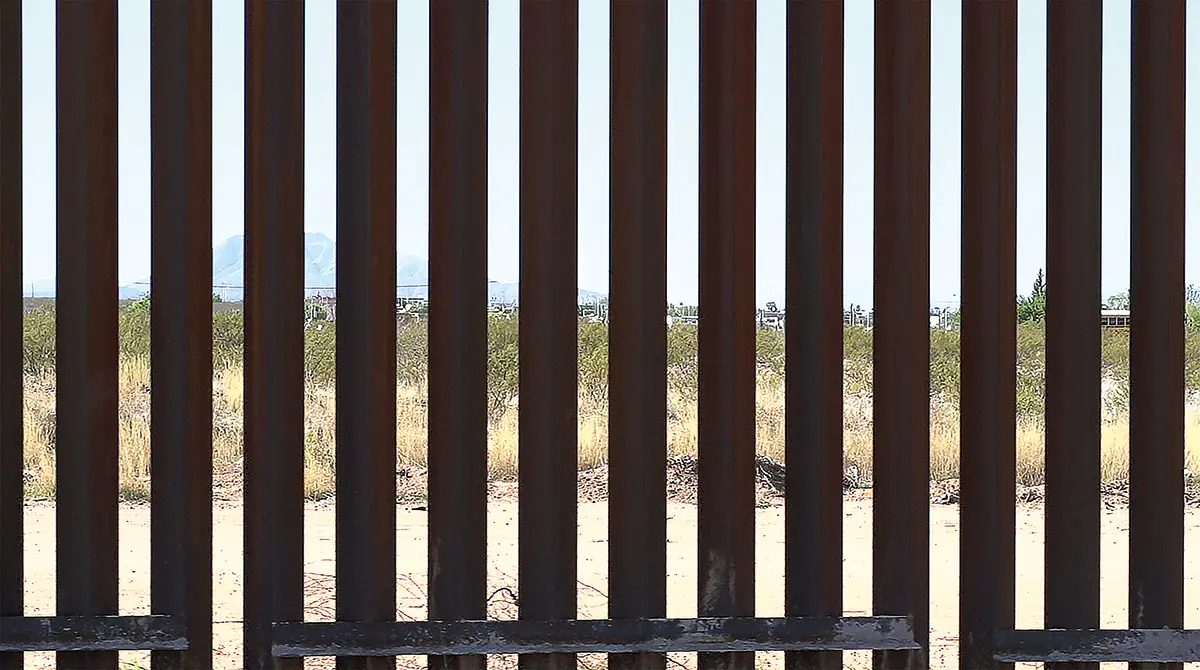
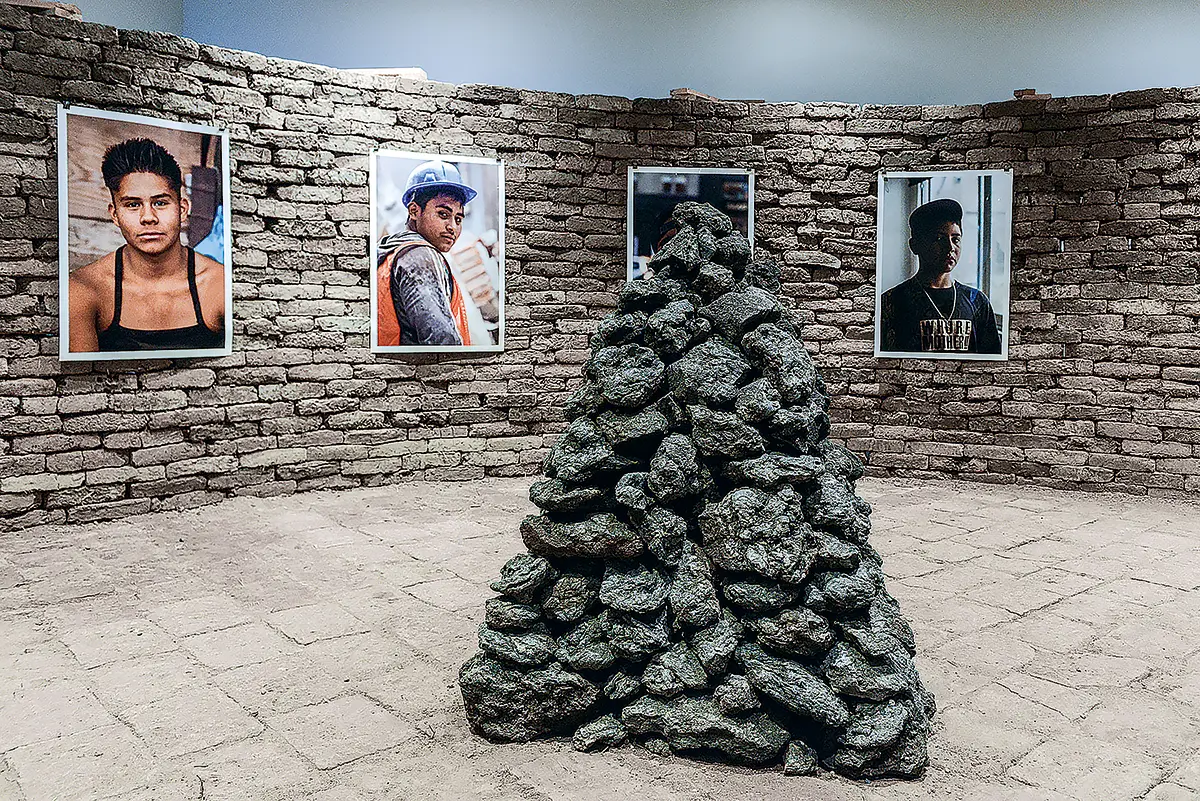
Beatriz Santiago Muñoz presented four films in the Whitney Biennial’s film program and their foci were post-colonialism in the Caribbean and its subtle after-effects within a broad purview of its inhabitants. Emanating from some point between documentary and cinéma vérité with elements of theater, the films included individuals that were quite transparent in their “performances”; yet their unforced and natural demeanor ostensibly transmitted a kind of feigned artifice amounting to engaging quotidian tableaus and mise-en-scenes of the everyday. Other artists of note were Postcommodity for their video installation focusing on the U.S./Mexico border within the context of Native American history, Henry Taylor’s beautiful and powerful expressive paintings, William Pope L. and his large-scale, Arte Povera-like sculptural installation consisting of bologna whose slight putrid odor was inescapable, and Rafa Esparza’s compelling collaborative installation on the first floor.
In what may encapsulate the 2017 Whitney Biennial’s sense of uncertainty that reflects the current U.S. social and political landscape, was a moment of happenstance in a vast, room-sized installation by Asad Raza. Titled Root sequence. Mother tongue (2017), this amazing environment of living artwork entailed 26 trees in planter boxes on wheels. Here and there Raza placed various objects including books on the edges of the planter boxes. As I entered the installation with no other viewer around but myself, a young caretaker immediately came up to me and asked me the month of my birth. After answering his query and knowing our interaction was part of Raza’s artwork, the exuberant facilitator picked up a book from one of the planter boxes and turned to a passage referring to June written by Shakespeare. As he read me the text with utmost sincerity, he then finished and looked up at me rather bewildered and seemingly with no one in earshot said almost inaudibly: “I have no idea what that means.”
RAÚL ZAMUDIO
Independent curator and critic. He teaches at Parsons the New School for Design.