
The city: a collective intimacy and a thing to behold. The object: a thing to be collected. The passer-by: he/she who appears and disappears. As a set, city, and object create urbanism flooded with the beauty and comity of Venezuelan referents. For the last two decades Caracas has been acquiring a reddish aspect, the appearance of which denotes an urban crisis, a clamor for creativity to escape the dangerous surge of chaos where uniformity becomes the sign not of elegance but of a supposed ought to command: red government propaganda. This city is a site of broken promises and sinking feelings, those of a modernization that could have been but was not or, at any rate, transited towards post-modernity but only halfway, unenthusiastically, thanks to the apathy that emanates from the centers of political power, the most overweening and tempestuous we have ever had. Yet, the proposal of Venezuelan artist Augusto Marcano moves in the direction of breaking with these pounding waves.
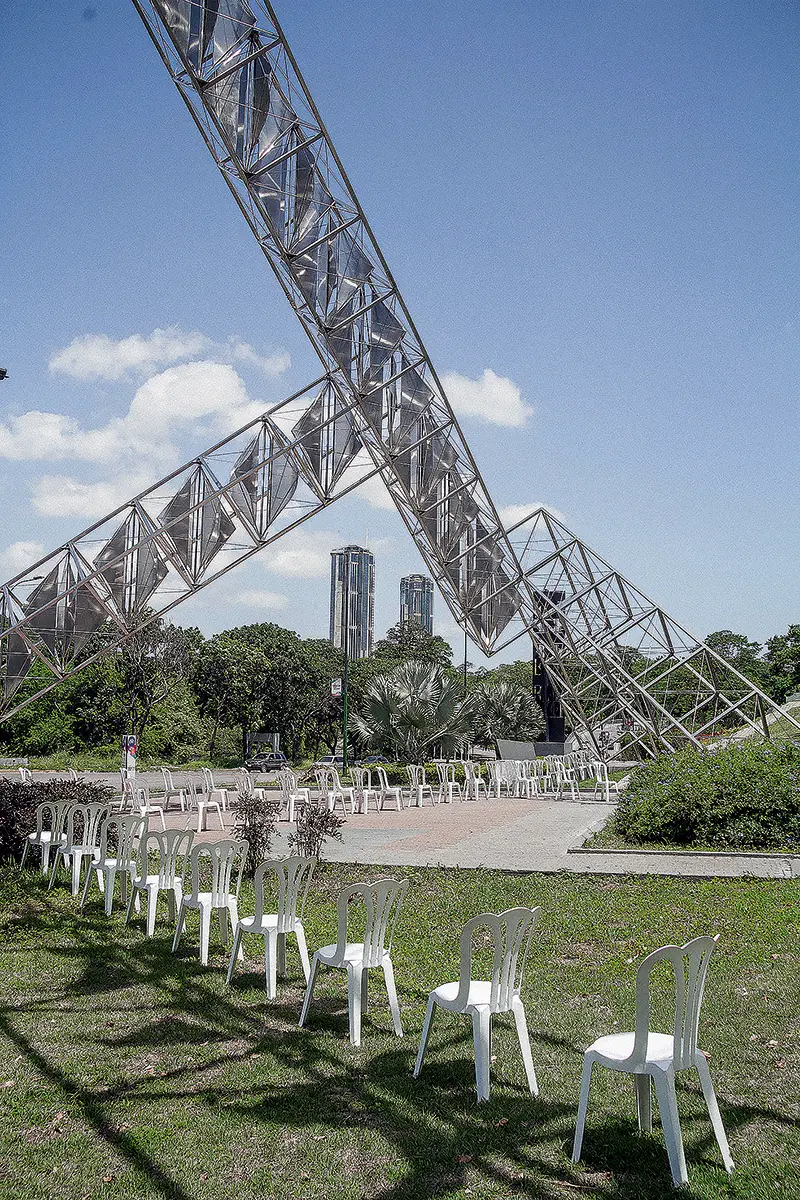
In Urbe desdibujada (Hazy City), an exhibition in Caracas at the D’Museo Gallery of the Los Galpones Art Center, Marcano brings together performance art and photography to present objects that are alien to the nature of a given space as that space’s extensions, acting as forces for connectedness and sequentiality between the city and architectural elements. The objects in question in this case are plastic chairs, all white and identical, looking almost geometrical. This collection is the communicating thread in the creation of geometric discourses as extensions of those initial shapes that the urban space already possesses and proposes. Within this chaos, Augusto Marcano is able to add linearity and specific structures to the architectural component, by deploying, by means of photographs mostly presented as panoramic vistas of the city, compositions where the chairs have been placed in a linear shape and form, as a whole, geometric schematics and patterns that give the location an aesthetic aspect. They seem to be the heralds of an order that will brook no ambivalence.
As a kind of memorial or tribute to spectacular Venezuelan spaces or local cultural personalities, the photographer stockpiles the riches of the moment in order to remind us of our heritage. For example, the series Plaza Venezuela (Venezuela Square) brings to mind the distinctive triangular angles of Alejandro Otero’s Abra solar (Solar Gorge), which, ignored to a degree by contemporary passers-by, are called upon and salvaged in their centrality thanks to the plus offered by the geometric composition of the white chairs arranged by the young artist. This composition is especially enhanced by each angle selected by Marcano: the extension of Otero’s masterful work that he has achieved blurs the visual outline and makes the presence of the chairs allude, in their symbolic discourses, to the modern as such.
This photograph provides a particular kind of visual interplay by means of conjunction of nature, city, the architectural element, and the set as a whole, where the passage of being comes nullified by a sum of human absences, merely suggested by the momentary presence of the chairs. At no point do we explicitly see a passer-by. There is emptiness, but not desolation. It is a clean, well-channeled, exquisite aesthetic.
Educated at the IUESAPAR (Instituto Universitario de Estudios Superiores de Artes Plásticas Armando Reverón, 2000-2008) and The Chelsea College of Art and Design, London (2002-2003), Marcano takes advantage of the moment to remind us of our own heritage. In the series mentioned above, the triangular angles give shape to a new urban way of drawing. Nothing comes to occupy the limelight all by itself; on the contrary, each element depends on the others to create a composition that dialogs with the viewer, perpetuating the moment and even allowing for the richness of the color to generate new fundamental visual sources. The photographs we encounter in the Urbe desdibujada exhibition establish an angular and triangular split, as is the case in the work where we see Otero’s classic masterpiece.
Augusto Marcano declares himself an adorer of the city of Caracas. Through his lens, he is able to extract the city’s natural beauty. In Marcano’s aesthetics, one can feel his love for Caracas and its monuments. He discovers the city’s corners and hideouts and creates for them aesthetic extensions that, once in position, make the space impossible to imagine without them. The work has been made open and, as a counterpart, space has been intervened and reformulated, and provided with new associations. Marcano’s work is an act of salvage, a dialog, and of course a contribution, but also a reinvention that emphasizes both the spirit of the legacy as well as, on occasion, the unsung beauty of some of Caracas’s hideouts.
GRISEL ARVELÁEZ