
“Serene,” “peaceful,” “relaxing,” “sublime.” These adjectives are recurrent in the exhibition guest book and convey the feelings of “inner peace” and “levity” that invade and marvel every visitor. Art as therapy? While probably not the initial intention by Elias Crespin (Caracas, 1965), the slow movements that he silently organizes gradually deconstruct the “lines” and forms in order to generate, as if by magic, new figures that clearly encourage visitors to philosophical reflections and meditation. Time is the central point in Crespin’s visual compositions. His work challenges a modern world subjected to a dictatorship of speed that disturbs, aligns, and imprisons our freedom to think and act. In Crespin’s proposals time to reflect is a welcomed guest, and, believing him to be right, visitors to the exhibition happily embrace this approach. The artist-mathematician also happens to be a philosopher.
The work by Crespin is inscribed in the kinetic art current. To a certain extent, and with contemporary tools, he resumes the technical and visual explorations initiated during the 1960s by a large number of Latin American artists. But much more than the heir to that legacy, Crespin is a creator deeply attached to the relationship between art and technology; an artist who through highly sophisticated computer programs is first and foremost after a relational aesthetic dimension (according to the thesis of the same name by Nicolas Bourriaud) at the service of kinesis. Following in the steps of artists committed to that current, whether virtually, like in the color vibrations by Carlos Cruz-Diez, or mechanically and electrically, like in Julio Le Parc’s work, to name only a couple of examples, Crespin’s central objective is transformation. Initially trained as a mathematician, he approaches the relationship between science, art, and nature by wondering about the place that mathematics occupies within that occasionally conflicting triad. And it is precisely this “kinship” or closeness to a “sensitive” dimension—that of the natural world—which, despite not being immediately perceived, becomes the true meaning that confers its entire value and uniqueness to art that combines wisdom, poetry, voluptuousness, and beauty. It is an art that carries through its peaceful and infinite breathing both a spirit and its affections. Because rather than being exasperating, Crespin’s choreographed slowness is actually tranquilizing and hypnotic.
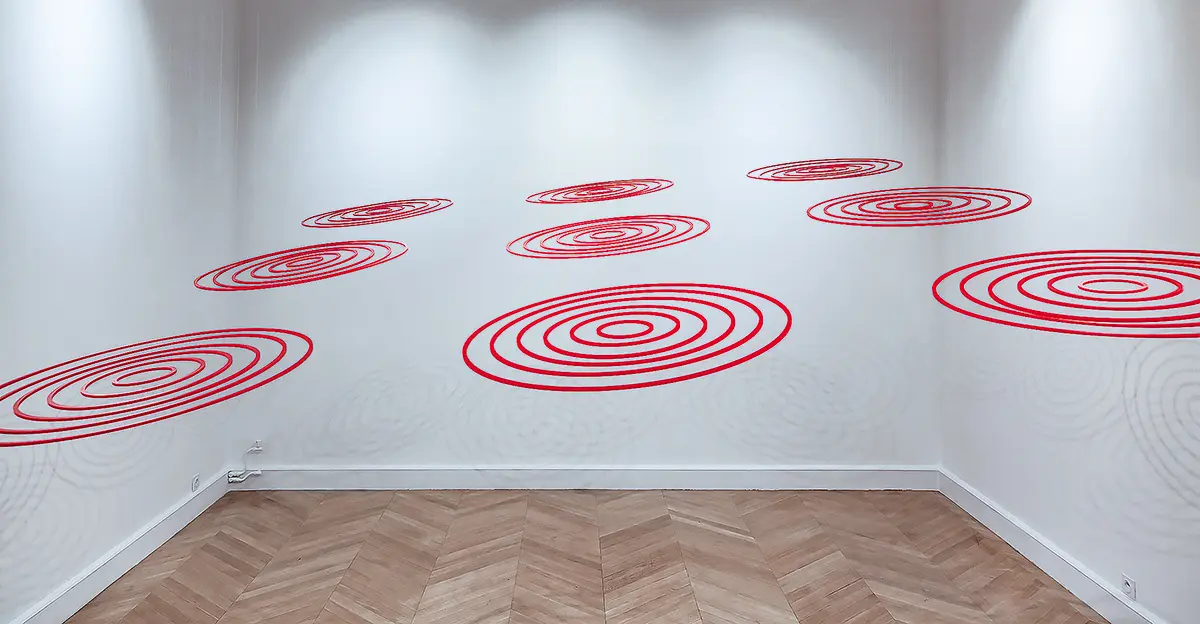
The exhibition’s excellent museography1 must be noted, especially if one takes into account the complexity of the computerized setup that remains invisible and contained in dozens of minicomputers programmed to activate the nylon threads that hold the metal rods or plexiglass in place as if they were contemporary marionettes. The exhibition consists of sixteen works, one of which was specially created for the show and has been placed by the entrance of the main floor. Titled Circular Inception, consists of nine groups of circles, each in turn formed by six circles of various sizes that generate a mobile group. The only non-silent work in the exhibition is accompanied by music composed for the show by Italian composer Jacopo Baboni Schilling. The variations of sound intensities are combined with the movements of the circles going up and down, separating, tilting, and straightening in an immutable inhaling/exhaling process. As in every installation by Crespin, the shadows drawn by light on the walls unfold the work and participate in its fascination. In the basement’s two small and vaulted exhibition rooms, Crespin composed two symphonies. The white and transparent Terralineados Transparente (Transparent Tetra Lined) is an organic marvel that, through voluptuous twists, evokes both a worm and the music absent from an imaginary accordion. In the black exhibition room, the identically sized fluorescent squares titled Tetralineados Fluo Verde (Green Fluo Tetra Lined) ripple in yellow and green tonalities under the effect of ultraviolet lighting.
Other more modestly sized installations underscore the impression of a Zen-like state, like the transparent circles in the work Circuconcéntricos Transparente 60 (Transparent 60 Circle Concentrics) or Línea Inox (Inox Line), formed by several stainless steel rods that undulate and multiply the original line. Solitón Cúbico (Cubic Soliton, 2016) occupies the large exhibition room at the back: three large installations created with stainless steel, copper, and brass—each measuring 380 × 20 × 20 cm. These are “cubes” that have been deformed, disintegrated, folded, and raised in simultaneous and different times—that confirm the unstable equilibrium of work based on opposites that look and find their harmony in this apparent contradiction.
In 1997, in his Eloge de la Lenteur (Praise of Slowness) Czech writer Milan Kundera blames speed for engendering oblivion. The slowness chosen by Crespin for his art, in turn, consecrates the preservation of memory and reflection while calmly contradicting the famous verse about ideal beauty by Baudelaire: “I hate movement for it displaces lines.”2
NOTE
1. Curator, Domitille d’Orgeval.
2. Les Fleurs du mal (The Flowers of Evil), 1857.
CHRISTINE FRÉROT