
The mention of the spiritual, the political, and the self-referential is the guiding thread followed, in recent decades, by Enay Ferrer (Caracas, 1974) in his creative work. In his recent exhibition at Beatriz Gil Galería, titled Con los Santos no se juega (Saints Are Not for Play), Ferrer presents a total of thirty-six works dated from the previous year. His discourse unveils figures generally inscribed in a fluid medium of blotches, scribbles, and fragments that emerge as apparitions of a kind or evocations articulated, in an irreverent manner, between reminiscences of the past and the immediacy of the present. In a narrative with neo-expressionistic features, he engages subjects where the Earthbound and the heavenly come together in a naïf style intercut with profuse brushstrokes and distorted shapes.
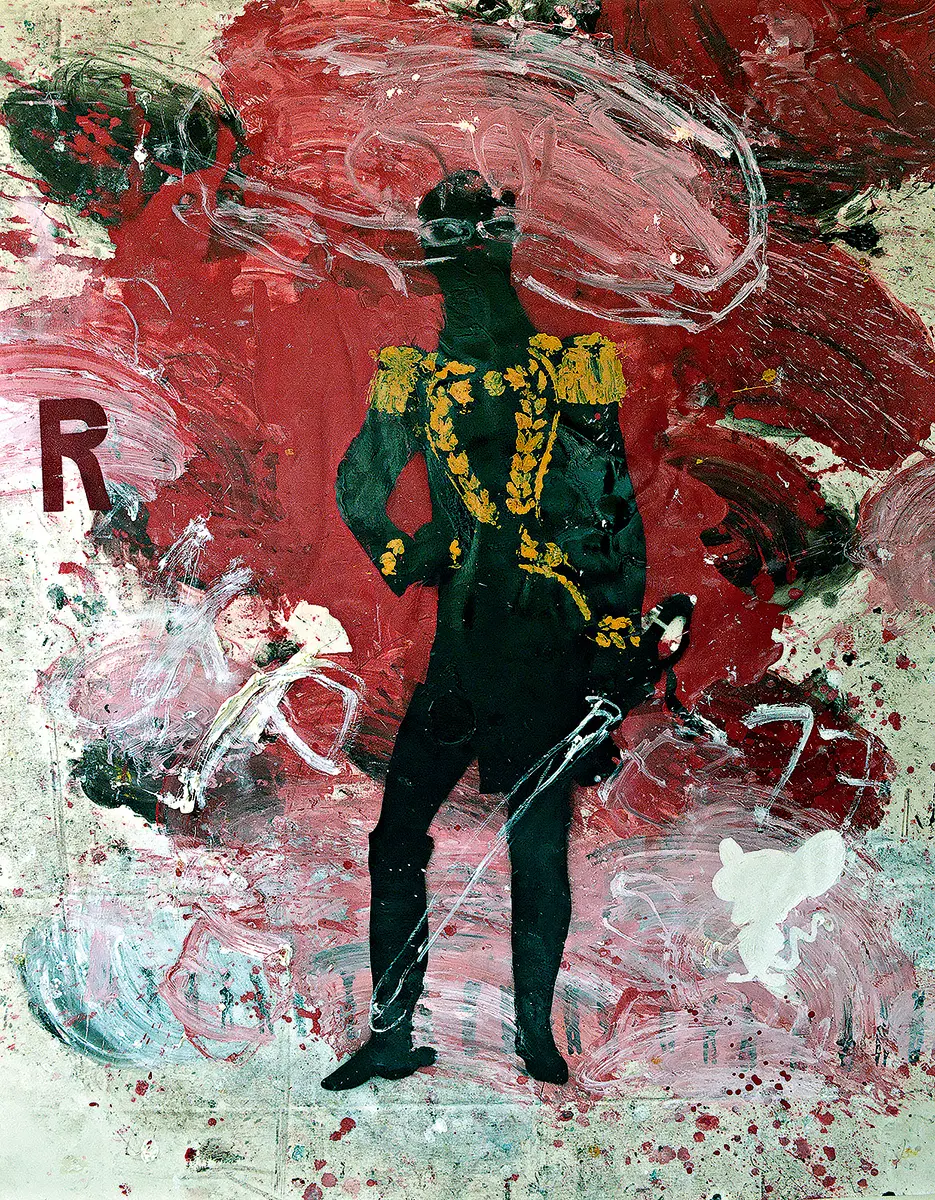
In that sense, the exhibition’s sequence is based on three essential axes—Los santos (The Saints), Los heroes (The Heroes), and Los autorretratos (The Self-Portraits)—that are closely interconnected by virtue of a combination of elements that prompts a contextualized reading of scenes and characters that are part of the collective imagination. In the series assigned to Los santos, for instance, we perceive the typical iconography that the Christian tradition had long established in the souls of Venezuelans and in the country’s identity. Mi querido Doctor Santo (My Dear Saintly Doctor), a 2016 canvas, describes a faceless body clad in a black suit, black tie, and black hat outlined against a white surface—the pose indicates that it is the venerable doctor to the poor that Venezuelans know as Dr. José Gregorio Hernández—and welcomes visitors at the front of the gallery. San Miguel Arcángel (St. Michael Archangel, 2016), features the traditional head of God’s army; in its emblematic devotional representations, Michael appears with his wings unfolded and ready to attack, but in these frames we encounter him in modern attire, wearing boots and Nike shoes. “In Ferrer’s works,” says show curator María Elena Ramos, "we do not find an acerbic or ironic critique of religion, as is often the case in the arts. Rather, there is a dual focus: on the one hand, an emotional view of religiosity as a family tradition and a people’s memory, and on the other a critique of its political misuse precisely on the grounds that it hollows out such essential emotions, such sincere beliefs in humanity’s connection the sacred.”
And it is precisely towards the realm of politics, as Ramos suggests, that Ferrer directs his attempt to provide new meaning to some paintings and sculptures that are part of the national heritage and represent some of the protagonists of the struggle for independence. Which takes us to the repertoire of Los heroes, where red of wine-red hues are brought in repeatedly as title and content for the allegorical ideologies that he seeks to comment on pictorially, as can be seen in Rojo (Red, 2016), a print that alludes to the standing, sword-in-hand portrait of Simon Bolívar surrounded by saturated colors that give vitality and relevance to the composition. Among the various reinterpretations Ferrer makes of “the Liberator,” we also find the same image, changes by the addition of a pair of Mickey Mouse ears. It is also possible to encounter an equestrian Bolívar set on a pedestal, as in another work titled Rojo, this one part of the series Con los Santos no se juega, 2016, and based on an intervened photograph of the classic bronze monument, positioned diagonally and set against a gestural atmosphere that gives the lonely hero, isolated from the landscape and sublimated by the agitation of colors around him, a mystical halo.
The sequence of Autorretratos (Self-Portraits) that complements this chain of introspective configurations is also important to consider. The inclusion of his own visage makes Ferrer a participant witness in a tumultuous reality, regarding which he expresses his inconformity via an openly sarcastic proposal. This is the case of Habitante del cielo (Denizen of the Sky, 1998-2014-2016), a painting Ferrer has revisited at different points in time, the violent features of which greatly contrast with the halo of light that characterizes the serene attitude of saints and enlightened beings. Like other artists of his generation, Ferrer transforms the impressions that, from the outside, impact his sensibility as an artist into a visual language. His compositions demystify the culturally instituted order so that the subversion of values that are intrinsic to human behavior—beliefs, heritage, customs—is questioned in accordance with the ongoing fracturing of the “establishment,” this is to say, the crumbling down of established ideologies, postures all of these that connect with the aesthetic explorations triggered by the post-modern movements.
GLADYS YUNES YUNES