
Esteban Lisa: The Abstract Cabinet could be regarded as a “small gem of an exhibition” whose dimensions, no matter how contradictory it may sound, reveal the pictorial ambition by Lisa and confirms—per se—the existence of a very unique stamp and poetic.
With this exhibition, the Museu Fundación Juan March in Palma de Mallorca, Spain, manages a new space—in the institutional context of Spain—aimed at giving visibility to the work of major artists within the historiographic narrative and critique of Latin American art. It is a gesture greatly appreciated, and even more so now that the formidable economic crisis is endangering the circulation until recently enjoyed by the art from that region. In any case, the initiative helps complete the narratives of a much fairer and coherent universality.
Under the classic typology of the cabinet, the exhibition that opened here, evoking in the form of a quote-tribute the 1927 Abstract Cabinet project by El Lissitzky at the Provinzialmuseum (today the Sprengel Museum), in Hannover, Germany, will later travel to the Museo de Arte Abstracto in Cuenca (from June 2 to September 3, 2017), and then to the McMullen Museum of Art at Boston College (from September 15 to December 10, 2017). One of the exhibition’s hosts will be renowned art critic and curator, Edward Sullivan, a resident at the Institute of Fine Arts of New York University (NYU). Sullivan will give important conferences in both venues centered on the work of this singular artist.
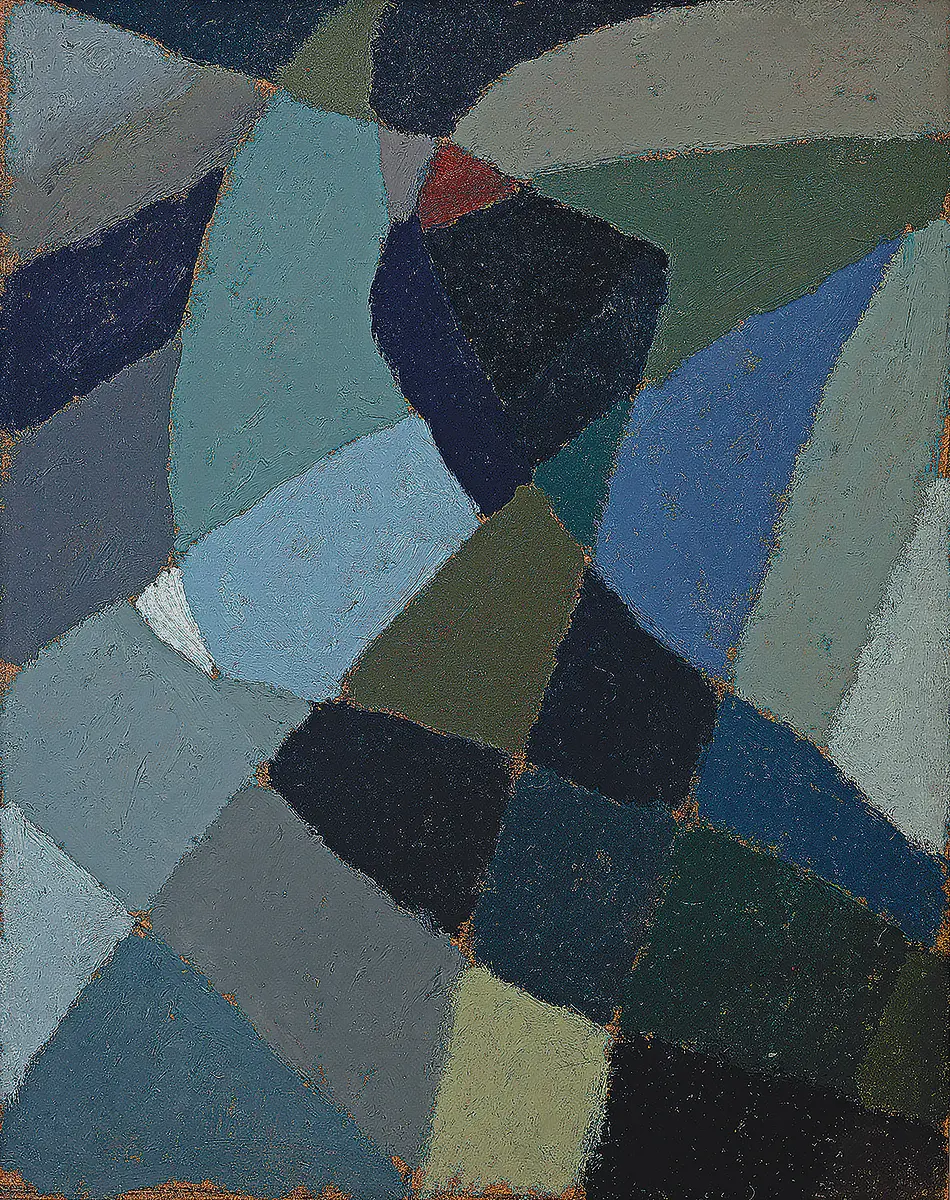
The argumentative line of this brief, and yet intense, the narrative is organized around 37 works created by Lisa between 1930 and 1968. Surely it must have been difficult for the historiography of art to come to a consensus on the value of the work created by this inventor of worlds. Nonetheless, once this dilemma was resolved, the name of Esteban Lisa (Hinojosa de San Vicente, Toledo, Spain, 1895; Buenos Aires, Argentina, 1983) belongs among the first and most important figures in the Latin American abstraction of the 20th century. Proof of this is the beautiful selection of small-size works and archival material exhibited inside an elegant display cabinet.
It has been precisely thanks to the solo exhibition model (and a few group exhibitions) that Lisa’s symbolic production transgressed silence and anonymity to figure today among the artists with “eccentric canons” that belong to the vanguardist and abstract currents of Latin American art. Since then, and in the name of a revisionist effort, the works by many leading figures in those currents today are included, through their own merits, in the central and hegemonic spaces of art. Esteban Lisa’s case is one more on that list. To the delight of his various researchers and collectors, he was included in the 2011 exhibition titled Cold America: Geometric Abstraction in Latin America (1934–1973) organized by the Fundación Juan March, and in many other monographic exhibitions in Argentina, Uruguay, the US, the UK, Italy, Germany, and Lebanon. Spain, his homeland, has also dedicated since 1998 important exhibitions centered on his work.
This beautiful exhibition pays special attention to an unequivocal sign of Lisa’s poetic identity: the unassuming supports he used for his work. Most of his pieces were of small dimensions; as if by rendering small he hoped to capture within the confines of the small frame the immensity of the world. Metaphorically speaking, his works perform an alchemical maneuver every time that the pictorial matter turns into a very personal, almost mystic, translation of the world outside that he perhaps never completely understood or, at the very least, was very strange to him.
We cannot lose sight of the fact that Lisa’s childhood was marked by an event as traumatic as emancipatory: migration. As a child, his parents separated him from his context to cross the sea in a huge ship that took him to Argentine soil. The experience surely led him to look for endless strategies to cope with the situation, including the development of a vocabulary that allowed him to understand that foreign reality that would eventually become his own. I would venture to say—without being able to back up my claim—that, in the long run, these works could be read as an expression of that need to exert control over and to understand the vastness of the world and its imprecise boundaries. Although it is very difficult to truly determine it through speculation in a critical essay, I have always believed that his work is closely associated with that moment in his life. While I was not lucky enough to meet Lisa, I feel certain that his work attests to an important life experience. It sometimes happens that great individuals do not regard grandiloquence as the end purpose of their work. Instead, they favor humility as an essential aspect of their respect for who they are and what they have. Someone once told me that the point was not to create large works but rather works that could touch the hearts of other people. And Esteban Lisa seemed to know a lot about that.
This exhibition, which begins here, attests to that great premise. Abstraction occurs in that place where the child and the man once lived.
ANDRÉS ISAAC SANTANA