
The organization and arrangement of this Federico Assler retrospective impress us with the variety of its resources, the dramatic environment it creates, and the creativity of its solutions. Intended to recreate or simulate a visit to the artist’s studio, the arrangement proposes subtle gestures like those photographs of the Roca Negra environs (the forest area in Cajón del Maipo where Assler works) on the wall, accessible only by sticking one’s head to the wall like a peeping Tom or a spy looking through a spy hole. This “studio visit” reveals for us—or confirms—the sculptor’s kitchen secrets, well known to Chilean audiences. Thus, a connection with natural forms and elements, the use of flimsy materials like cardboard and paper, and the importance of craftsmanship and sketching are highlighted as essential for an understanding of Assler’s production.
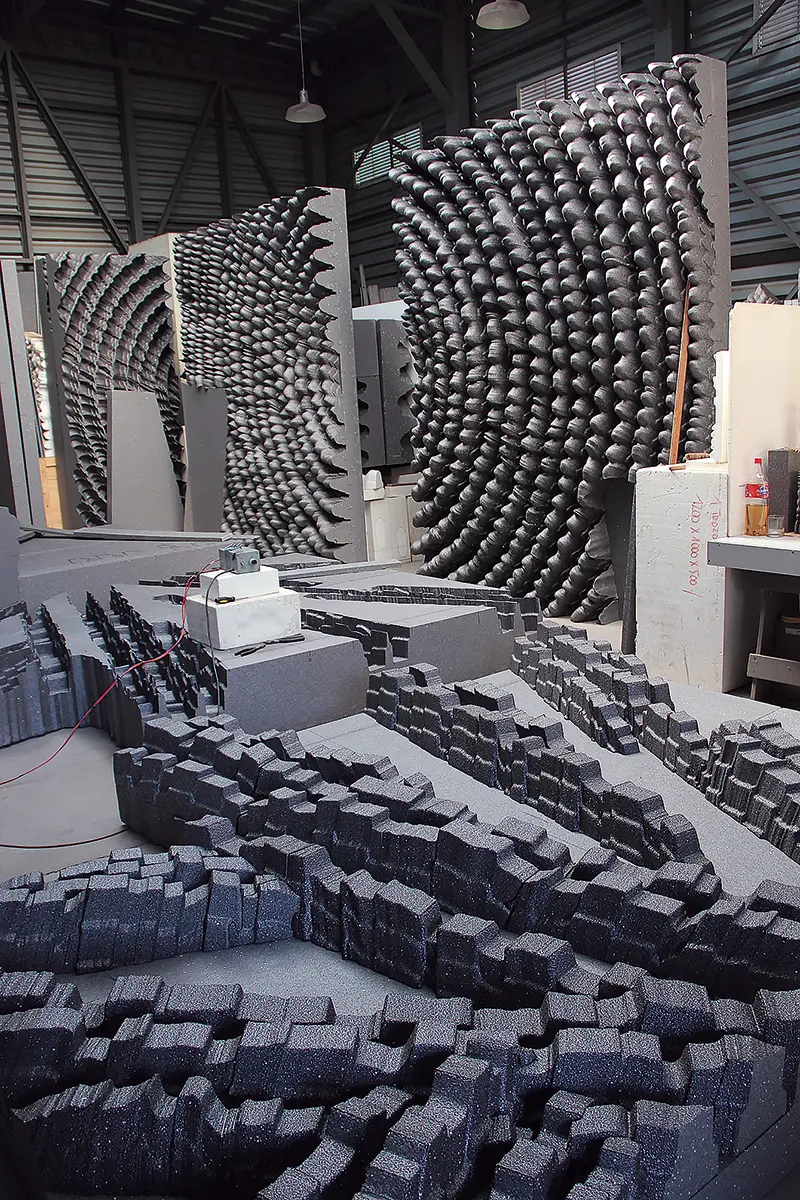
More than thirty works created since 1964 in different disciplines and formats, including outdoor sculptures and new productions, suggest the artist’s manifold interests and bring forth others that were perhaps not so well known, such as his extensive use of color and his study of shapes found in his surrounding environment, such as pieces of tree bark, fungi, roots, or volcanic dirt. The exhibition space also includes an informational room for viewers to educate themselves about the phenomenon of art, in a show whose mission is to generate a better understanding of, and greater empathy towards, the sculptor’s career.
Federico Assler is known for his public monuments, blocks of concrete marked by an ornamental sequence of reliefs in rounded, sinuous shapes that resemble waves of lava or semi-liquid organisms that have solidified in the midst of a fluid motion. Assler’s use of concrete dates from the 1970s, when he dropped his colorful painting in favor of monumental sculpture of rotund, large-scale blocks. Along with his works in concrete, Assler experimented with polystyrene, paying with the positive/negative dynamic of sculpture, the mold and the filling, the inside and the outside. Assler’s contact with the influential New Basque Sculpture movement during his stay in Spain (in particular with the work of Eduardo Chillida) was decisive to produce a new approach to sculpture, one that was, at the time, innovative in the country. Assler’s works on pigmented polystyrene make visible another density and another texture, along with the almost complete elimination of pedestals, and entrench even further the artist’s goal: to bring the work of art closer to the viewer, making it more earthly, thus countering the aura of unreachability of traditional art.
It is here, as we speak of certain advances Assler’s perception and approach to sculpture, leaving behind traditional constraints, that other, yet to be overcome vices become apparent. The curatorial proposal (by Carolina Abell, the artist himself, and his wife) has not paid sufficient attention to the textual work that accompanies the show: the texts on the wall are unnecessarily hagiographic, especially when it comes to an artist already widely recognized, honored, and exhibited as Assler. Interested revisionism highlights questionable aspects of the artist biography, such as his lack of academic credentials, forgetting that he attended art school in Viña del Mar and taught at Universidad Católica. The weakness of the curatorship results in unfortunate accidents, like the wall text that defines Assler as an “activist of the arts” and describes his intention as “aggressive” and an attempt to “discomfit others,” in the same room housing a sculpture that had to be withdrawn from its placement when a blind person hit himself against it due to its proportions and structure. The texts’ laudatory expressions hit almost with the same force: they seem to forget that the “aggression” and the “discomfiture of others” they mention are mere metaphors.
JUAN JOSÉ SANTOS