
After a career spanning more than three decades, in the course of which he garnered the most important honors in the field of photography, Cordoba-born artist Hugo Aveta forges ahead in his work by engaging new disciplines, like video and installation, but he does so in operations connected to time and memory that link these explorations with his previous production.
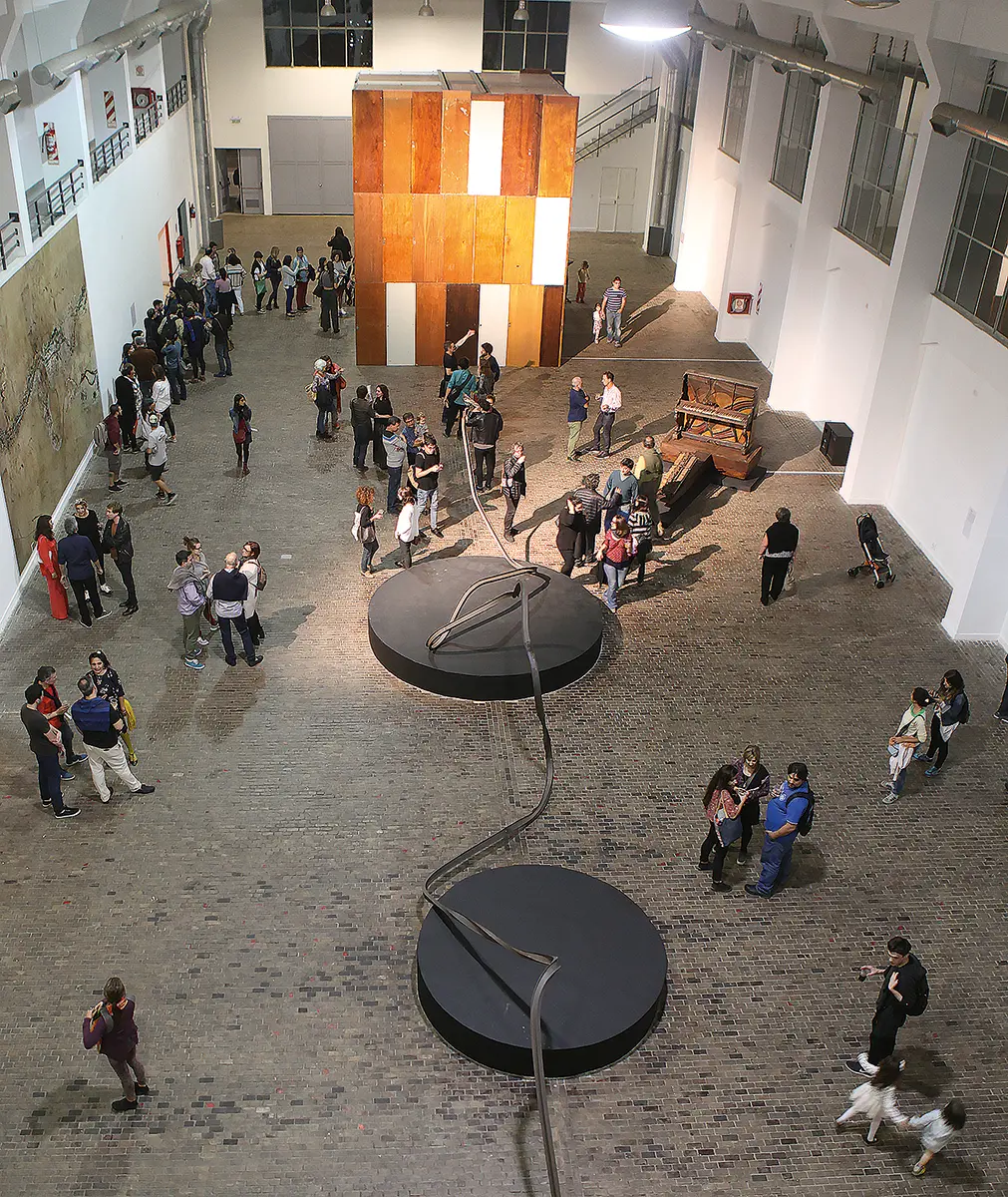
Aveta’s images are characterized by the way they work with socially significant spaces. Centered on the architecture of their locations, his photographs contrast the sites’ original value with their present blight and deterioration. Aveta’s most recent exhibition, titled La conciencia íntima de los objetos (The Inner Consciousness of Objects), continues with this dynamic of re-signifying social spaces, understood as markers that make it possible to connect history with the present. The exhibition was held at the main gallery in Centro Cultural de la Memoria Haroldo Conti, located in the old ESMA (the Argentinean Navy’s Mechanics School, in its Spanish acronym) that functioned as a clandestine detention center under the 1976-1983 military dictatorship and where thousands of citizens were kidnapped and disappeared in that period. More than twenty years after the country’s return to democracy, the compound was transformed and opened to the public. Its cultural center was established in 2008 as an open space sustainably committed to confronting the challenge of constructing memory through the transformation of a dark, sinister space. Art appears here as a space for the construction of memory via its capacity for reflection and for the structuring of debates.
In this complex space that connects the present with a tragic history, Aveta built a large tower of doors, installed at the center of the gallery. At first sight, our gaze is attracted to the beauty of the work’s formal aspects. Almost like a minimalistic installation, it appears as a large cube in space, a geometric composition demarcated by a grid of rectangles or equal size that alternate the visual rhythm through the doors’ chromatic variations. However, as we come closer to them the doors acquire individuality and historicity by virtue of the traces they retain of their everyday uses, from an old phone company sticker to a sign for a woman’s or a man’s bathroom.
Viewers can enter the tower through one of its corners. Inside, they will encounter a narrow staircase leading to a dark, lonely space. After climbing more or less a flight of stairs, visitors find a window that opens toward the center of the tower, and looking through it they discover a small narrow room. It is an office filled with filing cabinets, folders, sheets, or archival paper on shelves that cover the four walls from the floor to the ceiling. The scene is dominated by disorder and chaos. The documents are all strewn about on the floor, and the archive cannot be used as such. The artist titled this installation Síntoma (Symptom), like an indicial sign for something that is taking place. Indeed, something sinister seems to have occurred, the disorder, along with the silence and the absences, imbues the scene with a powerfully enigmatic character.
In turn, Ni vencedores, ni vencidos (Neither Victorious nor Defeated) works at a smaller scale and, in a way, clamors for slow, careful attention. It consists of a video projection on a small white-sheet notebook, bringing together images of bombing and the hand of the artist who tries to record, by drawing, the scenes that take place. The events force him to erase his work as it progresses, however. In the dialog between these two disciplines, Aveta builds a poetic game that presents, in metaphoric form, the continued exercise implied in the construction of memory. It is presented as a sustained, dynamic, unfinished effort that leaves traces on the paper: what is it that endures despite the passage of time, and how is memory constructed. In a way, the frantic exertions of Hugo Aveta’s hand speak of the effort involved in remembering.
AYELÉN VÁZQUEZ