
Four possible reactions come to mind when confronted with the works by José Olano (Cali, 1985) exhibited as part of the C program at the Museo La Tertulia under the curatorship of Miguel González. The first reaction may be moving away from the works because of the fear or caution that the pieces may elicit in viewers mindful of the likelihood of an impending, almost prophetic, accident. A second reaction could be feeling tense as a result of the suspense also generated by the awareness of the work's ability to be harmful. A third reaction, provoked by the anguish felt about the impending accident, would lead viewers to clumsily move away from the work and, in the process, accelerate the small disaster—a result associated with guilt. And, lastly, there is the possibility of sabotage by someone deliberately trying to take the works down.
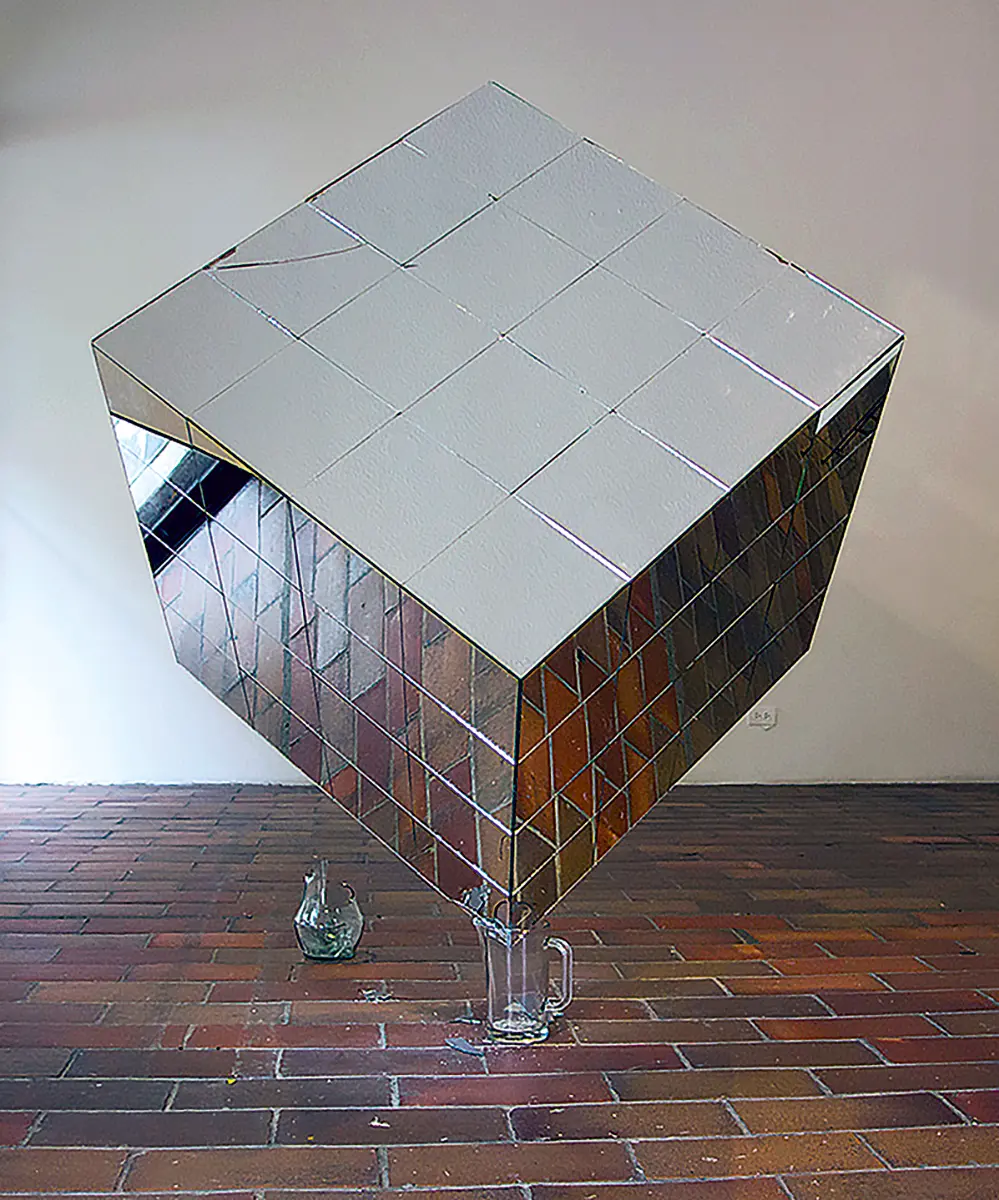
Titled Temporary Events Fragilely Disturbed, the solo show by Olano at the Museo La Tertulia turns the exhibition space into a single balancing system in which an accident may unleash a domino effect. While each work is autonomous, space unfolds, and the objects are projected, like variables in several levels of tension. Every work is like an equation (or poem) in search of an ideal state. In this exhibition, Olano proposes several installations that come together under the idea of events in a latent stage: the ends of an old ladder rest on several glasses in El Descanso de la Escalera del Museo (Sobre Vasos) [The Stair Landing of the Museum (On Glasses)]. In Uniendo Vacíos (Joining Voids) a thick white rope, originally from a boat, holds a piece of glass in place. In Aprendiz de Aviador (Aviator Apprentice) two ceiling fans are piled one on top of the other, while in Ilusiones de una Falsa Eternidad (Illusions of a Fake Eternity) a cube covered with a mosaic made with mirrors rests over a glass jar; in Dos Mesas Cojas Atrancadas Arriba y Abajo (Two Wobbly Tables Secured from Above and Below) two tables attached to each other cover the distance from the floor to the ceiling. And in La Forma Correcta de Reclinar un Pupitre Contra un Vidrio Pero no de Reclinarse en Él (The Right Way of Leaning a Desk Against a Glass but Not of Leaning on It). Nothing is glued or fastened, and all the installations (which become one) are not assembled, an important point if one considers that an assembly is the three-dimensional version of collage and implies attaching or fitting something together and the idea of permanence, stability, and preservation. Conversely, the fragile-systems proposed by Olano are playing on balance highly dependent on the moment, and the works are not themselves the work but a representation of the new order.
Relying on this process, Olano has developed a series of installations that have gradually been constructed as formulations, namely, as multiple objects that relate to each other through absurdly juxtaposed imperatives. Most times, the works break apart or the most fragile objects are destroyed but they can always be reinstalled, given that the structure of the work is preserved in the assembling instructions. The instructions are presented in an objective language (surrounding the absurd) that describes, without the use of adjectives, the necessary steps for the installation and the objects that must be used. The aura irradiated by these manufactured objects here is transferred to avoid, towards the unknown record of objects that form the installations and the domestic prow not witnessed: the intervention by the artist that causes an imbalance in the universe of things.
The works by Olano at the Museo La Tertulia have also fallen apart, but not as the result of any of the reactions stated at the beginning of this chronicle. It was unexpected. During several days, the Carretera al Mar (Highway to the Ocean) remained closed due to a landslide: “(…) 200 meters past the 66-kilometer mark, on the Buga-Buenaventura highway, stones continue to fall on the highway to the ocean. The terrain is unstable and the rocky material continues to fall every second from the mountain top. The earth has not stopped trembling.”1 As a result, the city of Cali waved restrictions on trailers and trucks with the intention of showing support to the drivers. For a couple of days, they drove through the alternative route that passes in front of the museum. The vibrations caused by the heavy vehicles led to the breakage of some of the works. This situation generated by a landslide that occurred relatively far from the exhibition is manifested as a phenomenon throughout works that were already waiting for a chain of events to unfold, or as Miguel González concludes in his curatorial text: “The environment of danger in the face of the disaster takes over the place and there could not be a more pertinent social and political allusion.”
NOTE
1. http://www.cmi.com.co, Monday, March 13, 2017.
BREYNER HUERTAS