
Juan Roberto Diago’s exhibition is truly memorable. Vera Ingrid Grant helms the Ethelbert Cooper Gallery, a new, welcome space at Harvard University’s Hutchins Center for African & African American Research. It is easy to explain to someone who has not seen the exhibition why a reviewer so disinclined as I am to using adjectives describes it in such forceful terms. Diago uses an autobiographical platform to launch a creative, valiant denunciation. He situates us from the start with Yo soy mi raza, mi historia, amor (I Am My Race, My History, Love), a large-format work in an uncommon whitish hue that also features Diago’s use of red-colored graffiti, notably an influence of Jean-Michel Basquiat. He has also intervened the space at the entrance, just as viewers have cleared the reception area, with an installation of recycled wood. Diago—whose full name is Juan Roberto Diago Durruthy—was born in Havana in 1971, twelve years after the Revolution, and was educated in two simultaneous tracks. On the one hand, the black Cuban community of which he is a member, with its rituals, traditions, and venues where popular culture unfolds as a way to confront poverty and rejection. On the other, his family’s interest in music and in visiting museums that were more commonly the turf of white Cubans. His oeuvre was forged in that symbiosis, and this includes the materials he started to use, such as wood and burlap, and later metal, paper, fabric, and rope.
In the Pogolotti neighborhood where his family lived, folk Afro-Cuban religions like Yoruba and Abakuá remained alive, albeit somewhat hidden from view, having been banned by the government. These traditions intertwined with everyday life in the country. This was the situation in the predominantly black area of Pogolotti, and Diago began to reflect on the privations and unjustified social divisions that became even more acute after 1991 when Cuba ceased to receive the support of the former Soviet Union. Everything began to decay, the conditions of justice and equality in the country eroded, and even what had been a very good educational system started to crumble, as did the country’s coverage of nutrition and other basic needs. The government was slow to accept this reality, belatedly designating it a “special period.” The struggle for a moderately dignified survival became increasingly harsher. By 2000, Diago made the personal decision of offering support to the neighborhood’s children, with workshops and art classes in his home.
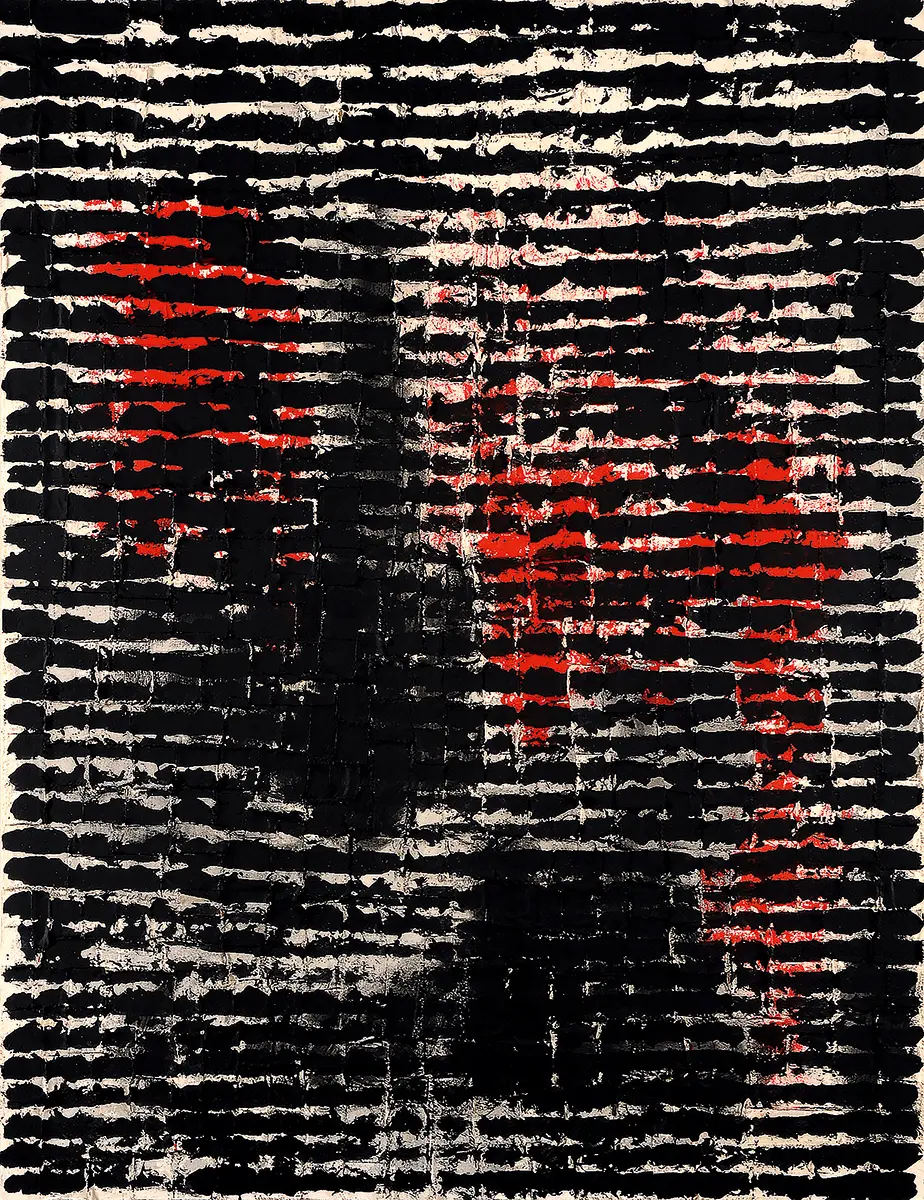
Diago had exhibited his work in Havana since 1987. He created and presented works that made unmistakably sociopolitical statements both in Cuba and abroad. He did not leave the country, but the exile chosen by many of his contemporaries is a well-known phenomenon. This phenomenon and the way it affected Biennials in Cuba have been addressed in previous articles. Meanwhile, racism—which the Revolution claimed to have eliminated—remains commonplace. (Let’s remember that as he left for Paris, Wifredo Lam carried with him the baggage of racial discrimination in pre-revolutionary Cuba.) Diago continues to put a stark focus on this subject in many of his works, like his Queloides (Keloids). Starting with the series Aquí lo que no hay es que morirse (What We Need Here Is To Not Die), from 2003, with the title set vertically, the word yo (“I”) begins to appear in other sections of the canvas, as does the place that the artist is interested in highlighting: Havana. The focus begins to soften in Diago’s creations, which start to communicate a degree of delicateness and joy. He includes more metal and photography as a tool, in lightboxes and installations. In some works, metal welding is used to represent, to great effect, the scars on the body of a savagely punished slave. Diago’s figures begin to give way to certain abstractions, such as spreadsheets showing the sustained presence of autobiography and racism. Black, white, and red are dominant in several of his most recent works. The triptych La fuerza de tu ser (The Power of Your Being) and other works from the 2012 series Entre líneas (Between the Lines) express the artist’s maturity. Los pasados de este presente afro-cubano (The Pasts of This Afro-Cuban present) features twenty-five artworks and installations that play with the coziness of the gallery space, where every work seems to have a specific space designed for its placement. The installation titled Ciudad en ascenso (City in Ascent), with burnt, piled-up black drawers restates Diago’s aesthetic of wreckage and reuse. The avenue of constructing via the materials can be appreciated in every work, and from every angle, in this exhibition organized by Alejandro de la Fuente, Director of the Harvard University’s Hutchins Center for African & African American Research.
GRACIELA KARTOFEL