
After his arrival in Paris in 1964, Juvenal Ravelo developed an interest in exploring the abstract-kinetic language than in fashion. He frequented the studios of Victor Vasarely, Julio Le Parc, and Jaacov Agam, as well as, of course, Jesús Soto and Carlos Cruz-Diez. Ravelo was at the time a young student at the Sorbonne, where he read on Sociology of Art under such distinguished professors as Pierre Francastel and Jean Cassou. This background explains the social intent of his later artistic investigations, where he intervened walls and streets in collaboration with local communities, an interactive project Ravelo began in 1969 and continues to this day.
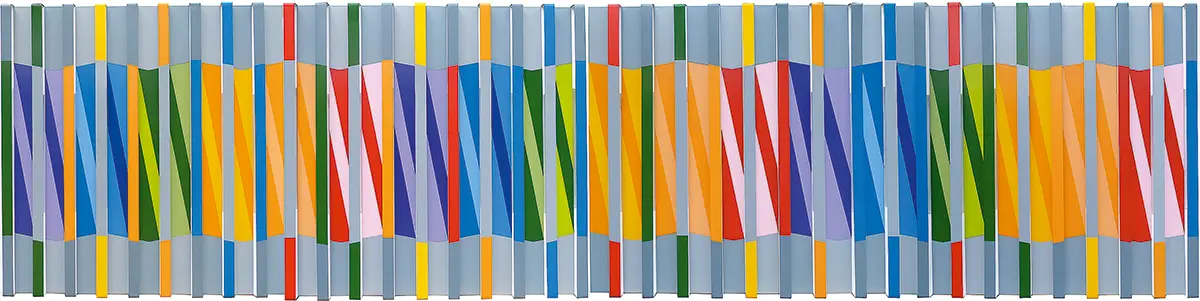
The work of Juvenal Ravelo is proof of how heterogeneous and unbound artistic creativity can become in the context of the Venezuelan and international kinetic-art tradition. There is not one kinetic art, but many, as goals and objectives vary considerably from one artist to another. Ravelo, for instance, was clear on the path he had to follow already in the 1960s: to analyze the shifting effects of natural light on a static, two-dimensional surface. At the time he worked on silkscreen, and through that expressive medium, he sought to produce optical instability by means of systematically repetitive color planes. The determinant element of Ravelo’s kineticism was defined in those years: the effects of the fragmentation of light and its impact on color.
Later, Ravelo began to include small reflecting pieces (mirrors, metal sheets, etc.), thus giving the environmental color a significant influence on the visual perception of his works. He called this effect “fragmented light,” and it involved exploring in great depth the work’s unstable, vibrating elements.
From that point on, every one of Ravelo’s series carried forward the exploration. Based on those principles, in 1967 he began to produce variations such as, for example, vertical arrangements of lines in relief on a monochrome surface. Similarly, he began to work with sheets arranged serially in different directions and in increasingly smaller sizes, seeking to generate greater vibration and optical instability. Juvenal Ravelo’s art is characterized, ever since those years, by its dual objective: on a formal level, the fragmentation of color and light by means of relief; on a sensorial level, the conception of the work of art as a mutable phenomenon, apt to being transformed on the basis of our visual perception.
In the thirty works recently on exhibit at Centro de Arte Daniel Suárez, Juvenal Ravelo once again confirmed not only his great productive capacity and his painstaking dedication to the execution of his works but also the development and the depth of his investigation. To this, we must add a number of particulars. First, the fact that the artist has given color a central role, albeit still on the basis of the incidence of light. While previously he focused on the fragmentation of light, on this occasion we encounter a similar process with regards to color. Color is fragmented and shaded according to the variations generated by natural light (shifts of light in the context) as well as by the reflecting elements (mirrors and pieces of metal), all in very small sizes and arranged serially, that project the environment’s colors and make them intervene in the transformation. In order to perceive these effects, of course, the viewer’s motion is indispensable.
It is important to note also the influence of other contextual and extra-pictorial referents, even though this art is abstract. On the one hand, we have the impact of environmental color on the works’ sensorial effects. Indeed, the artist in a way expresses the tropic’s vast chromatic diversity. On the other hand, Ravelo’s tributes and memorials to characters and values of local Venezuelan culture are evident in the exhibition. Indeed, he does this specifically through color: to Reverón, with a white-dominant work with imperceptible color accent, allusive to the painter’s white and ochre periods; to poet Cruz Salmerón Acosta, via a reference to his well-known poem Azul (Blue) in a large-format work dominated by, among others, precisely that color. This work is interesting also for the way in which it integrates itself into the architecture, creating an angle between two walls. Similarly, Ravelo dedicates one of his works to the Dancing Devils of Yare, an expression of folk religiosity, with his use of the colors of their vestments.
These works have been made using advanced technology. Ravelo designs his works digitally and then processes the materials at the Centro de Arte Daniel Suárez workshops, working with the center’s team. In this way, art and technology come together in order to achieve the desired perfection that characterizes the work of a kinetic artist like Juvenal Ravelo.
SUSANA BENKO