
Daniel Canogar tells us that ruins appeared as an artistic motif during the Renaissance when linear perspective became common in pictorial compositions. Artists at the time took advantage of linear perspective to posit, via the representation of ruins, a multiplicity of times, a kind of anachronism. This is to say, an image was captured or created in which the past could be read in the background and the present at the fore. Ruins occupied, of course, a spot in the past. This will perhaps allow us, by way of introduction, to suggest a reading of the temporalities that meld together in Leyla Cárdenas’ works on exhibit at Casas Riegner Gallery. The time that grabs our attention in this show does not flow in two-dimensional planes but along the entire journey through the various spaces, the artist has been able to construct. Heidegger already told us that space originated as a verb. It is not that space exists per se, but that human beings create and reveal space, and make it significant. This is no longer an art gallery but several spaces that time populates in layers, in threads, in accidents, in transgressions of form.
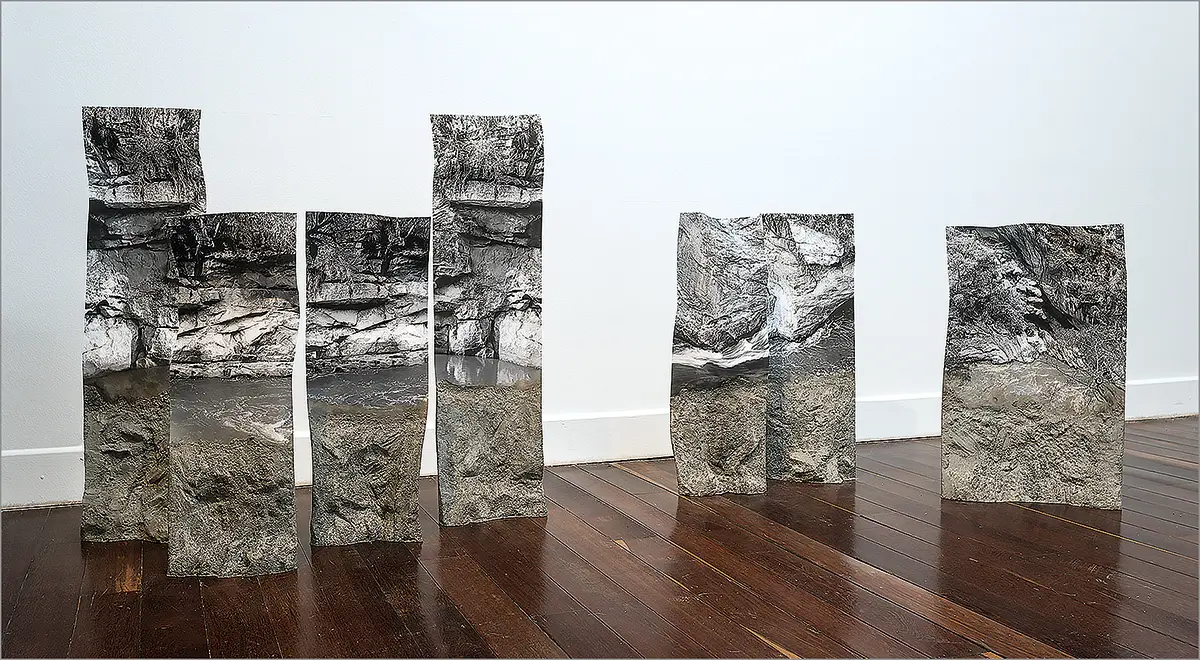
Based on that, we are able to apprehend a space that questions the status of time as a linear construct created hegemonically to denote causes and consequences derived from social processes, from positivistic constructs, or even from impositions about how to read history. Cárdenas has disarticulated that time, dismembering and provoking it a gaze that is more organic, more in communion with nature, and, of course, more transversal and sinuous. Cliffs come undone, showing their fragilities; bluffs, and their long years of geological formations fight against time. With her interventions, the artist has been able to render visible for us the fact that there is no “inside out” to time, no beginning or end, and that time and space are as palindromic as the word that gives the exhibition its title: reconocer (to recognize; in Spanish, it is formed by adding the prefix re- to conocer, which means to know; a literal reading is to re-known).
This simple yet admirable move begins to generate cracks in the way that knowledge has been handled in the modern era, slowly prodding us in the direction of posing questions about how we have constructed history, our history. The Great Lie resulting from progress by invented truth and fragile necessities that have only driven us to the long wait for a future that will never come. In the show, we are able to construct ourselves on the basis of the air that remains between the transversal threads of an eroded mountain. With an almost sarcastic stance, we see that time crumbles down and comes undone, not only on the landscape that is built but also in the confrontation of the viewer’s body with the geographic features that emerge from the floor. Whether at one point the floor bifurcates and rises, making it possible for us to see the time underfoot1; the horizon becomes as fragile, poetic, and seductive for us as an infinite hourglass; or the image of a mountain struggles between the instantaneous photographic act and the sculptural reflection on a formless mirror, questions will not cease to accost us. Subtly, the spaces created by Leyla Cárdenas become aggressive. They become subtly aggressive.
According to Cristián Simonetti, one of the authors consulted by the artist, an archaeologist’s reading pattern does not flow from left to right, which is how we read and write and conceive of time and history, but up and down. The lower we get in the Earth’s strata, the further back we are in time. The reading of time is different, then. In the traces and singularities of geological layers, we will only find the inscriptions of large-scale events2 (ice ages, periods of incessant volcanic activity, repeated earthquakes, great atmospheric shifts, etc.) To go back to our previous point, this vertical reading of horizontal layers is what we encounter, for example, in the video installation included in the show, which features no beginning or end but a slow continuum in an absolute present, a Borgesian time that is as cyclical as it is labyrinthine, alternating the before and after as in the ruins represented in Renaissance-era paintings, or as in Giorgione’s The Tempest (1506-1508). Time oscillates up and down, and it suddenly crashes against a reflecting pool that subverts even its own narrative. As she observes the slow-motion rotations that alternate in a coiling and uncoiling yo-yo, Leyla Cárdenas plays with time and, in consequence, with history. If history is tethered to measurable scientific principles that render it “real”, the reflecting pool in this video installation brings even the issue of historicity into question.
NOTES
1. “On the development of time concepts in archaeology”, Cristián Simonetti.
2. The Never – Ageing Ager, Soren Jensen.
ANDRÉS GAITAN TOBAR