
Maria Elena González’s newly created works in wood, porcelain, and concrete represent the artist’s concept of the works as both sculpture and musical instruments. In Tempo, her recently opened exhibition at Hirschl & Adler, NY, González explores the relationship between the physical presence of the objects and the acoustical possibilities she envisions from a complex process she has developed to make sound effects out of trees, thus she creates a voice for the unspoken vegetation around us, and narrates a relationship with nature that is both uniquely appreciative of its importance for us as an audience and receiver, as well as a new expository groundwork for meditation on this subject, which becomes more important every day as we become more aware of the fragility of our environment and the dramatic changes that it is undergoing at present, which is a direct consequence of our intervention and misinformed attitude to that reality.
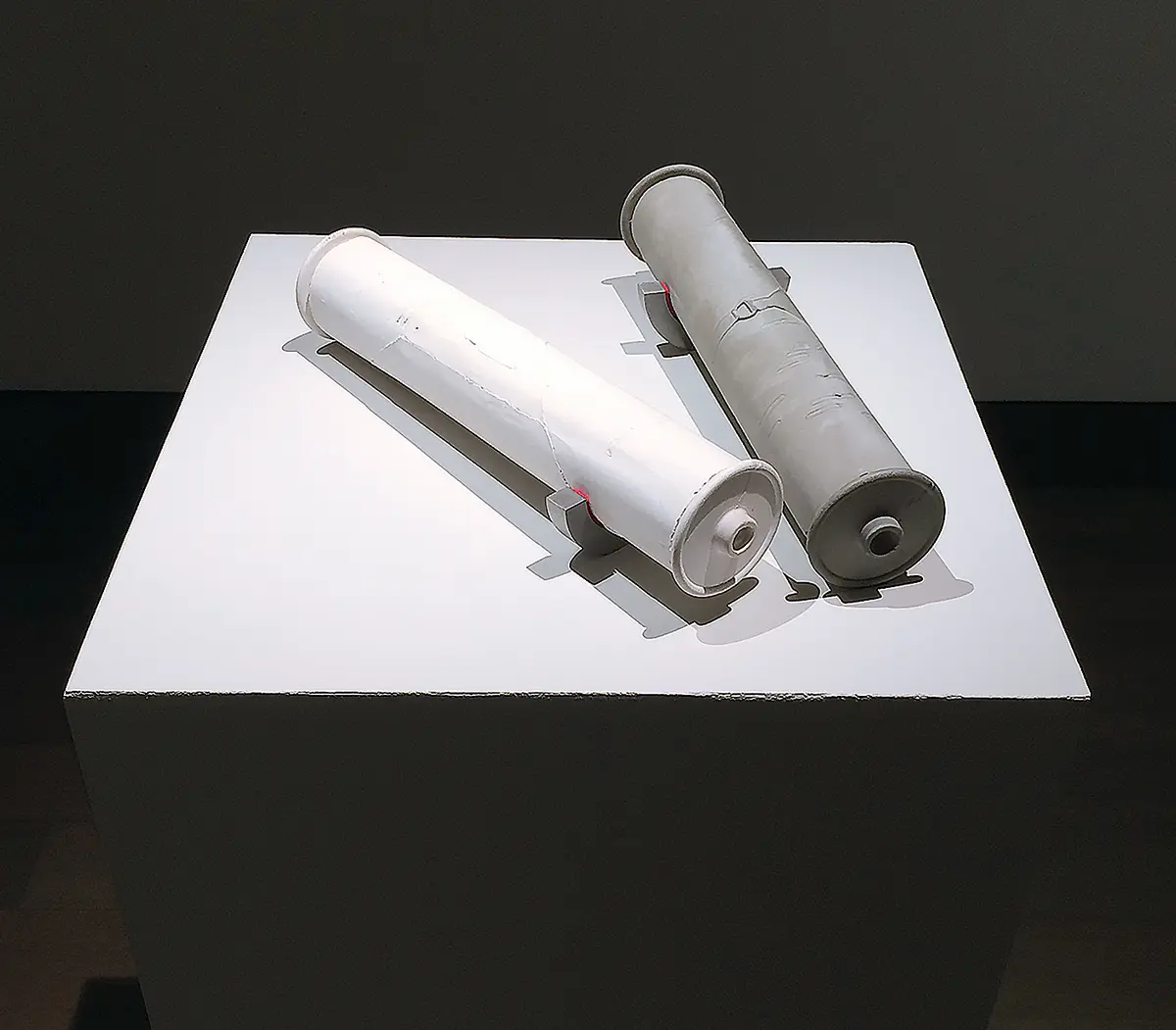
The artist exposes the deep-rooted sound of these materials and makes that sound itself a building block of her sculptural pieces. As a continuum of her Tree Talk series this new development in her work marks an exploration into uncharted territory, albeit one that has captured the attention of contemporary artists like the recent exhibition at the Prada Foundation at Ca’ Della Regina in Venice (2014) testified. This extensive and comprehensive exhibition, curated by Germano Celant explored the relationship between art and sound and the way it has developed from the 16th Century to the present and was particularly valuable at presenting works that developed this relationship much further through the 20th and 21st centuries with the developments of technology. Gonzalez's cross-references between the objects exhibited and music are her interpretation of a process where technology interacts with natural materials to expound on new horizons of perception.
One piece in particular at this exhibit beautifully illustrated the relationship between sound and object. Clave is a work that represents two cylinders that look possibly capable of producing sound and certainly look very close to the original wooden cylinder-like shaped musical instruments. The Clave is a traditional Cuban instrument of two pieces of wood that marks the rhythm in Cuban traditional dance music, dictating the steps of the dances as well. From their position in popular dance music, the claves later expanded to the concert hall, where the instrument remains a key identifier of Latin American music.
Turn I and Turn II are wood pieces that represent the piano rolls-like instruments of the sound system that the artist has designed. The look of the pieces, however, particularly Turn II which comprises two larger cylindrical wood pieces elevated from the floor by metal stands, reminded this viewer of Babylonian foundation cylinders which contained in the iconic cuneiform writing of the time, the description in detail of the newly installed structure they were meant to commemorate. Gonzalez’s notations have a similar series of mysterious coded markings that are her interpretation of the birch tree’s natural markings transformed by her into musical codes. There is also a very strong element of the monumental memorial, about these works, which refers us to issues of memory and remembrance that are a consistent component in the artist’s work. Although the look of the works, which included video and large pieces on paper, definitely portray a post-industrial aesthetic, Gonzalez addresses deeper possible interpretations about the workings of nature and our relationship to materials, her concrete and porcelain pieces reflect the influence of tree forms and textures, and they open up possibilities of dialogue with different art forms, acting together to reach unexplored regions of understanding.
ALBERTO BARRAL