
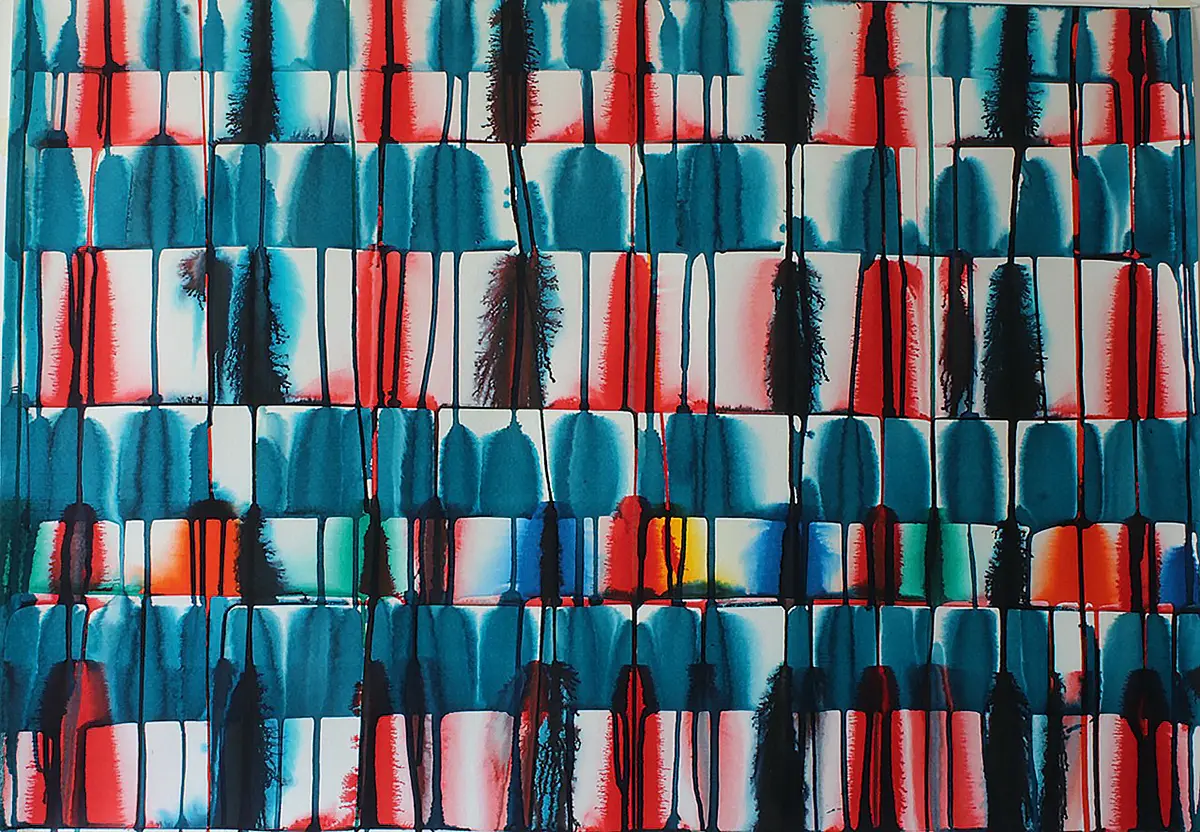
The title of Martín Reyna’s exhibition at Teodora Galerie in Paris is En suspensión. The Argentinean artist executed an installation covering an entire wall, twelve medium-format works (most from the last two years), and a diptych from 2010. All are untitled mixed media on paper.
Martín Reyna was born in 1964 in Buenos Aires, and he lives and works in Paris. He started as a painter at a young age and has had a significant career since the late 1970s, influenced by the period’s Neo-Expressionist wave. It was a time when eclecticism, the values of artisanal work, and the projection of feelings and emotions predominated. In recent works, however, Reyna displays connections with action painting and the Latin American abstract movement.
Be it in oil or acrylic on canvas, a fluid universe made of inner vibrations determines a relationship with the real. The recurring subjects are trees and houses surrounded by a controlled emptiness.
There is a subtle difference in tone and suggestiveness between Reyna’s previous works in ink, more serial in form, and the new ones, where essentialism is de rigueur.
Reyna intervenes with the still-wet paper by applying color with syringes or droppers; the water decides the path and the combination of the colors. Color is applied from above, once the lines are traced on wet strips. This has to be done quickly and intuitively since once the surface dries the accidents cease.
The various, rich monochromes and polychromes settle like a musical score, a base system. The elements traverse the work, be it anchored to a frontal surface or within Euclidean space. This time, Martín Reyna adapted his tasks to a specific context.
At each step, viewers encounter a new plot, the suggestion of an opening to the world, a passage, a path, or a repertoire. A non-representational imaginary within a universe that is lyrical and watery in its essence. The results, which express both fragility and solidity, appeals to recondite places of memory and subjectivity. A kind of test of psychophysical signals. And while chance does make an appearance, it is for the time being a controlled accident.
Parisian audiences were able to observe the artist in the course of executing one of his paintings on-site, to the accompaniment of Isaac Albeniz’s Asturias, at the Maison de l’Amérique Latine in October of 2013. Reyna transformed the thirty-five square meter space, with its four-meter high ceiling, into a studio. Starting from a scheme of lines in perspective on the central wall, the lines continued throughout the space. The reference is not direct. It is just one more instrument in the artist’s hands.
Reyna follows specific criteria in the selection of his tools, and the image is “poured”. The artist extends his system into space, as in the case of the series around the letter “H”, in a suggestive Spatio-temporal synthesis. The reference is not direct.
The house as a symbol responds to an unflagging need for affirmation. The metaphor is just another instrument in his hands.
The subject is not limited to what is represented. As if faced with a challenge, the viewer is trapped in a web with its base on every one of the points where the signifying gaze seeks to rest. But that is only the beginning.
Due to a kind of magic or polysemic ambiguity, the artist’s subjectivity and the subjectivity of the participant come to share a virtuous vibration point. A dialog is established in a kind of metaphysical poetry, and the gaze expands. The repertoire is varied and provokes cognitive tension in the various assemblages and in every chosen medium.
Constantly challenging us but also with a sense of playfulness, Martín Reyna “shows” the uninhabited aspects of the habitat, the intangible aspects of the visible. Inscribed in an “expressionism of absence,” each color note drips to the same time disfigure and figure the space that contains it.
Reyna’s works are found in collections in the United States, France, Belgium, and Latin America.
SUSANA SULIC