
The landscape has been engaged as a subject in many different ways in the history of art, perhaps because it symbolizes the primordial origin of individual and collective identity, as an acknowledgment of our situatedness in a specific environment. In the space of the arts, the concept of identity is so enigmatic and mutable that an urgent need to recognize what defines it, and eventually makes it visible for the reassurance of some, recurs constantly.
Arriving in Venezuela in 1981, Natalya Critchley (Bournemouth, UK, 1963) was captivated by the local landscape. The following year she moved to Puerto Ordaz, an industrial city located in the vast expanse of Venezuelan Guyana. Light, climate, and nature complement each other as attributes of reality. Critchley’s encounter with the light of the tropics drove her to paint the local industrial landscape in order to recognize herself in that environment and make it her own. This is why she used such furious colors to paint her new reality, the place she had chosen to forge a new identity under the cover of a suggestive, fierce landscape. The people Critchley found there were also pioneers, and like her, they were searching for their place in the world. This is how she began to give shape to the narrative of the social and industrial project promoted by the Venezuelan democracy in the country’s southern region in the 1970s.
The exhibition Crookedfield says Hi to Henri Hair Mattress, presented at the Museo de Arte Contemporáneo del Zulia in Maracaibo, is retrospective in character and brings together Critchley’s production from the last thirty years. Medium and large formats reflecting a spellbinding scale that, transported to Caracas, will become the portrait of a city marked by chaos, inequality, and violence. From those long and productive pictorial processes, Critchley gradually extracted recurring shapes that came to configure a personal alphabet. Signs of various referential, morphological, and symbolic references that on occasion seem to represent the curved, intricate nodes of high-speed expressways, and at other times the human body with its vital organs and its systems of fluids. The alphabet is a synthesis of signs that appear as a constant in many of Critchley’s works, but the signs are also worked individually on large rubber sheets, emphasizing their emblematic graphics.
The title of the exhibition is a personal salute to Henri Matisse, for whom Critchley feels great admiration. Matisse was mocked as Henri Hair Mattress when the Armory Show exhibition traveled to Chicago in 1913.
Unfolding in the ample spaces of the Zulia museum, the exhibition features the unique images of a pictorial oeuvre that engages the landscape not as a site of pleasure, but in order to reveal its contamination. Critchley deals with physical detritus, social violence, and industrial spaces via the complexity of symbols and allegories. Her approach is indebted to such masters as Paul Klee, David Hockney, and Philip Guston, as well as Matisse. Tangled structures, distorted perspectives, cluttered hodgepodges: the landscape as a stage for human action.
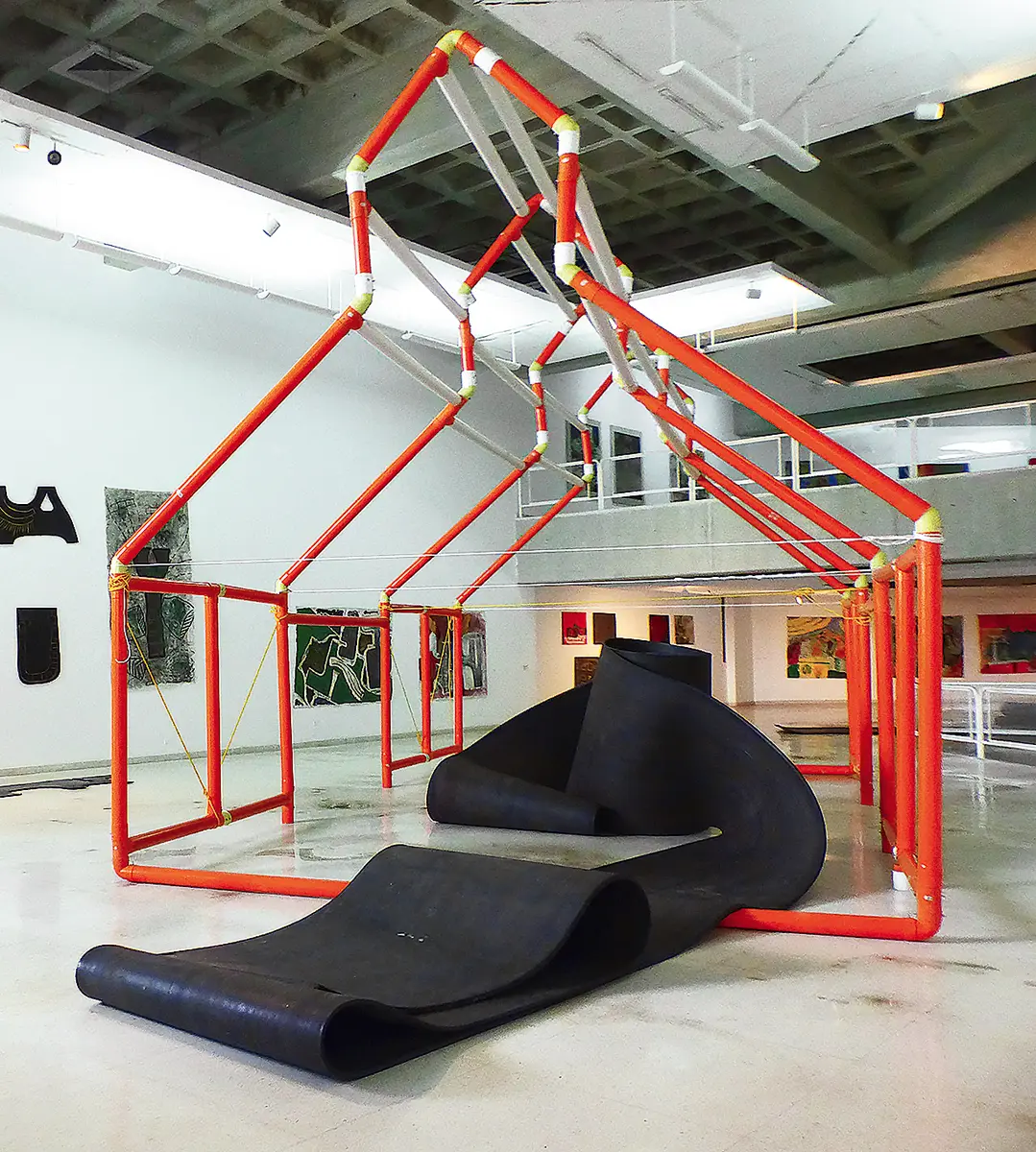
Natalya Critchley is one of the few artists working in Venezuela with the landscape as a constitutive element of the territorial imagination. This exhibition signals a radical shift in strategy for the process of inclusion in the work of art of the different human groups who make a living in the city outside all institutional systems of participation. Collaboration has pervaded the concepts that defined in recent years art exhibits and specific artworks seeking to open themselves up to democratizing political projects. It was perhaps the exhibition work around the Metrocable de San Agustín, presented at CELARG in 2009, that triggered this turn towards the collaborative. Then came De San Agustín a Los Palos Grandes at La Caja del Centro Cultural Chacao, in 2015, followed by Oficina de Turismo at the Museo de Arte Contemporáneo, in 2015, and the exhibition at MACZUL we are now reviewing. Concepts like citizenship, conciliation, emancipation, and identity are engaged via the collective execution of the work. Meanwhile, Natalya has developed leadership and group management skills, and she has especially had to deal with the notion of solidarity. Art is a utopian dream, a vehicle for people’s empowerment. For example, Línea de producción (Production Line, 2016) is an interactive work based on a plastic-tube structure that resembles an industrial warehouse, traversed by a large strip of black rubber. Carved with different images, that surface operates as a lithographic plaque upon which groups of people draw on paper plans. The participants “paint” their lives by means of images that they select on their own, and in that way build the memory as well as personal and collective history. They come together, share, live the experience of creativity, and skepticism transforms into participation. Natalya Critchley continues to construct the cartography of her identity alongside people who, consciously or otherwise, go on the same quest.
TAHÍA RIVERO