
The exhibition titled Seat by Saidel Brito (Matanzas, Cuba, 1973) has the quality of being disturbing, despite the unknown origin of the images that it traffics with. The viewers better suited to interact with these images are those who have experienced the history of Ecuador during the last thirty-five years, the period corresponding to the country’s process of democratization. But Brito is also interested in contrasting the interactive possibilities of the show with the response of younger generations so the discourse can reach beyond the local.
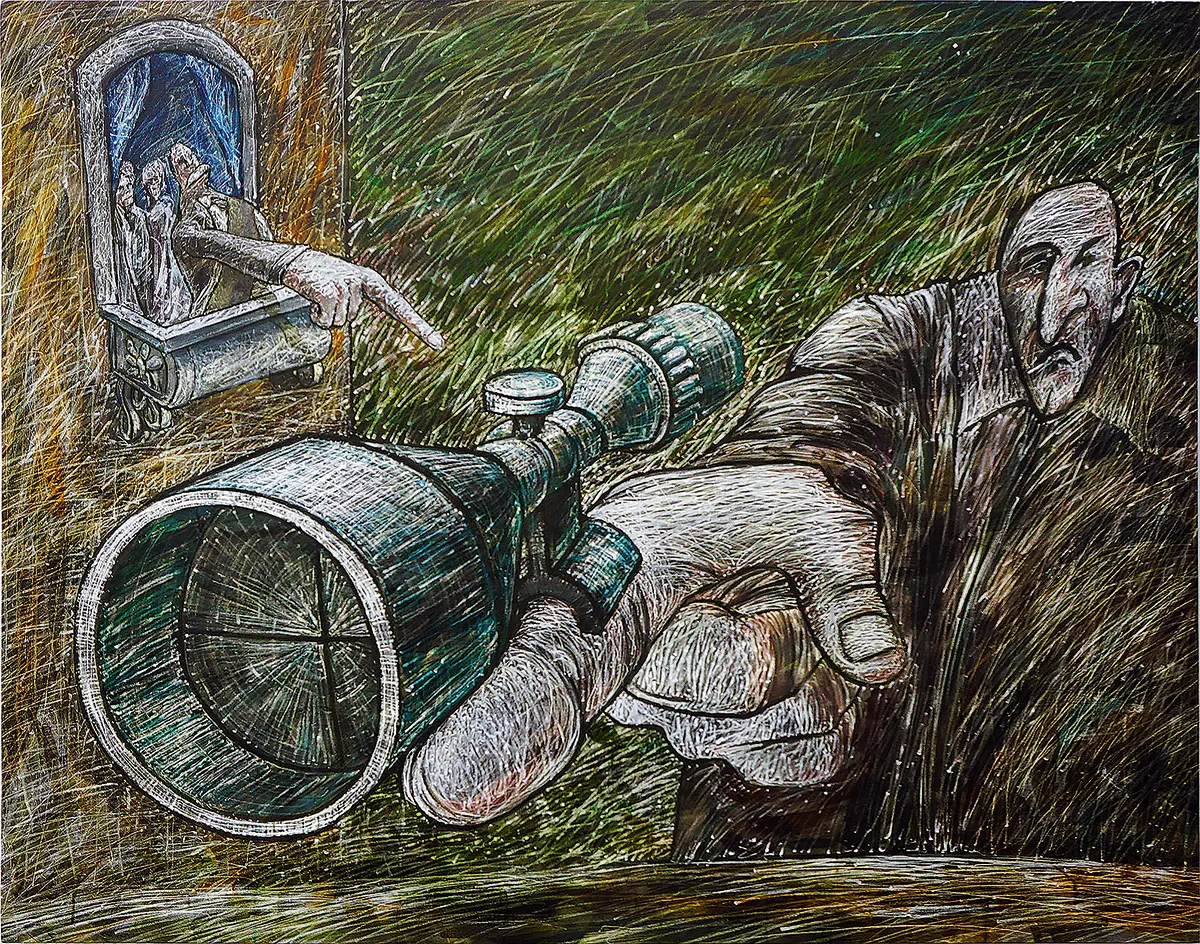
It is no accident that among the eighteen works featured at the DPM Gallery, the exhibition was titled after the only installation included. This typology of a seat, of Etruscan origin, used by magistrates since the times of the Roman monarchy as a symbol of real power, continues to be relevant in Latin America. It is also the seat occupied by senators and representatives in congress and in the legislative branch. Here, it is the work excerpting the centrifugal power of the discourse. Brito researched copies of El Universo periodical to look at the history of democracy in Ecuador since 1979 through comics. That the seat is represented through an aesthetic nomenclature associated with dematerialization reveals the rules of the game that interest Brito. Arranged on a red platform, as if alluding to the socialist connotation of progress in Ecuadorian territory, the installation addresses the shifting areas of creation, the possibility to experiment, to burn the art object. Conversely, the two-dimensional caricatures rendered on canvas or paper approach viewers from a pragmatic perspective, from tradition, and from visual traps.
Brito’s favorite cartoons have been those created by Luis Peñaherrera-Bermeo, who signed his contributions in the periodical as Robin and who is known for being the creator of Juan Pueblo, an iconic character that encapsulates the idiosyncrasy of the people from Guayaquil; and the cartoons by Xavier Bonilla, aka Bonil, whose sharp gaze has zeroed in on the last ten years of the Ecuadorian democratic process. The works by both cartoonists have helped Brito to unleash a group of highly iconic and, at the same time, puerile images that ridicule the credibility of the platforms in which they were used, the processes that sparked them, the political actors, and the economic, cultural and electoral “contexts.” The greyness of the canvases connotes every possible subterfuge within the democratic regime, and their ironic tenor (since they were appropriated precisely from the entertainment section of the aforementioned publication) uncovers the lack of transparency in those saturated contexts. What is then the relationship between these historic revisions and the paths marked by Brito’s art and its preoccupation with the critical destiny of creation? In Brito’s opinion, for the last decade, Ecuadorian art has opted for adherence to institutionalism and has avoided its critical component, which is a tendency that demerits the cultural processes and avoids confronting censorship. In many instances, in order to secure funding, artists have favored participating in competitions organized by the Ministry of Culture, something that restricts the legitimate sense of creation.
To activate a reading beyond the visual, Brito has established connections with literature, history, and universal thinking by giving his work the title of literary images by authors like Reinaldo Arenas, José Lezama-Lima, Jorge Luis Borges, Carlos Monsiváis, as well as Salvador Allende’s last speech in 1973. In this manner, the piece titled Las Alamedas del Porvenir (The Avenues of the Future), a title based on that last speech by the Chilean president in 1973, strengthens a reading associated with censorship and power that acquires unforeseen connotations in the temporary framework in which the piece was exhibited—given that the show opened just before the electoral period in Ecuador.
The disputes that have occurred since the beginning of western culture—where the discourse of the exhibition points to, after appropriating that seat that epitomizes the tense relationships between democracy and totalitarianism since the times of the Greeks and the Romans—are constructed in the ideological and aesthetic thesis that pushed the ideas forward beyond the local context, in order to establish dialogs about the future of mankind given the current conditions of political uncertainty.
The texts are taken from the balloons and bubbles of the cartoons researched by Brito, and the tweets exchanged during the development process of certain works, are some of the ways to build the dense “cushions” of the content found in the pieces. While such densities could very well provoke rejection, they can also lead to inquiries. They are suggestive of the poetic cadence announced in the titles. Atruena la Razón en Marcha (Reason Deafens in Demonstration), for instance, one of the sharpest pieces in the exhibition, may seem overwhelming for showing the possibilities of democracy in public demonstrations, in squares, as part of the construction of a much needed civil society, just as Carlos Monsiváis used to call it.
At its core, Seat offers an analysis of democracy as a government model still under construction and addresses the challenges of its less promising side, when our own decisions could be responsible for leading us into a totalitarian option. The possibility of building that destiny through the skeptical gaze of research, the recovery of historic memory (archives), humor and creativity, could become a possible path towards the emancipation of mankind without having to revisit the same places.
AMALINA BOMNIN