
In an interview included in the 2009 catalog Imagens em migração (Images in migration), Vera Chaves Barcellos answers a series of questions posed by curator Glória Ferreira. Among other topics connected to her trajectory, one of her statements is interesting as an introduction: “printmaking and photography both offer the possibility of producing copies, and that is almost an addiction, it becomes an addiction when you make prints, that possibility of producing copies. My resistance to painting, due to the fact that it is a single unique item, is also connected to that potential for multiplication.”
Recently, Chaves Barcellos presented a large-scale solo exhibition at Rio de Janeiro’s Paço Imperial, titled Fotografias, manipulações e apropriações (Photographs, Manipulations, and Appropriations). This exhibition offered the public a rare opportunity to approach the ways in which this artist, whose long career began with studies in printmaking in the 1960s, has probed the sequencing of images.
Some of the works in the first exhibition space already point towards these concerns. For example, O peito do herói (The Hero’s Chest), from 1966, comprises a series of nine images created by means of photographic manipulation. Presented side by side, each photo print features the reproduction of a Greco-Roman breastplate. Instead of highlighting the initial photographic referent, the artist places the image in the field of pictorial fantasy and suggests a series of images that look like the frames of an animation. Underneath, a large, dyed woven fabric refers to, and at the same time enlarges to gigantic proportions, the element found in the photographic referent. The relationship between the original image and manipulated image, the duo of the real and of materiality as such, is made present in this experiment and brings forth for the audience some of Vera Chaves Barcellos’ constant themes.
Something similar occurs in Os nadadores (The Swimmers), from 1988, and already the plural title brings us to another narrative construction: manipulated newspaper photographs accompany a swimmer’s plunge step by step. The body is replicated several times and created chromatic tones that transform it into the storyboard for an unrealized movie. To my mind, this is one of the greatest potentials in Vera Chaves Barcellos’ investigation: the ability to fragment static images and to suggest not only physical motion but also narrative development. These works were created at a historical time marked by the power of the mass media (like newspapers and television, also referenced by other artists of the period, for example, Andy Warhol), and as such is good anticipation of the state of the image in more recent years. In other words, these are the very sequences of images that interest a younger generation of artists, albeit no longer printed but in GIF format.
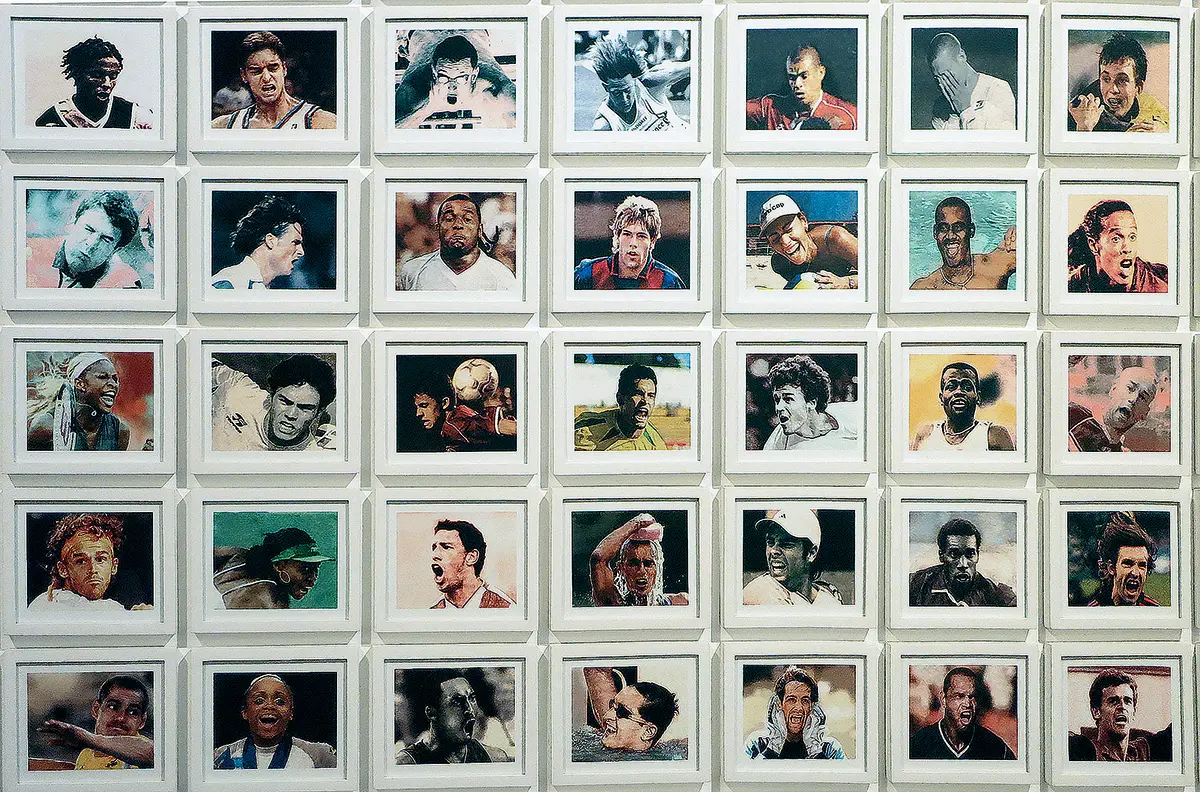
The repetition of a single body gives way to an anatomic multiplicity in O Grito (The Scream), interesting work from 2005. The semantic field of athletic practitioners is again present, but the artist is now interested in an inventory of facial expressions that are neither harmonious nor symmetrical, by shouting subjects. There are victory yells, pained screams, lamentations of marks missed by mere centimeters; what holds these images together is photography’s inherent silence. It is difficult to contemplate these images and not remember, for instance, some of the most famous screams in the history of Western art, from the Lacoön to Munch’s iconic painting. And here we encounter another important verb for Vera Chaves Barcellos’s work, in terms of technical reproduction: to collect.
The activity of collecting is present in most of the exhibition, in several different ways. There is a large-scale work, Casasubu (Ubuhomes), from 2006, made at Ubu beach in the state of Espírito Santo. The artist photographed a variety of tropical-architecture façades and, after painstaking digital operations, confounds the viewer’s gaze by mixing elements from different shots. What we have in front of us is a work of art where the photographic act was executed by the artist herself and manipulation no longer takes place in an artisanal way, but through computers. This is just an example of how Chaves Barcellos achieves and insists on her poetic/operational interest, but by means of different media. The boundaries between photography as a record of the real and as something that turns into fiction are blurred, and only a careful study will make it possible for the observer to figure out what was architecture and what a mirage.
Finally, with discretion and eschewing the rusticity of Pop Art, the body of the artist is present in another series, Meus pés (My Feet), which started in 1970. Vera Chaves Barcellos—constantly in transit between Barcelona and Porto Alegre, and between her occupations as director of her Foundation and as practicing artist—photographs her body in high-angle shots, always from a first-person singular point of view. Mounted directly on the floor at Paço Imperial, those photographs are an example of how serialized and sequential thinking is present in the most workaday experiences in the life of the artist. More than that, given the time range, they can be seen as a record of the passage of time, both in terms of the photographic techniques that went from the analog to the digital and of the biography of an artist whose presence has gone from local to global.
Appropriations, manipulations, collections, mirages, and self-images are some of the keywords in the investigation presented in this exhibition by Vera Chaves Barcellos. It is an excellent opportunity for Rio de Janeiro audiences to encounter her work and, of course, to establish connections with contemporary artists who produced in dialog, such as Anna Bella Geiger, in Rio de Janeiro, and Regina Silveira, in São Paulo. One can also consider which of the traditions active in Chaves Barcellos’s work have not become a point of reference for a younger generation of artists who regularly reflect on the dichotomy between the unique image and its multiplication.
RAPHAEL FONSECA