
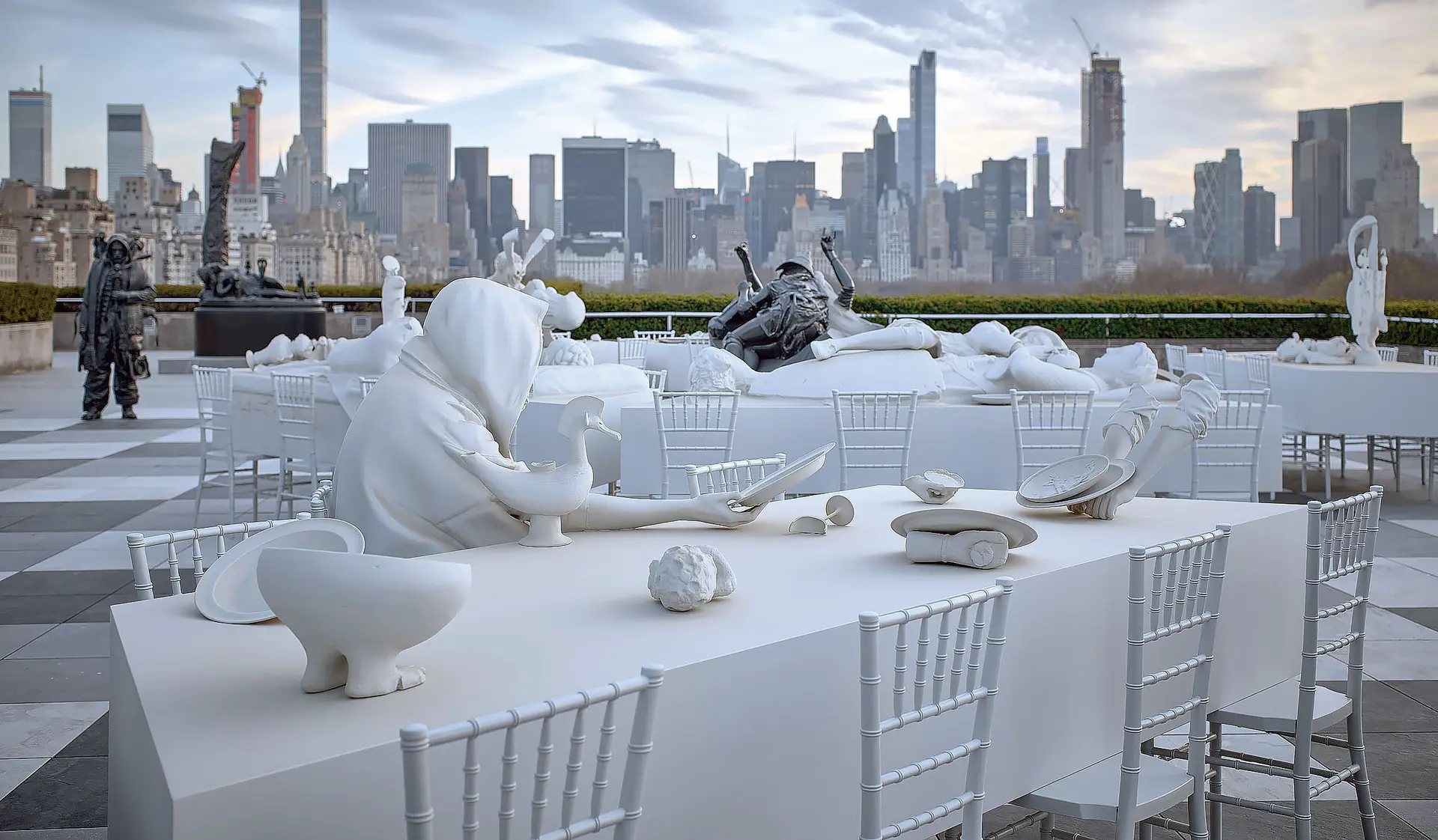
“Theater” and “disappearance”—words featured in the title of the recent exhibition of works by Adrián Villar Rojas (Rosario, 1980) at the Metropolitan Museum’s Iris and B. Gerald Cantor Roof Garden—are not terms, locations, or metaphors for non-places unconnected to the artist’s thinking and practice. In his conference last year at the New School’s Vera List Center, for instance, Villar Rojas (who prefers the words “thing” and “disorder” to art or public space, refers to his practice as to a theater, seeing himself as a “director” and his “team”, whom he also calls his “collaborators”, as the “actors” in the process in which the works take place.1 And those works, which are not transported from one place to another but exist only once and only in a single site, are manufactured over the course of months in temporary “laboratories” in order to be exhibited and then disappear. An itinerant theater that can be said to resist and represent the post-capitalist, post-human contemporary while at the same time longing to return to that distant aura that Benjamin wrote about almost a century ago. In my opinion, what occupies Adrián Villar Rojas are the artist’s own sensorial experiences and those of his collaborators and the audiences confronted with his fictional works; in other words, the effects arising from those imaginary theaters that are at the same time organic and post-human.
In terms that are more technical than philosophical, this is what the art world knows as site-specific. In Villar Rojas’ work, for example at the Moderna Museet in Stockholm in 2015, clay and concrete make, in their fragility, an apocalypse from the science-fiction worlds that characterize the artist’s sculptures, but also a document of their ruins. Everything (the shoes, the moss, the fruit, and the pigment) was destroyed once the theatrical run—the exhibition—ended. But as we were saying, that disappearance is also a ruin—writing that knows from the start that it is also a mirror, mimicry, rupture, and fragment. This is, then, a theater of ambivalences made from hybrid objects that are so strange and so pointed that they interrupt, because of their monumentality, the geopolitics of power in museums and galleries around the world. The images are thus the dramaturgy, and it is precisely this kind of theater script that viewers are confronted with at the Met’s Roof Garden.
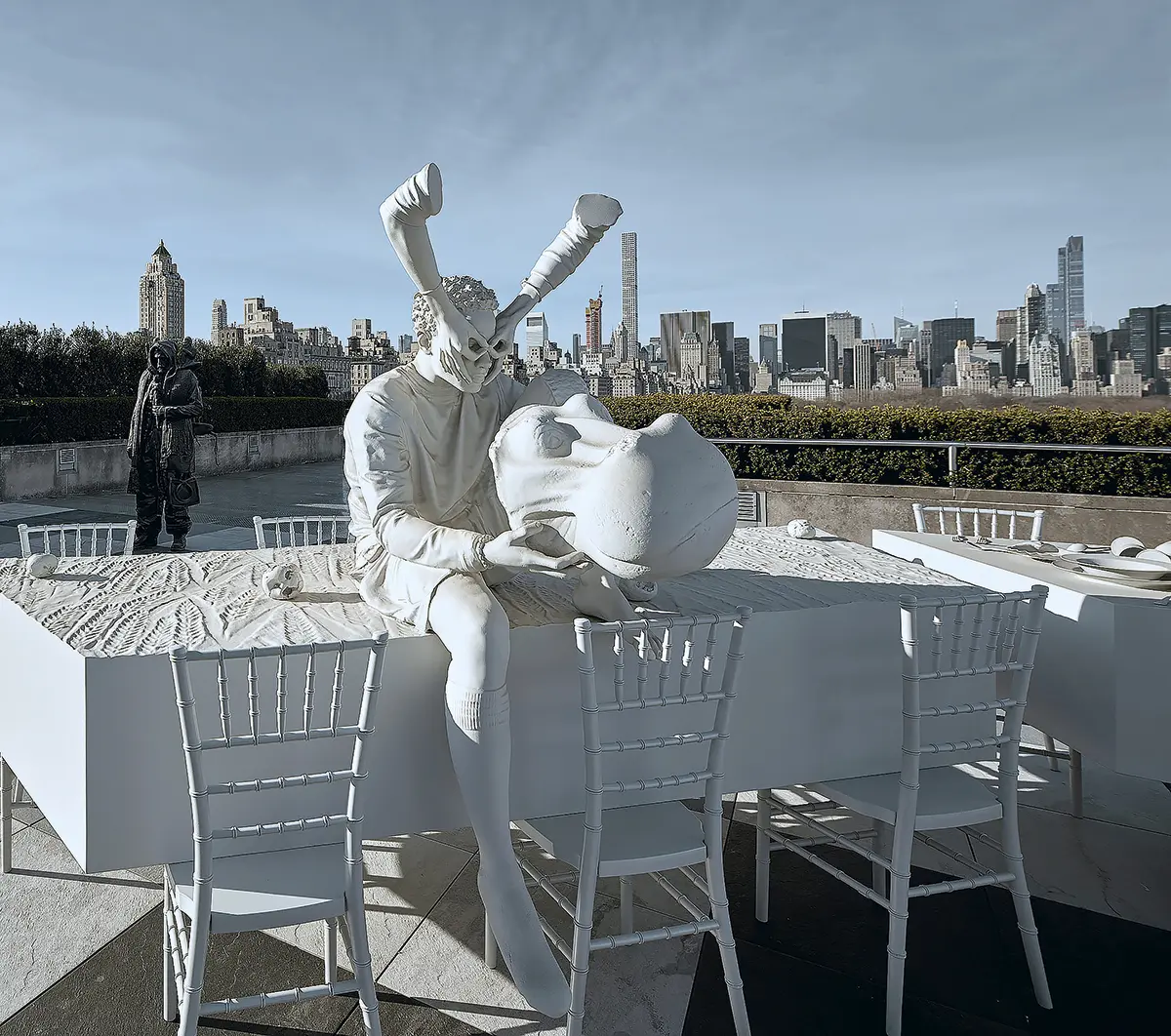
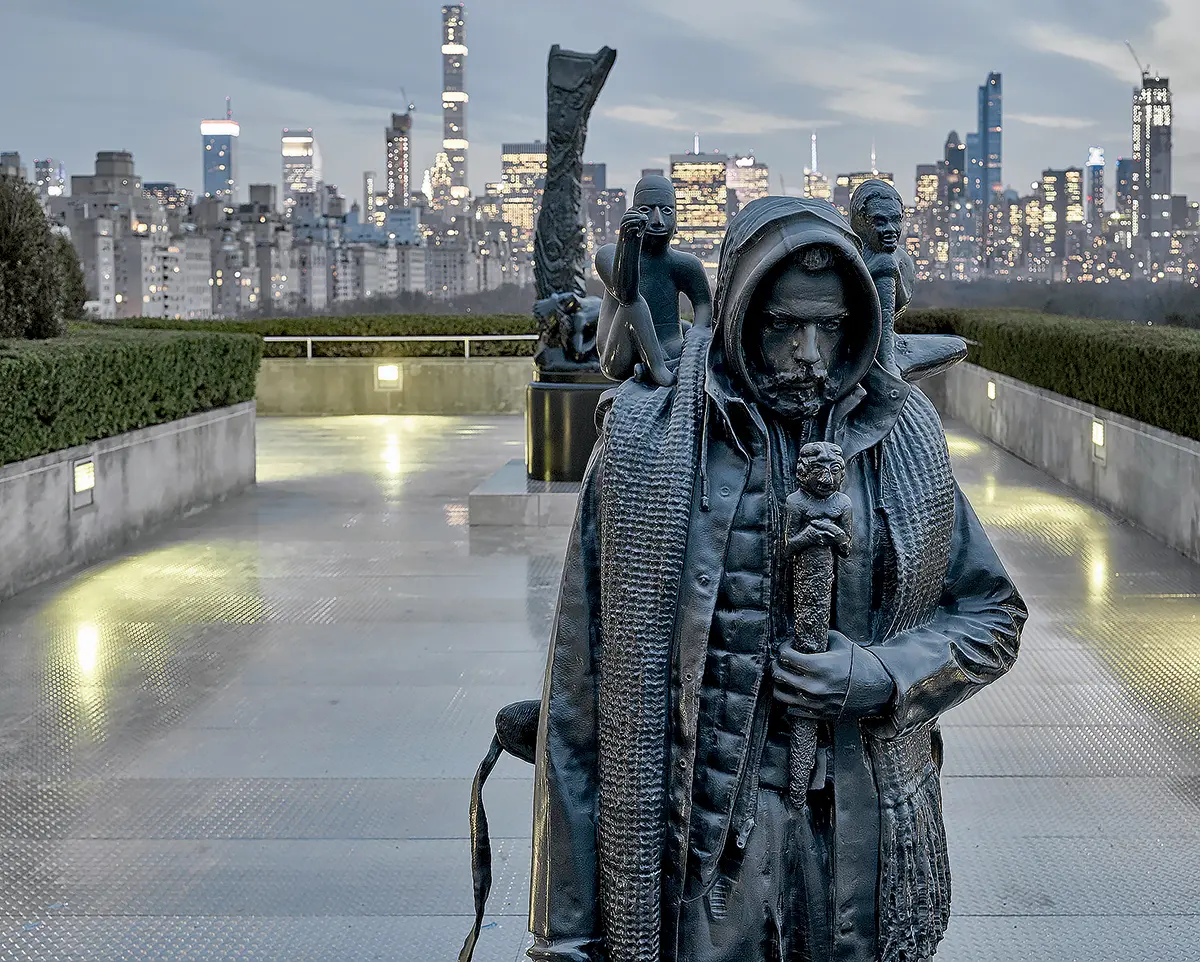
Made no longer in clay but in urethane foam with layers of matte industrial paint (which prompts a disappearance beyond mere materiality), sixteen sculptures that mix human figures with replicas of nearly one hundred objects from the museum collection, selected from different periods and cultures, occupy the space in its entirety, installed on a floor in black, white, and gray tiles that were created, like the bar and the landscape design, specifically for this site; the work, titled El teatro de la desaparición (The Theater of Disappearance), includes dust, food, and animals, as well as an interrupted circuit of white tables with replicas of Tiffany chairs supporting them. In fact, many sculptures are an amalgam of those tables and that dust, while others set themselves apart from the dramatic feast. Within this second group are a young contemporary couple kissing and a man painted black resting on his left leg. The man, a totem that surpasses human scale and carries on his shoulders a small Hellenistic sculpture and a small Mesoamerican one—which is not, as has been said,2 an attempt to reproduce a Cartesian model like the figure of the angle and the devil, but to interrupt it—lowers his head and his gaze, yet he seems to be watching us vigilantly. Perhaps he protects or forgets, what he left behind: a sculpture on a plinth whose origin we could recognize with some precision: Thomas Crawford’s mid-Nineteenth Century marble sculpture titled Mexican Girl Dying. But the fact is that very few sculptures reveal their origin, intent as they are above all on revealing imagination as a site for the aura, as a possibility to differ from the encyclopedic museum that at the same time drives the artist to such an imagination. In that sense, Villar Rojas’ critique is not just intended to question, rather late, the classificatory systems within the encyclopedic museum, as so many artists did four decades ago, which would be nothing more than a reproduction of the power of an institution that negates itself to underscore a supposed diversity. Rather, what we have is a desiring, exuberant script that imagines in and with the museum, fascinating some and irritating others.
NOTES
1. Adrián Villar Rojas. Conference. Public Art Fund at the New School. January 25, 2016.
2. Jason Farago. “A Mini-Met Mashup on the Museum’s Roof, With Summer Views”, New York Times, April 13, 2017.
FLORENCIA SAN MARTÍN
Ph.D. candidate in Art History, Rutgers University. Art critic and curator.