
Enemy of the Stars, the multimedia exhibition by Peruvian multidisciplinary artist Alan Poma at the Museo Mario Testino (MATE) in Lima, Peru, borrows its name from an experimental play by British artist Wyndham Lewis written in 1914. Based on that work, Poma reinterprets the meaning of opposing and complementary relationships in an original work as he commits to establishing inventive and ludic associations. These associations are used to build a bridge between himself and Lewis; between an English modern artist from the beginning of the 20th century and a contemporary artist from Peru working today.
This type of approach by Poma has a clear precedent in his work titled La Victoria Sobre el sol (Victory Over the Sun, 2011), an adaptation of the 1913 futuristic opera of the same name created by Russian painter and composer Mikhail Matyushin, with a libretto by Aleksei Kruchenykh and scenography by Kazimir Malevich.
The discovery of the painting by Lewis titled Inca and the Birds (1933) inspired Poma to direct the project towards the idea of future encounters between moments and places completely different from one another.
With this in mind, Poma put his referents into perspective: while the Incas would have regarded Lewis as someone from the future, the present from which Poma’s approaches Lewis’s vorticism would have also represented the future for that artistic vanguard. In fact, the artistic current founded by Lewis ("Enemy of the Stars" was originally published in Blast, the British magazine of the Vorticist movement) already was marked by the future as a result of the catalyzing role that Italian Futurism played in its inception. Nonetheless, the future in Enemy of the Stars is not one that will arrive soon; it is just as far away from us in 2017 as it was in 1914.
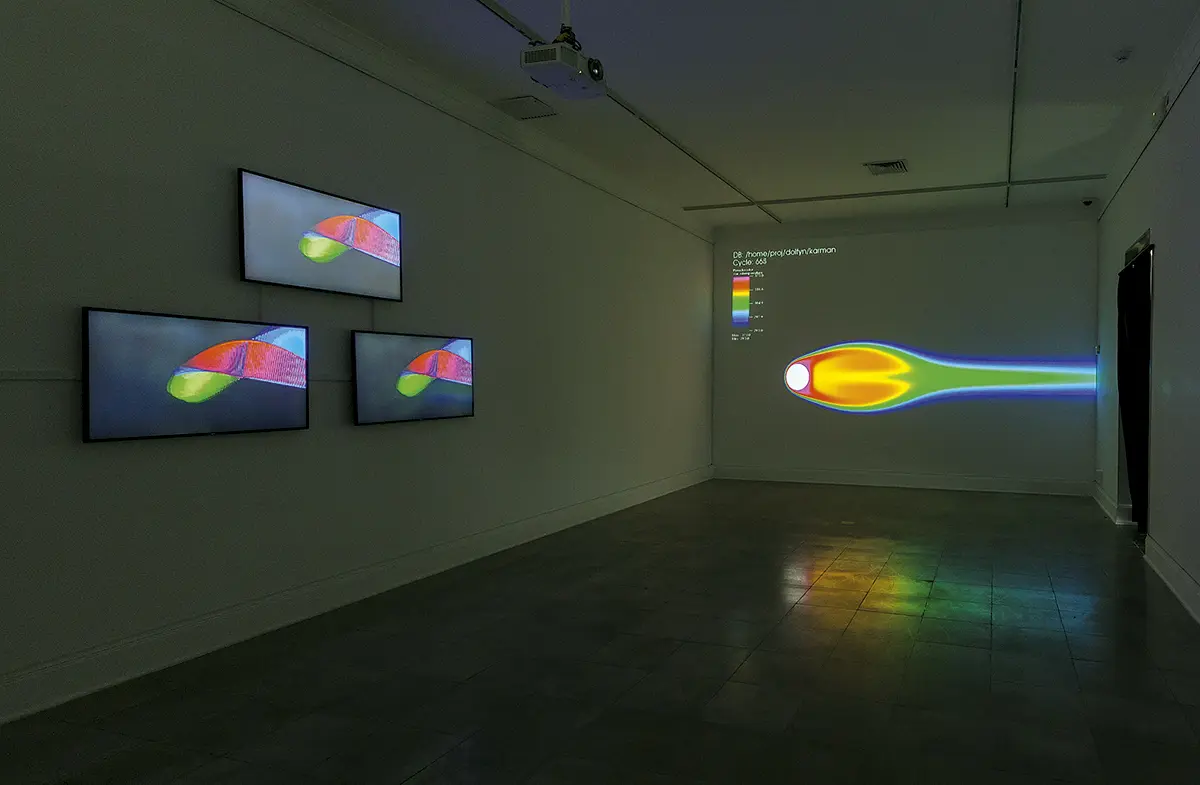
Two video projections and three monitors transform the museum’s exhibition space through lighting, chromatic compositions, and video images. These visual effects aim at a perceptual estrangement that symbolically places us in other time-space coordinates.
With the fantastic flight of an "andean bird of the future," Poma projects a stellar future emerging from Peru’s ancestral and millenary past. It is a narrative device conceived by this artist. The installation invites us to follow the trajectory of a migratory bird—we become some sort of copilots—as if it were a singular meditation with psychedelic tones.
The shot sequence articulates the Andean landscape, the cosmos, pre-Columbian archeological ruins, and a technological universe (through digitally created abstract images) that takes us on a journey where the sidereal and the earthly converge, as well as the digital and the natural worlds and past and present.
To some degree, this 23-minute -long flight corresponds to the recognition of dominions of unreachable dimensions. Geographically speaking, its length goes from outer space to the Andes of Cusco and, time-wise, it covers a millenary past—evoking the Pikillaqta, the Titicaca, and the Saqsaywaman archeological sites—and a distant future hinted through the science fiction winks contained in the installation.
But this realm also contains the natural world (the Urcos Lagoon, for instance), the artificial worlds of the present and the future (expressed through digital images), and the Andean cosmogony—conveyed through the idea of the Andean bird born from the sun’s reflection on the lagoon and covering Incan temples and fortresses. Incidentally, Saqsaywaman means “Place where the falcon gets satiated.”
Alan Poma establishes impossible nexus between seemingly unbridgeable times and spaces as he radically transforms them in the process. In this sense, he proposes a journey of discovery: this artist not only avoids the most renowned archeological site in Peru (Machu Picchu) but also offers zenithal views of the ruins covered and transforms them into abstract design patterns (closer, perhaps, to the artistic vanguards of the 20th century than to the millenary past or even than to its current standing as a tourist attraction?). Poma suggests a past that has broken with its past (The Inca Empire, the Colonization) as if it had forgotten it. But he also proposes a future that has broken with its future: scientific expectations and cinematographic imagination (NASA and science fiction), because there is a mystical and, paradoxically, ancestral element.
The artistic career of Alan Poma is a journey through an imaginary world in which past and future feed from each other, where an era is anticipated by an artist who is actually trying to invoke its birth.
MAX HERNÁNDEZ-CALVO