
The Teatro Nuovo film house, where movies first arrived in San Gimignano—a Tuscan city frozen in the Middle Ages—remained active for thirty-four years. One day, however, no one came for the show; the theater was “abandoned” as audiovisual entertainment options changed. Something similar happened to the Águila de Oro movie theater in Havana’s Chinatown. There, as blight spread through the building, locals from the community began to give it new functions. The common denominator in both cases is that today the theaters serve as locations for Continua Gallery in their respective cities.
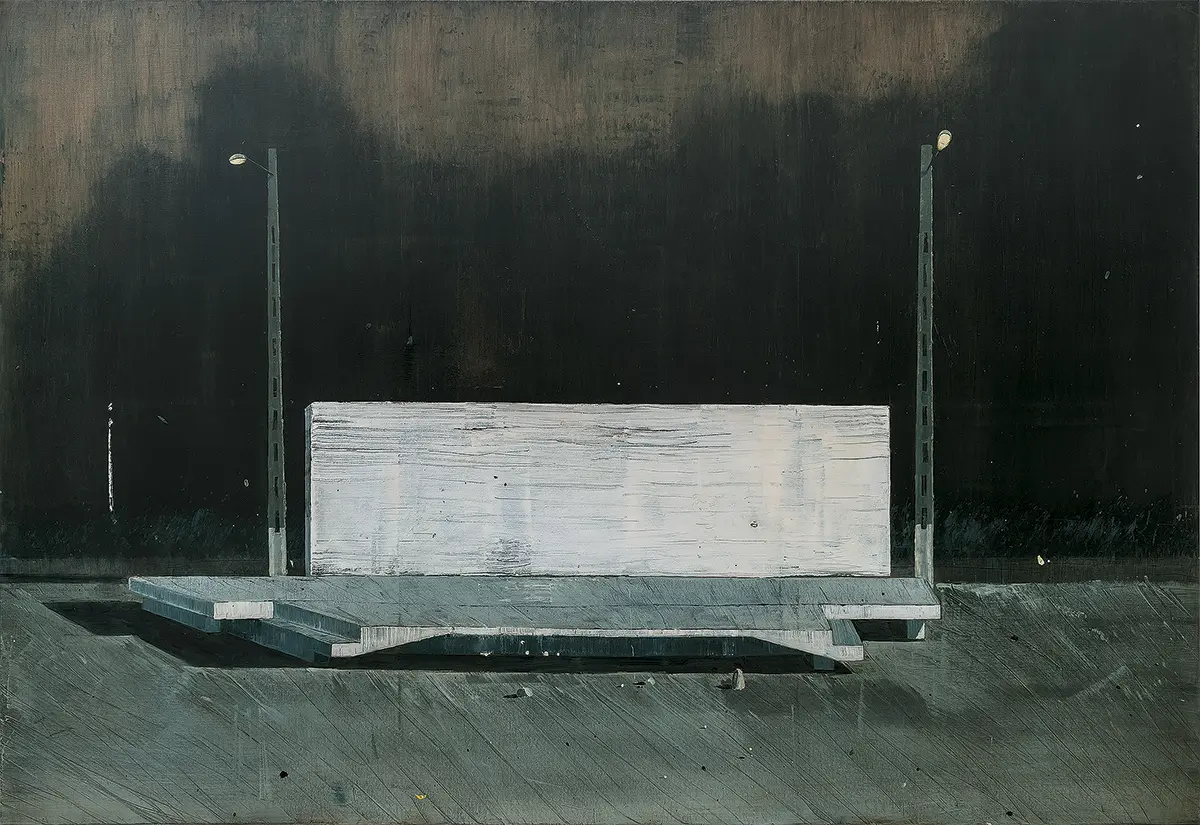
Declaración pública (Public Declaration), an exhibition of works by Cuban artist Alejandro Campins was on view at Continua’s original San Gimignano location between May 14 and August 28. This space, called Arco dei Becci, dialogs with the six works on exhibit, since Campins conceived and executed each of the latter specifically for the site. Also on view in the city, in other Continua spaces, are exhibitions by Antony Gormley (Britain) and Subodh Gupta (India); the gallery policy is to present young and well-established contemporary artists in parallel, thus facilitating a forceful intergenerational and intercultural conversation.
Campins started his Declaración pública series in 2015 with a large-scale painting, the monumental Nido (Nest). After this came a succession of works shown, alongside those by other talented Cuban artists, at Continua’s first exhibition in its Havana location. Nido, in a format almost like a movie screen, was well adapted to the Águila de Oro space, where it was placed so that the stage recreated in the painting was tautologically superimposed on the real one.
During the last 60 years in Cuba, the revolutionary government has built many outdoor stages in many towns and villages: platforms to motivate local citizens with movies and plays, and also to present spectacles that glorify and communicate official doctrine. Today, many of those spaces are empty, the victims of government indolence; neglected, covered by vegetation, they serve as a platform for children’s games. For Campins, this change in their “utility” is an open statement, since the historical freight of the place is narrated, in the gesture itself, in an ironic manner. The images of those idle daises tell, in this way, stories in which nothing seems to happen, but which in truth are large-scale allegories of the present. Devoid of human presence and of the notion of time, they disturb us and capture our attention. Curiosity overcomes us and we want to know why there are no people in these metaphysical scenes, why all we see are empty spaces.
For a number of years, Campins has been dealing with the landscape in a unique way, breaking with the “affability” that the history of art has infused into the genre. This is why the series includes large cement blocks, images of a reallocation that Campins has previously visited, photographed, and drawn. These processes develop independently, yet they connect to arrive at the concretion of Campins’ often colossal-sized canvases.
As in many of Campins’ works of recent years, a grey and blue palette is dominant here. It is a nostalgia-tinged blue that never becomes green, and which I prefer to think of as “Campins blue.” This color, omnipresent in these works, contributes to the creation of a timeless atmosphere that breaks with the clichés of tropical light.
The only work in this show made on different support is the fresco project for the niche in Arco dei Becci. There, Campins depicts a real Cuban site transported to Tuscany, filtered through its representation “in the manner of Giotto.” It is not by chance that Campins has chosen to produce this tribute to the land of the Tuscan masters, starting with the great forebear of the Renaissance. From his first visit to San Gimignano, a little more than a year before, Campins connected the location with his passion for the history of Italian art, a subject he has studied in-depth, and this was his way to pay homage.
In this emotional exhibition, presented in an accessible language yet with great depth of thinking, we are invited to introspection. This took both initiates and neophytes by surprise on opening day. Alejandro Campins proposes to recover memory by valuing these forgotten sites, presenting us at the same time with a meditation about painting itself—certainly because he is an outstanding painter, but also because he is able to make these “metaphysical spaces speak about their own history,” as he puts it.
LAURA SALAS REDONDO