
The work of Beatriz Milhazes has all the characteristics of great art. Not without reason, she is among the art market’s most valued contemporary Brazilian artists and enjoys widespread international recognition. It would be exceedingly superficial to explain such success only on the basis of the hypnotic beauty of her forcefully colorful images. Their poetic vitality rests on an anthological combination that blurs the borders between the regional and the universal.
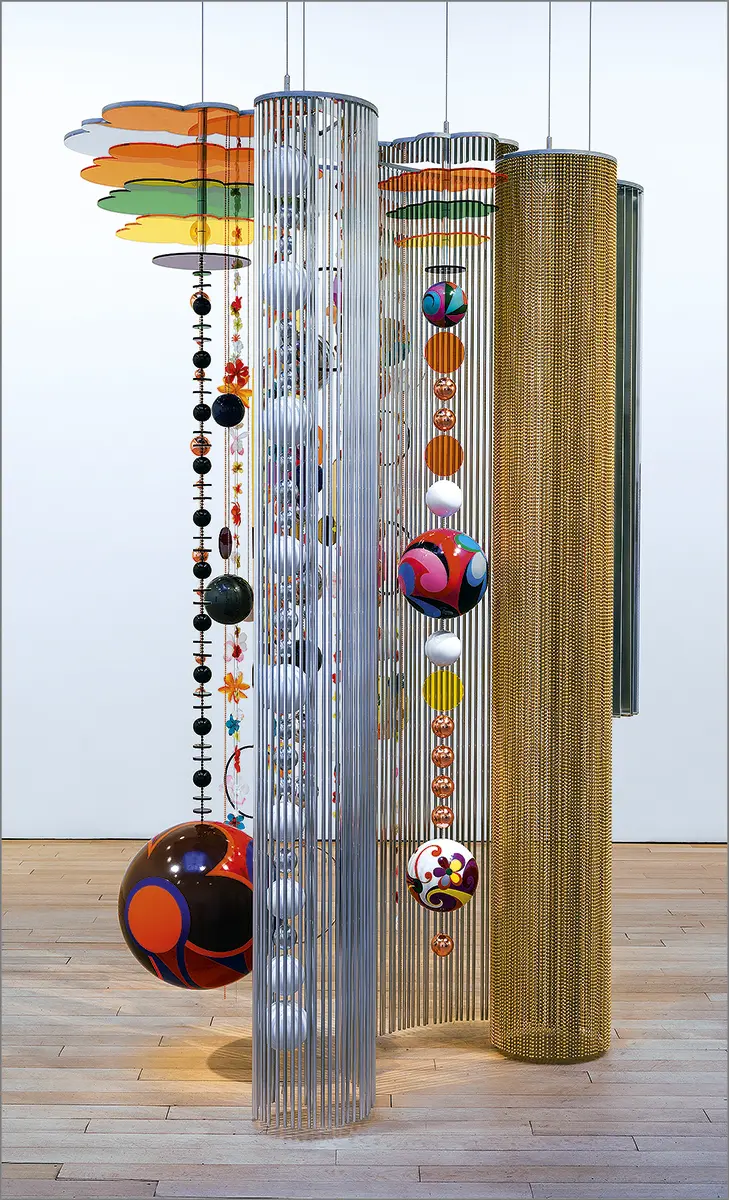
All of this was on view in Marola, Mariola e Marilola, at Carpintaria, a new space of the Fortes D´Aloia & Gabriel gallery in Rio de Janeiro. The exhibition features three large three-dimensional works that, although well in sync with Milhazes’ canvases, prints, and collages, nevertheless propose new and intriguing perceptual connections. The recursive elements in Milhazes’ work—such as circles, flowers, and arabesques—expand towards the environment, establishing a play of sensorial transformations as the images seem to shift according to the viewer’s motion. Based on the angle of observation, new work comes into being.
Although Milhazes works almost exclusively in two dimensions, the felicitous result of her spatial mandalas matches the characteristics inherent to her paintings, delineated by the expressive vibration derived from her chromatic choices and her collages of diverse, overlapping shapes. It is as though it were possible to verify in her paintings an innate spatial expansiveness. These are “sculptural paintings,” inasmuch as they seem to jump out of the canvas into space with retinal fluidity. The spatial experience made possible by this exhibition reaffirms this corporeal aspect of Milhazes’ paintings, unfolding as an invitation to the physical, passionate enjoyment of her art and following the path laid down by Hélio Oiticica’s Penetrables.
Beatriz Milhazes echoes a Brazilian visual legacy that starts with the Baroque period, continues through Modernism, Neo-Concrete art, and Tropicalia, and reaches today’s ebullient contemporaneousness: the carnival, folk culture, musicality, sensuality, joy. There are no human figures because circles, arabesques, and flowers became the central characters in a repertoire permeated by formal “self-pastiches.” The similarities between Milhazes’ works throughout her career induce a repetitive, seductive trance—a ritual that exalts beauty in itself, a plastic hedonism that explains the artist’s international reception.
A representative of the ‘80s Generation, which returned to figures, color, and large formats against the grain of the previous decade’s conceptual rationality, Beatriz Milhazes has remained faithful to the precepts of plasticity. A profusion of rigidly calculated images marks her concentric, expansive dislocations. Milhazes’ technique consists of preparing images on a transparent sheet of plastic, detaching them like film, and tracing them onto the canvas in a succession of collages.
Milhazes exchanged her generation’s characteristic free gesturality, so commonly used by artists trained at the Parque Lage School of Visual Arts, for precision and detail. In this way, she is able to balance the legacy of Brazilian constructivism, based on homogeneity and order, with extreme inventiveness. Common sense crumbles to reveal that paradox is the key to her works’ poetic richness.
The three sculptures that give the exhibition its title were produced in the course of a five-year investigation—including the creation of several life-sized models—at Durham Press, the study in Pennsylvania where Beatriz Milhazes has been carrying forward her graphic work in parallel with an intense exhibition calendar and a packed work agenda. These are large works, with heights between 2,26 and 2,89 meters, and they deal with space in different ways, be it by strengthening the body of the work itself, be it by functioning as divisors between fields (as in the case of Mariola). Previously unseen in Brazil, the three works were exhibited in the artist’s galleries in New York (James Cohan) and Paris (Max Hetzler).
Beatriz Milhazes’ path towards three-dimensional experimentation began with a set she designed for a dance show by her sister, choreographer Márcia Milhazes, in 2004. Creating a kind of chandelier at the center of the stage, Beatriz moved away for the first time from the idea of the panel that had always governed her work as a stage designer. The first result of this immersion in space was the series Gamboa, seen at her show four years ago at Paço Imperial in Rio de Janeiro.
“I belong in the two-dimensional realm; my concepts and ideas are entirely connected to the plane,” the artist says to explain how difficult and motivating was the challenge. “The greatest difficulty was to begin to think in three dimensions.” It was a back-and-forth process in which she sought, based on her repertoire, “to delve deeper, to work vertically, to evolve in the three-dimensional”. “It was almost an adventure,” she concludes.
This year, Milhazes will see a large portion of her work brought together in a new book, part of the special series that the German publishing house Taschen devotes to great contemporary painters. The large-format book will be a limited edition, hand-signed by the artist, and will be launched in four languages: German, English, French, and Portuguese. Beatriz Milhazes will thus join a select group of honorees that includes Jeff Koons, Christopher Wool, Neo Rauch, Albert Oehlen, Darren Almond, Ai WeiWei, and David Hockney. One more proof of her position among the contemporary scene’s stellar names.